.svg&w=384&q=75 "logo")
Team USA Faces Tough Challenge Against Italy in World Cup

Team USA rattled. Italy fearless. And in Berlin, a World Cup giant suddenly looked very human.
What began as another routine group-stage assignment for the four-time defending champions turned into a grind, a defensive slugfest where shots clanged, fouls piled up and Italy refused to bow to the sport’s superpower.
A heavyweight slowed to a crawl
The Americans walked into Sunday’s game against Italy riding a 94-61 demolition of China and a World Cup winning streak that stretches back to 2006. Same tournament, same dominance, new faces — but the expectation never changes. Gold or bust.
For 10 minutes, the script held.
Team USA jumped out to an 18-8 lead after the first quarter, nine different players on the scoresheet, the “young and turnt” group swarming passing lanes and turning defense into instant offense. Paige Bueckers led with four points, but it was the collective that suffocated Italy: six steals, four blocks by the 6:45 mark of the second quarter, and Italy stuck at 21% shooting with eight turnovers in the opening frame. Jasmine Keys scraped together four points, but the Italians looked overmatched.
Then the game changed.
Italy digs in, USA goes cold
Italy tightened its defense, packed the paint and dared the Americans to shoot from outside. Team USA accepted the invitation. The rim rejected it.
By halftime, the U.S. had just nine points in the second quarter. Not a single three-pointer had dropped. This, from a team that buried 12 triples against China two days earlier. The offense stalled, possessions bogged down, and those early transition bursts turned into halfcourt struggles.
The numbers told the story: 32% shooting for the U.S., 31% for Italy at the break. Ugly, tense, and exactly the kind of game underdogs dream of.
Angel Reese became the early tone-setter for the Americans, not with scoring but with edge. She led the U.S. at halftime with six points, two blocks and a steal, imposing herself at the rim and giving Kara Lawson’s team some much-needed bite. Three other Americans chipped in four points apiece, but there was no rhythm, no flow.
On the other side, Cecilia Zandalasini — the name circled in red on every USA scouting report — started to heat up. Playing under Team USA assistant coach Natalie Nakase with the Golden State Valkyries in the WNBA, Zandalasini brought that familiarity and fearlessness straight into Berlin Arena. She poured in nine first-half points, keying Italy’s 16-point second quarter and slicing what had once been a double-digit deficit down to six: USA 30, Italy 24.
There was a catch. Zandalasini picked up her third foul before the break. In FIBA play, five fouls means you’re done. Italy suddenly had a balancing act: keep their star aggressive without losing her to the whistle.
Lawson’s warning at the break
At halftime, Kara Lawson didn’t sugarcoat what she was seeing.
“I think we're playing physically; we're just making too many errors. We're making too many mistakes,” she said. “Italy's playing with great force. We knew they would. It's forced us into a lot of unforced errors.”
Turnovers. Missed reads. Empty trips. For a team still building chemistry after late roster changes and the loss of A’ja Wilson and Kelsey Plum to health reasons, this was the first real stress test of the tournament.
Italy punches back
The third quarter opened with a twist no one expected: Italy grabbed the lead.
At the 5:32 mark, Italy was in front 33-32. Before that, it had led for just 42 seconds all game. Now, the U.S. looked rattled. Seven straight missed field goals. An 0-for-9 line from beyond the arc. The paint sealed off, drives swallowed up, kick-outs clanking off iron.
Italy’s defensive pressure turned every American catch into a decision under duress. Passing lanes shrank. Angles disappeared. The same team that ran China off the floor suddenly looked stuck in mud.
Complicating matters, Napheesa Collier found herself in foul trouble. She picked up her third foul with 7:31 left in the third quarter, forcing Lawson to turn to Rhyne Howard earlier than planned. In a FIBA game, three fouls that early is a flashing warning light. Five, and you’re gone.
A different kind of World Cup test
This is not the version of Team USA fans have grown used to at World Cups — the one that overwhelms opponents with star power and firepower, buries games by halftime and spends the second half fine-tuning.
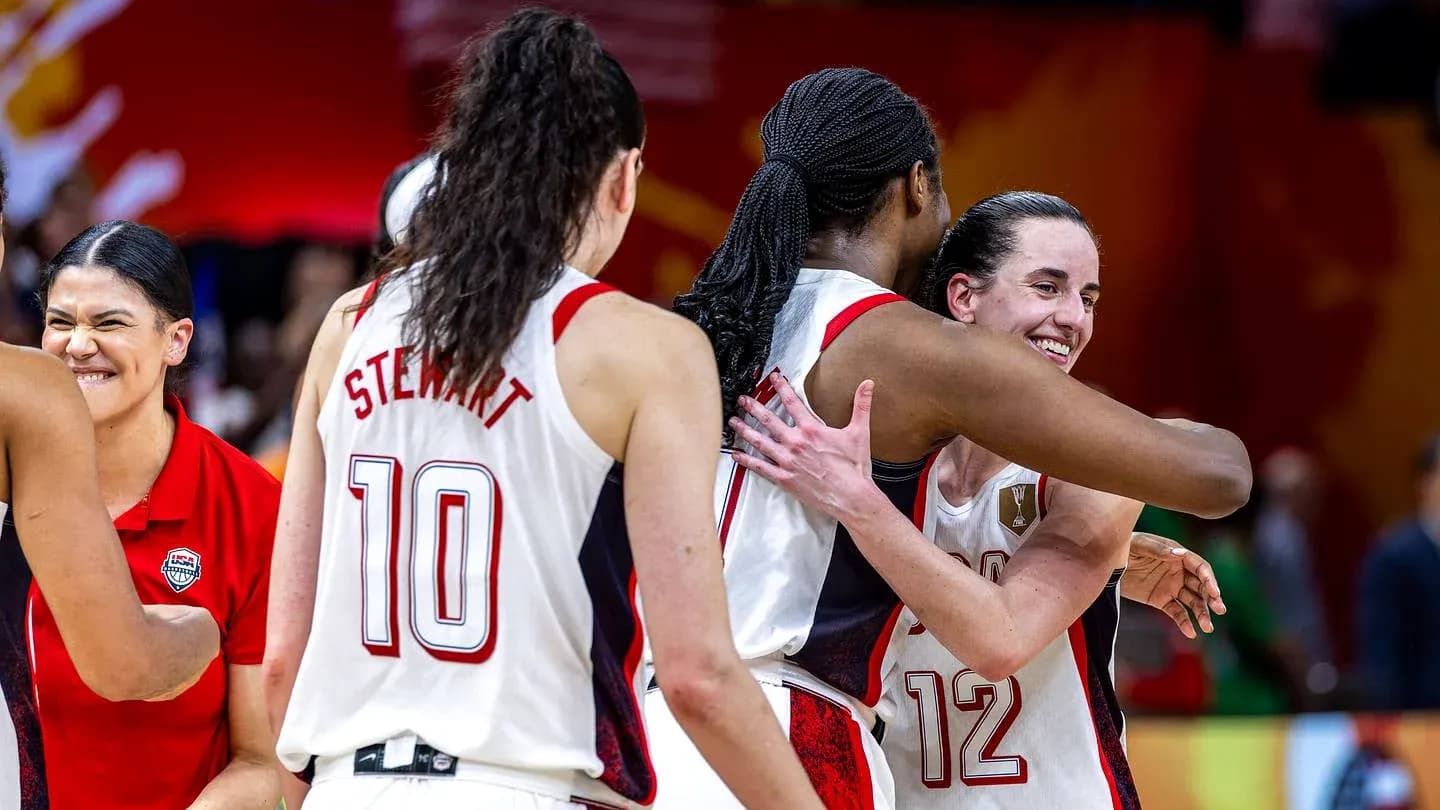
This roster is new. It leans on veterans like Breanna Stewart, Chelsea Gray and Collier, but it also leans hard into the next wave: Caitlin Clark, Bueckers, Reese, and a supporting cast still learning each other in real time. Sue Bird, now USA Managing Director, framed the mission clearly before the game.
“I think we want to continue to work on ourselves, try to build a chemistry as we go through the tournament, but obviously respect our opponent,” she said. “It'll be a challenge, and hopefully, we can do a little bit of both.”
Italy made sure the “challenge” part landed.
Zandalasini leads, Italy believes
Zandalasini came into Berlin already carrying Italy’s hopes. She led the team with 19 points in a 63-54 opening win over Czechia in group play, and she brought that same scoring burden into this showdown with the United States.
When Italy ripped off a 14-3 run in the second quarter to slice into the Americans’ 19-8 first-quarter cushion, she was at the heart of it, rising to nine points by the 4:15 mark. Every jumper she hit, every aggressive drive, chipped away at the aura of invincibility that usually surrounds the U.S. in this competition.
Italy’s belief grew with every stop, every forced miss, every American three that refused to drop.
Defense, not fireworks
For the purist, this game delivered something different: a defensive knife fight.
By the halfway point of the first quarter, both teams already had two steals. USA led 11-6, but nothing came easy. Passing lanes were contested. Drives met bodies. Shots met hands. Every possession felt like a wrestling match for control.
Reese set the tone early with a steal and two blocks in under three minutes. Aliyah Boston added her own touch of craft, spinning through traffic for a bucket that stood out in a game short on offensive highlights.
Chelsea Gray opened the scoring for the Americans with a smooth jumper after USA won the opening tip. It felt routine then. It didn’t stay that way.
Stakes rising in Group D
All of this unfolds against a larger backdrop. Group D is no soft landing: United States, Czech Republic, Italy, China. Only the group winner gets a direct ticket to the quarterfinals on Sept. 10. Second and third place drop into a do-or-die Playoff Qualification Round on Sept. 8.
Team USA announced its arrival with that 94-61 dismantling of China on Sept. 4, powered by a 14-point, 11-assist double-double from Caitlin Clark — the 11 assists a record for an American in World Cup play — and 14 points each from Rhyne Howard and Paige Bueckers. Before that, in March, the Americans hammered Italy 93-59 in a World Cup qualifying tournament in Puerto Rico, with Kahleah Copper scoring a game-high 15 points as one of five players in double figures.
This meeting in Berlin looked, on paper, like a continuation of that dominance.
Italy refused to read the script.
A tournament that won’t wait
The schedule doesn’t slow down for anyone. After Italy, the U.S. faces Czechia on Monday, Sept. 7, again at 2:45 p.m. ET. Every game is on the clock, every rotation choice magnified, every sign of chemistry — or lack of it — a data point for what comes later in the knockout rounds.
Team USA arrived in Germany as the clear favorite, the only side with minus-odds to win the 2026 FIBA Women’s World Cup. France, Belgium, Australia and Spain lurk as the most serious challengers, but no one else carries the weight of a 20-year World Cup unbeaten run.
Against Italy, that weight looked real. Heavy, even.
The Americans still have the talent to carry it. The question, as the pressure ratchets up and the margins shrink, is whether this new-look group can turn tense afternoons like this into the kind of ruthless, inevitable march that has defined a generation of USA Basketball — or whether the rest of the world is closer than ever to finally cracking the code.