.svg&w=384&q=75 "logo")
Team USA Overcomes 14-Point Deficit to Win Fifth Consecutive World Cup
BERLIN — For 15 jittery minutes, the script looked broken. The giants of women’s basketball were wobbling.
Down 14 in the first half to a fearless France side in their first-ever World Cup final, Team USA stared at its largest deficit of the tournament and a genuine crisis. The Americans had been pushed this week, but not like this. Not on this stage. Not with a fifth consecutive FIBA Women’s World Cup title on the line.
Then the veterans took over.
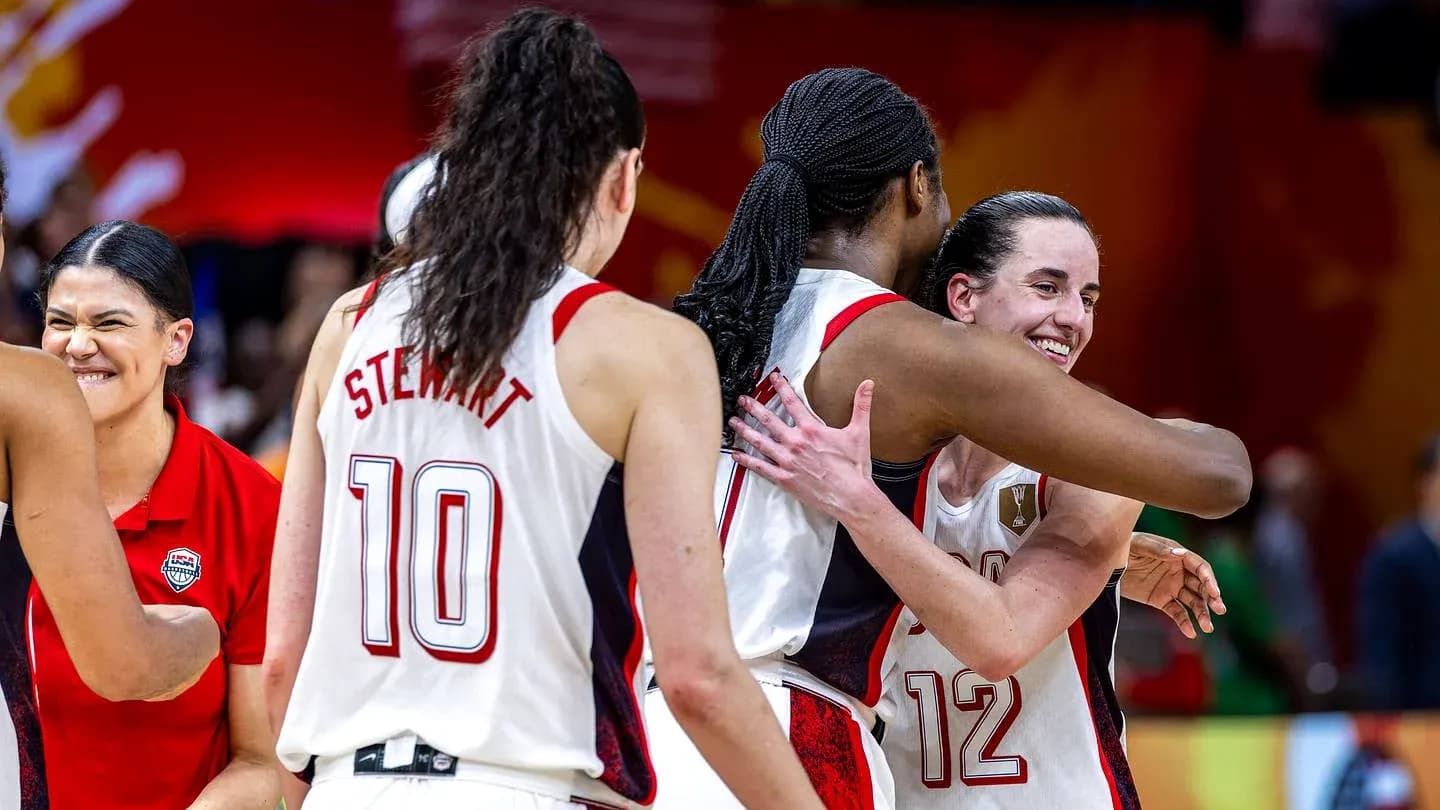
By the final buzzer on Sunday night, the panic had given way to inevitability again: USA 97, France 79. Another gold medal. Another reminder that the road to the top of women’s basketball still runs straight through red, white and blue.
Veterans drag USA back from the brink
The turning point wasn’t a single shot. It was a stretch of basketball where the American core simply refused to let this era slip.
Breanna Stewart, Chelsea Gray, Jackie Young and Kahleah Copper dragged the U.S. out of that 14-point hole with the kind of ruthless, grown-up basketball that separates champions from challengers. They didn’t just steady the ship; they seized the wheel and floored it.
Stewart finished with 22 points, 10 rebounds and four assists in 30 commanding minutes, earning World Cup MVP honors and becoming the first player to win the award twice. She also joined Sue Bird as the only players in Team USA history with four World Cup gold medals.
“Four World Cups? That’s tied for the most ever,” head coach Kara Lawson said. “She is USA Basketball. When you think of the last 15 years, it’s Stewie. We’re just really lucky to be a part of her era.”
Jackie Young poured in 18 points, grabbed six rebounds and dished five assists. Copper added 15, Gray chipped in 12, and together that veteran quartet combined for 65 points, each logging at least 27 minutes in the gold-medal game.
This roster was built as a bridge between generations, a blend of established stars and rising talents. On the night it mattered most, it was the old guard that stormed through the fire. They flipped the momentum in the second and third quarters, turned a hostile deficit into a 27-point lead, and slammed the door on any French dream of an upset.
Behind them, the next wave watched and waited. Paige Bueckers played fewer than three minutes. Sonia Citron and Kiki Iriafen saw less than two each. Their time is coming. On this night, the message from Stewart, Young, Gray and Copper was blunt: the future can wait; the present still belongs to them.
Stewart’s historic night
Stewart’s resume was already absurd. Three Olympic golds. Now four World Cup golds. Two-time World Cup MVP. And on Sunday, another slice of history: the first USA player ever to post a 20-point, 10-rebound double-double in a World Cup final.
“I've been fortunate to play with a lot of amazing players and this group was really special,” Stewart said. “The way that we were tested on and off the court and we continued to thrive through it, really proud of them and excited to get this gold and bring it home.”
Her tournament numbers — 12.8 points, 7.3 rebounds and 2.8 assists per game — don’t scream dominance at first glance. The impact did. When the game quickened, when France’s belief swelled, Stewart’s fingerprints were on every important possession. Defensive rebounds that killed second chances. Smart switches. Timely threes. The quiet, relentless control of someone who has seen every possible scenario at this level and usually solved it.
On a night that could have belonged to France’s breakthrough or to the new American generation, it circled back, inevitably, to the player who has defined this program for more than a decade.
Jackie Young, serial winner
If Stewart is the face of sustained excellence, Jackie Young is its most decorated accomplice.
Young didn’t just score 18 in the final. She did it with ruthless efficiency: 7-of-14 from the field, 4-of-7 from deep. She was named player of the game and became the only player in Women’s World Cup history to record at least 15 points, five rebounds and five assists in a final.
“Not really focused on the individual accolades. I'm just trying to do whatever I can to help my team win,” Young said. “And today it was just being aggressive. They're really physical with us, and so I just try to get to my spots and I hit a few shots early.”
That aggression has carried her through a career that now borders on the ridiculous: high school state champion, NCAA champion, WNBA champion, Olympic 5x5 gold, 3x3 gold and now World Cup gold.
Put simply, wherever there are trophies, Jackie Young shows up.
France’s first final, USA’s familiar finish
For France, this was uncharted territory. Their first appearance in a World Cup gold-medal game, their first real shot at toppling the sport’s ultimate dynasty.
They came out swinging.
Gabby Williams and Dominique Malonga combined for 41 points and led the early charge that stunned the Americans. France played with freedom, with pace, with the kind of nothing-to-lose swagger Marine Johannes had promised before tip-off.
But the pressure of sustaining that level against a team like USA is unforgiving. As the third quarter unfolded and the American defense tightened, the French attack began to fray. Missed threes turned into long rebounds and transition chances. Physicality ramped up. So did frustration.
Johannes, who entered the game leading the tournament with 19 made threes, managed just one triple on 1-of-6 shooting from beyond the arc. Her night crystallized in the third quarter when she was called for unsportsmanlike conduct after smacking Copper in the face. She finished with five points in 23 minutes, a harsh end to what had been a sparkling tournament.
For all of France’s progress, the final step remains the hardest. They reached the mountaintop. They just found USA still standing on it.
Angel Reese, meme machine on the world stage
Angel Reese didn’t need a stat line to leave her mark.
Her impact came in the form of pure, unfiltered emotion — the kind that has already turned her into a meme factory in the WNBA and now has gone global. As the U.S. blitzed out of halftime and blew the game open, Reese roared, flexed and delivered a gritty face that will live on in screenshots for months.
Later, from the bench, she turned into the loudest cheerleader in Berlin, celebrating every run, every stop, every dagger three from her teammates. It was theater, energy, and joy rolled into one — the kind of presence that doesn’t show up in the box score but pulses through a team’s identity.
Lawson and Bird pass the first big test
The stakes for Kara Lawson and managing director Sue Bird stretched beyond one tournament. With an Olympics on home soil in Los Angeles looming, this World Cup doubled as a referendum.
Bird had to build a roster without A’ja Wilson, who withdrew due to injury, and with seven players making their major senior-tournament debut. Lawson had to mold that mix into a champion, manage egos, minutes and expectations, and still deliver the only result USA ever truly accepts: gold.
They did exactly that.
Bird’s roster struck the balance between continuity and experimentation. Lawson leaned into her veterans when the walls closed in, then picked her spots to unleash the youngsters in more controlled moments. The plan held. The pressure eased.
Had they lost, the next two years would have been filled with questions about whether the right people were steering this juggernaut into a home Olympics. Instead, the noise has gone quiet. For now.
The grind resumes
There’s no parade waiting for most of these players. No long offseason to bask in a fifth straight world title.
The WNBA schedule roars back to life on Thursday, Sept. 17. That gives every player who just battled through this World Cup only a few days to cross continents, reset their bodies and jump straight into the stretch run of the league season.
The slate is unforgiving: Sun-Dream, Mystics-Sky and Sparks-Wings open the night, followed by a Mercury-Fire and Storm-Aces double-header. On Friday, Sept. 18, three more matchups await — Indiana Fever vs. Toronto Tempo, New York Liberty vs. Minnesota Lynx and Portland Fire vs. Golden State Valkyries.
Jet lag or not, the expectation will be the same: perform.
The dominance continues — and the rest of the world waits
For neutral fans and those craving chaos, this World Cup ended on a familiar, perhaps frustrating note. The final everyone expected — USA vs. France — delivered the result almost everyone predicted: another American gold.
Spain had their moment in the semifinal, pushing USA before fading in the second half. France built that 14-point cushion in the final before crumbling under a third-quarter avalanche. The global talent pool is deeper, the margins are thinner, and the gap is smaller than it once was.
But the scoreboard keeps telling the same story.
Five straight World Cups. Stewart rewriting record books. Young stacking trophies like trading cards. A new generation waiting in the wings while the current one refuses to step aside.
The rest of the world is coming. The question, after another night like this, is simple: how much closer can they really get before Los Angeles 2028?