.svg&w=384&q=75 "logo")
Stefanos Tsitsipas Comments on Kyrgios Suspension
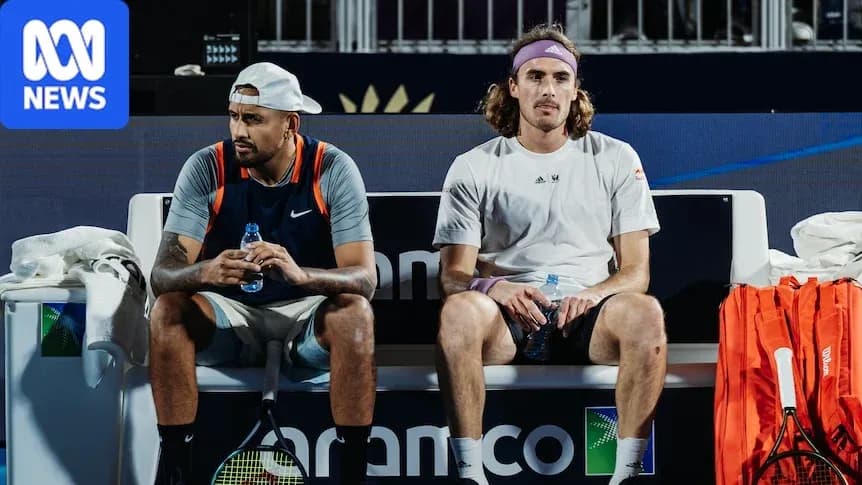
Stefanos Tsitsipas did not flinch. Not at Arthur Ashe Stadium, and not when Nick Kyrgios’s name came up.
Fresh from knocking out 10th seed Arthur Fils in the first round of the US Open, the former world No 3 was asked about Kyrgios’s suspension for cocaine use. His answer cut through the usual locker-room diplomacy.
He said he saw it coming.
Kyrgios was banned earlier this month after revealing he had tested positive for cocaine in June while in Spain for an event. The Australian faces a potential four-year suspension, though the expectation around the sport is that the final sanction will be lighter.
For Tsitsipas, the news hardly registered as a shock.
“I mean, to be entirely honest with you, I knew about this before the announcement. Myself, I knew about it,” he said. “So what can I tell you? I will just tell you the truth. I knew about all of this before any announcement was made, and when I saw it on social media, I was, like, ‘Here we go.’ I kind of expected it, to be honest.”
Those words land differently given the history between the two. Their relationship has long been one of the most combustible in men’s tennis.
Old wounds, new headlines
The tension burst into full public view at Wimbledon in 2022. Kyrgios, in one of the most electric runs of his career, surged all the way to his only Grand Slam final. Along the way he faced Tsitsipas in a third-round match that felt more like a grudge bout than a tennis contest.
Tsitsipas fired balls directly at Kyrgios, drilled one into the crowd in frustration, and later branded the Australian a “bully”. Kyrgios, as ever, leaned into the chaos. The match became an instant reference point for the sport’s culture wars: tradition versus rebellion, restraint versus volatility.
Since that summer, Kyrgios’s story has largely been written in medical reports and missed tournaments. Injuries have kept him off the tour for long stretches. When he confirmed his suspension, he spoke of feeling “helpless and alone”, while accepting that “none of that excuses what I did”.
For Tsitsipas, sympathy did not erase what he says he already knew.
“I knew that those were things that were happening away from the tennis courts. I will tell you that,” he said. “I’m not going to try and cover up someone that I know the truth for. I’ll consider myself a nice person with everyone, but these were behaviours that I personally heard on the tour and heard other people in that same environment saying those sort of things to me.”
The implication is stark: this was an open secret, or at least a widely shared suspicion, inside the players’ inner circle.
So when the announcement finally dropped, Tsitsipas’s reaction was blunt.
“So when I saw it I was like, ‘well, pretty much expected, to be honest’. I am surprised it came so late, though.”
While Kyrgios now waits to learn how long he will be kept away from the sport, Tsitsipas moves deeper into the US Open draw, carrying not just his own ambitions, but a rare, unvarnished verdict on one of tennis’s most polarising figures.