.svg&w=384&q=75 "logo")
Singapore Grand Prix: The Race That Never Stops
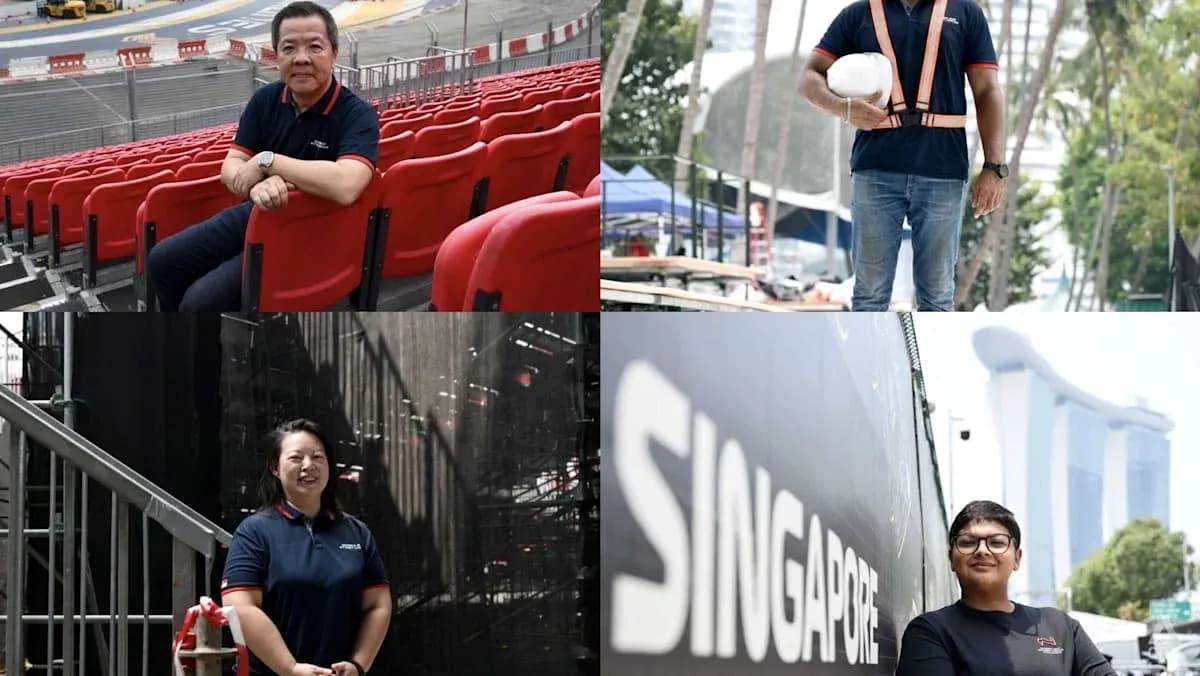
By 1am on Monday, the Padang is silent. The last guitar riff has drifted into the humid night, the fireworks smoke has thinned, and the howl of Formula 1 engines is only an echo off the glass towers.
On the Marina Bay Street Circuit, the real sprint starts.
Senior manager Shiv Raj Panday and his technical crew have four and a half hours to do what looks impossible from the outside: peel back a world-class street circuit and hand the roads back to a waking city. By 5.30am, the same tarmac that saw cars touch 300 km/h will belong to taxis, buses and office workers again.
The Singapore Grand Prix sells itself as a three‑day festival. Inside Singapore GP’s offices, it never ends.
The race that never stops
Singapore GP, the race promoter, runs with a skeleton crew by F1 standards – about 70 full-time staff – but the workload fills all 12 months. Ticketing, traffic flow, marketing, safety, global risk assessment: it all starts again almost the moment the chequered flag falls.
Raj, who oversees event facilities in the technical department, spends “at least about two, three months” on planning before a single barrier goes up.
His team runs feasibility studies, rethinks layouts, and wrestles with the same problem every year: how to squeeze more out of limited space in a downtown park that also has to stay alive as a city.
He knows the rhythm well. He worked for one of the race’s contractors from 2010 to 2023 before joining Singapore GP. The post-race teardown, the overnight scramble, the quiet satisfaction when the first Monday cars roll through – it has been his September routine since the inaugural night race in 2008, barring the COVID-enforced cancellations in 2020 and 2021.
This year’s edition, from Oct 9 to 11, will be the latest the race has ever been held in the calendar. The contract, renewed for a fourth time in January 2022, keeps Marina Bay on the F1 map until 2028. The long game is locked in. The work, though, is always immediate.
Tickets that never sleep
Ask ticketing and accreditation director Clarence Lai how long he has to prepare and he doesn’t reach for a number.
“The amount of time spent… is enormous,” he said, because for most fans the Singapore GP is three nights of racing and concerts. For his team, it is an “endless” loop.
Ticketing for each race starts in race week of the year before with “super early bird” sales. It runs all the way through to the next Grand Prix, then the cycle snaps back to the start.
Lai’s department controls access to the circuit – public tickets, vendor passes, contractor accreditation. They constantly review seating capacity, decide where new grandstands are needed, and dissect the customer experience row by row.
One change has already paid off. Mobile ticketing, introduced last year, has helped clamp down on scams. Previously, fans could be duped into buying duplicate PDF tickets from third-party sellers. The new system makes that far harder.
The track itself, though, is a moving target.
Some grandstands go up one and a half months before the race. On paper they sit in the same place every year. In reality, once the metalwork returns, there can be missing rows, small shifts in layout, tiny discrepancies that turn into big headaches.
“We do our best to really make sure that all the seats are there, there're no missing seats and the seats are properly labeled,” Lai said. His team checks the condition of every seat too. Rain, wind and relentless sun do their own quiet damage.
Building and breaking a circuit around a live city
Time is the enemy for Raj’s technical unit. So is the city’s daily routine.
Some structures sit on “live” roads that cannot be shut for long. Connaught Grandstand, at the end of Esplanade Bridge, is one of them. Traffic still flows past as the race weekend approaches.
On race week, they close the road in the early hours of Wednesday. The window is brutally tight. The crew works through the night, bolts and beams under floodlights, then clears out so that morning traffic can flow again.
The same choreography plays out in reverse on Sunday night. As the last car returns to the pits, the countdown starts. Esplanade Drive and other key stretches must reopen by 5.30am. For drivers heading to work, the circuit has to feel like just another road.
Behind the scenes, operations director Melissa Phua runs a different race.
With Singapore GP since 2008, she spends a large part of the year in schools, working with the Institute of Technical Education and Republic Polytechnic. Each year, nearly 1,000 students fan out across the circuit park as grandstand and gate officials, welfare stewards and frontline staff.
They are the ones who guide fans to their seats, answer questions, and soak up the first wave of complaints when things get tense.
Phua’s team also designs and polices the movement of massive crowds through a maze that looks nothing like the city beneath it. Their key performance indicators are blunt: get everyone out safely, keep the complaints down.
The biggest stress point comes after the nightly concerts at the Padang. Tens of thousands surge towards the MRT stations, racing the last trains home.
“So we are on the ground, making sure that all the necessary gates are open and everyone leaves according to the planned routes for effective dispersal,” she said. The routes do not always match the way spectators came in. Tempers can flare.
“It's about making sure that ushers are there and we are there on the ground, making sure that nobody gets yelled at or gets crushed.”
Selling Singapore in a 24-race world
If Raj and Lai work in steel and tarmac, senior director for marketing and partnerships Sasha Rafi works in perception.
She joined in October 2007, before the first race, when Formula 1 in Singapore was a hard sell at home.
“When I first started, Formula 1 wasn't something that was known to most Singaporeans. It was seen in the first few years by some as an elitist sport,” she said.
The early years focused on explaining F1 to locals and introducing Marina Bay to international audiences. The story has changed. The race is now a fixture on the global calendar. The challenge is keeping it irresistible in a season that stretches to 24 rounds.
Repeat visitors matter. So does convincing international fans that, with so many choices, Singapore is still worth the long flight.
To widen the appeal, Singapore GP built a portfolio of products: premium hospitality for corporate guests, accessible grandstands for hardcore fans, and cheaper options for those who come more for the concerts than the cars.
“We were the first circuit in Formula 1 to actually inject entertainment into the racing experience that you get over the weekend,” Sasha said. That mix – racing and headliners at the Padang – has become the race’s calling card.
Her team spends months hunting for fresh angles. What’s the latest tech that actually fits the event? What entertainment trends are fans paying for? What global shocks – war, economic downturn, shifting travel habits – could hit demand?
They also tweak the ticket menu. This year brings a notable addition: a two-day sprint bundle.
Singapore will host one of six sprint races on the F1 calendar. Sprint qualifying lands on Friday, the sprint itself on Saturday. It’s a 100 km dash, roughly a third of a full race, about 30 minutes of flat-out running with no pit stops.
“We have looked at bundling and packages of different kinds over the years,” Sasha said. But the sprint bundle is new territory – one of the only times Singapore GP has offered a two-day ticket, instead of the traditional three-day or single-day passes.
The idea is simple: reach fans who don’t want the full weekend but don’t want to miss the sprint’s debut at Marina Bay.
Sasha also confirmed that super early bird tickets for the 2027 race will go on sale this year. The calendar rolls on, even as the current edition is still in the works.
A temporary giant, rebuilt every year
The Marina Bay layout has never been static. In 2023, the track swung behind the Floating Platform as one of F1’s largest grandstands disappeared to make way for NS Square. The team adapted, rethinking sightlines and capacity.
Lai’s ticketing and seating headaches stem from that core reality: this is not a fixed stadium.
“It's unlike a fixed venue, let's say, the National Stadium. The seats are always there, so most of the time you won't go wrong, it will not disappear,” he said.
At Marina Bay, everything disappears. Then it all has to come back.
The removal of the Bay Grandstand left a hole the team has yet to fully plug. They have spent years trying to claw back those lost seats, experimenting with new structures and angles to maximise both capacity and vantage points.
This year, the grandstand at Turn 2 – just after the cars blast out of the pit straight – will be merged from two structures into one larger stand. Additional viewing platforms will flank it, squeezing more fans into one of the circuit’s prime action zones.
Phua knows that while a city race offers multiple dispersal routes, it also turns familiar streets into a puzzle. Barriers, fencing and grandstands warp the map.
“There are also many foreigners who may not know where to go,” she said. “Even for ourselves, when we close up the track, it can be unfamiliar at times as the path isn't as straightforward.”
In 2022, heavy rain delayed the start by an hour. The schedule buckled, the carefully drawn plans for crowd movement and train connections had to flex on the fly. It was a reminder that for all the planning, Marina Bay always has the last word.
Playing the long game
The Singapore Grand Prix is often framed in lap times and podiums. Inside Singapore GP, the numbers look different: four and a half hours to reopen key roads, seven more years on the contract, nearly 1,000 students on the ground each race, 24 rounds in a global season.
Every October, the world sees the lights, the skyline and the sparks as cars skim the walls. What it doesn’t see is the overnight shift that turns a racetrack back into a city – and the year-long grind to make three nights in Marina Bay feel like the centre of Formula 1.
The question now is not whether Singapore belongs on the calendar. It’s how long this temporary circuit, rebuilt and reimagined every year, can keep setting the standard for what a city race should be.