.svg&w=384&q=75 "logo")
Serena Williams Advocates for Women's Health Care After Childbirth Experience
Serena Williams has spent a lifetime forcing the world to pay attention to what happens on a tennis court. Now she’s asking it to listen to what happens in a delivery room.
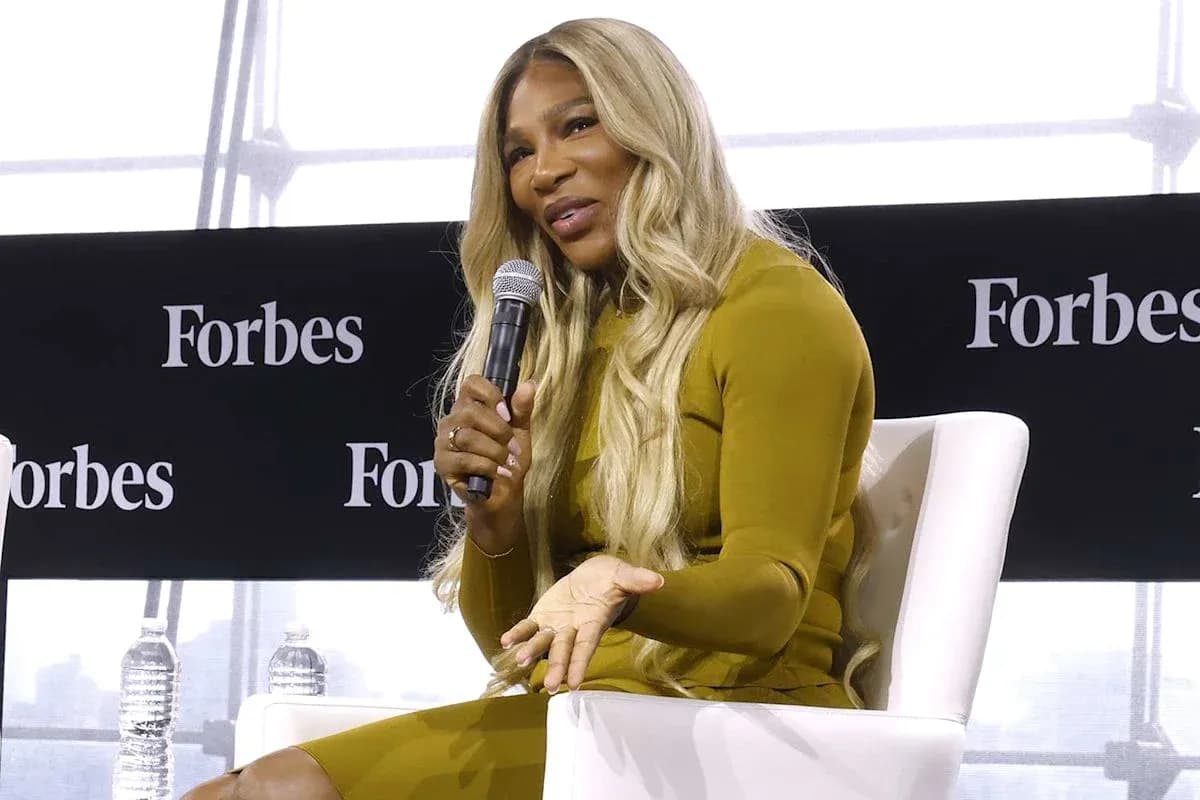
Speaking at the Forbes Power Women's Summit 2026 on Thursday, the 44-year-old laid out, with the same clarity that once dismantled opponents, how nearly dying after the birth of her first child dragged her into the wider fight over women’s health care.
“When I told my story, I didn't realize how many people could relate,” she said on stage, reflecting on the trauma that followed the 2017 birth of her daughter, Alexis Olympia, with husband Alexis Ohanian.
At first, Williams admitted, she thought her ordeal fit a familiar narrative.
“I thought it was just a minority problem,” she said. “But then I realized it's a women's problem.”
That realization hit hard. Women from “every single background,” she noted, came to her with their own “nightmare's tale” of childbirth. Different countries, different incomes, same pattern: pain dismissed, concerns brushed aside, danger missed.
The contrast, she joked, was obvious.
“If men were giving birth, they would have sweets [and] like all kinds of medicines,” she quipped, drawing laughs while landing a sharper point. “So it wouldn't be the same problem at all.”
Behind the humor sits a story that nearly ended in tragedy.
Williams was rushed into an emergency C-section when she delivered Olympia in 2017. The operation saved her baby, but the danger didn’t stop there. A coughing fit after the birth caused her wound to reopen. That led doctors to uncover a large hematoma — a swelling of clotted blood — in her abdomen.
What followed was a six-day battle with a pulmonary embolism, a life-threatening condition in which one or more arteries in the lungs become blocked by a blood clot. It meant multiple surgeries. It meant fear. It meant a champion used to controlling every variable suddenly fighting just to be heard.
“I knew something was wrong with me and it was super important that I was heard,” she told the summit audience. “Thankfully, my doctor listened to me. The nurses did, but I was so fortunate enough to have a doctor that did and literally saved my life.”
That single fact — that her survival hinged on being believed — has driven much of what she has done since.
Williams had already conquered tennis, stacking up 23 Grand Slam singles titles and rewriting the record books. After Olympia’s birth, she turned that same relentlessness toward a different arena: access to health care for women and underrepresented communities.
Her experience pushed her into advocacy work, including a role as the first entrepreneur-in-residence for the Reckitt Catalyst program, a global social impact and innovation initiative backing female and underrepresented entrepreneurs working on health, hygiene, water and sanitation solutions.
“What these women are doing is they're really letting us know that women's healthcare is so important, and healthcare in general,” she said, pointing to the often invisible load many women carry. “Because also we're talking about women who take care of the kids, you know, I take care of my kids mostly.”
For Williams, it’s not abstract policy. It’s lived reality.
“With the program, we're able to actually solve a lot of issues,” she explained. “Make, like I said, make those connections that are really vital, that are really important to open so many doors. Because every time we open a door, we're solving another problem that's closer to helping us all in this room and helping our kids.”
She has repeated her story over the years not for shock value, but to underline how preventable many of these complications can be. In a 2018 opinion piece for CNN, Williams spelled out the basics: “We know simple solutions exist, like access to midwives and functional health facilities, along with breastfeeding, skin-to-skin contact, clean water, basic drugs and good nutrition.”
The indictment came in the next line.
“Yet we are not doing our part. We are not rising to the challenge to help the women of the world,” she wrote then.
On Thursday, the message hadn’t softened. The language around it has only grown more urgent, more collective.
“Together, we can make this change,” she wrote in that same piece. “Together, we can be the change.”
Life has moved on for Williams since that terrifying stretch in 2017. She and Ohanian welcomed their second daughter, Adira River Ohanian, in August 2023. Ohanian marked the moment with a family photo and a note that their home was “teaming [sic] with love: a happy & healthy newborn girl and happy & healthy mama,” before calling his wife the “GMOAT.”
The tennis icon now moves through a different phase of her life — mother of two, investor, advocate — but the through line remains familiar. She once forced a sport to confront who gets to dominate its biggest stages. Now she’s asking a much larger system a tougher question: who gets to survive bringing life into the world?