.svg&w=384&q=75 "logo")
Roger Federer Reflects on His Legacy and Future in Tennis
In a career built on constant forward motion, Roger Federer has finally been handed a moment to stand still.
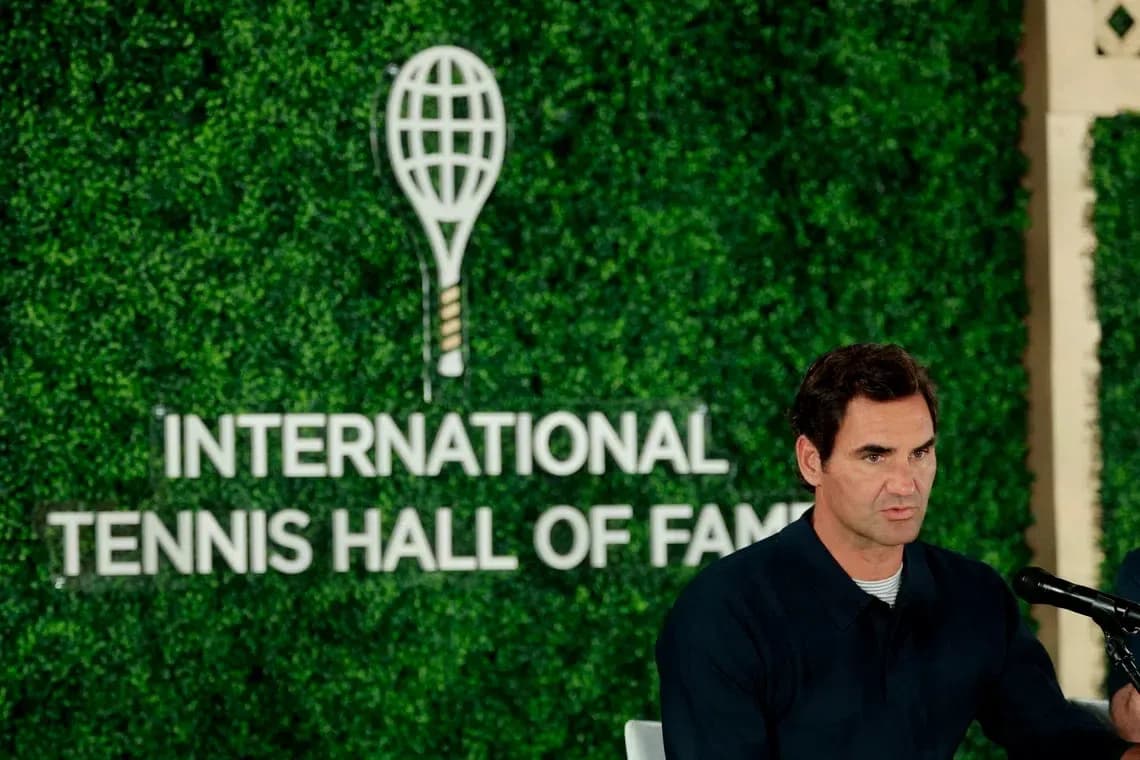
On Saturday in Newport, the 20-time Grand Slam champion will walk into the International Tennis Hall of Fame, joining the game’s immortals alongside broadcaster and journalist Mary Carillo. The man who spent a lifetime chasing the next title, the next ranking, the next impossible angle, admitted this honour feels different.
“It’s a huge, huge honour, one of the greatest we can achieve in this sport,” Federer said on Friday, speaking at a news conference moderated by Hall of Fame president Patrick McEnroe. This is not another trophy for the cabinet. It is, in his words and in his demeanour, a rare invitation to reflect.
He is 45 now, two years removed from his final match, yet his résumé still reads like fiction. A men’s-record eight Wimbledon titles. Six Australian Opens. Five U.S. Opens in a row at his peak. The 2009 French Open to complete the career Grand Slam. Olympic doubles gold with Stan Wawrinka in Beijing in 2008. A Davis Cup crown for Switzerland in 2014.
In total: 103 ATP Tour titles and 310 weeks as world number one. Numbers that defined an era and set standards that shaped careers around him.
But Federer was clear: if his legacy stops at statistics, it falls short of what he hoped to leave behind.
“I hope I represented the sport well,” he said. “But more so that maybe I helped drive the sport in the right direction through all the conversations we had together with the leaders of the sport — on the ATP side, with the Slams, the players and councils where I donated my time.”
This is the Federer the public rarely saw. Away from the cameras, he sat in meeting rooms, argued over prize money distribution, pushed for better conditions. He pointed to the rise in earnings not just for champions, but for those grinding in the first and second rounds, and to improvements for players, media, medical staff and the infrastructure that surrounds them.
“I feel like way more players can make a living. And I hope that I have helped with that as well,” he added.
For a player who once seemed born to Centre Court, the journey from talented Swiss teenager to global icon carried its own weight. Federer never pretended otherwise. He admits he craved the spotlight, even as a youngster.
“I felt like I was a winner early. I liked being on Centre Court. I preferred Centre Court to Court Five or Court 18. I wanted to be that person, so I think I embraced the pressure.”
That embrace came at a cost. The higher he climbed, the louder the noise. Every defeat dissected, every season judged in binary terms: champion or failure. He described the mental toll with the bluntness of someone who has lived it.
“You get affected by so many outside comments that it’s like one big storm sometimes in your brain. Sometimes you lose the fun in it,” he said. “But I feel like, for the most part, I’ve really done a good job of staying really happy on the road.”
That happiness, he insists, helped sustain him through two decades at the top. The joy in travel, the locker-room routines, the familiar faces at tournaments year after year. It was never just about the trophies.
This week, he stepped back onto a grand stage, if only briefly. At Arthur Ashe Stadium on Tuesday, Federer rolled back the years in an exhibition ahead of the U.S. Open, a reminder of the elegance that once ruled that court. The forehand, the movement, the aura – all still there in flashes, even if the stakes have changed.
Retirement, for Federer, does not mean disappearance. The competitive days are gone, but the pull of the sport remains strong. He is already thinking about what comes next, and how he can shape the game from the other side of the net.
He left open the idea of captaining at the Laver Cup, mentoring younger players or stepping into the commentary booth. None of it is fixed. All of it is possible.
“I would like to give back to the sport,” he said. “I try to attend three, four or five events during the year, so I stay connected.
“It rejuvenates me mentally to see what I could be doing in the sport that would be meaningful down the road.”
On Saturday, Newport will honour what Federer has already done. The more intriguing question, as he lingers a little longer in this rare moment of reflection, is what he chooses to do with the influence he still clearly holds.