.svg&w=384&q=75 "logo")
Roger Federer Reflects on His Journey at the Hall of Fame
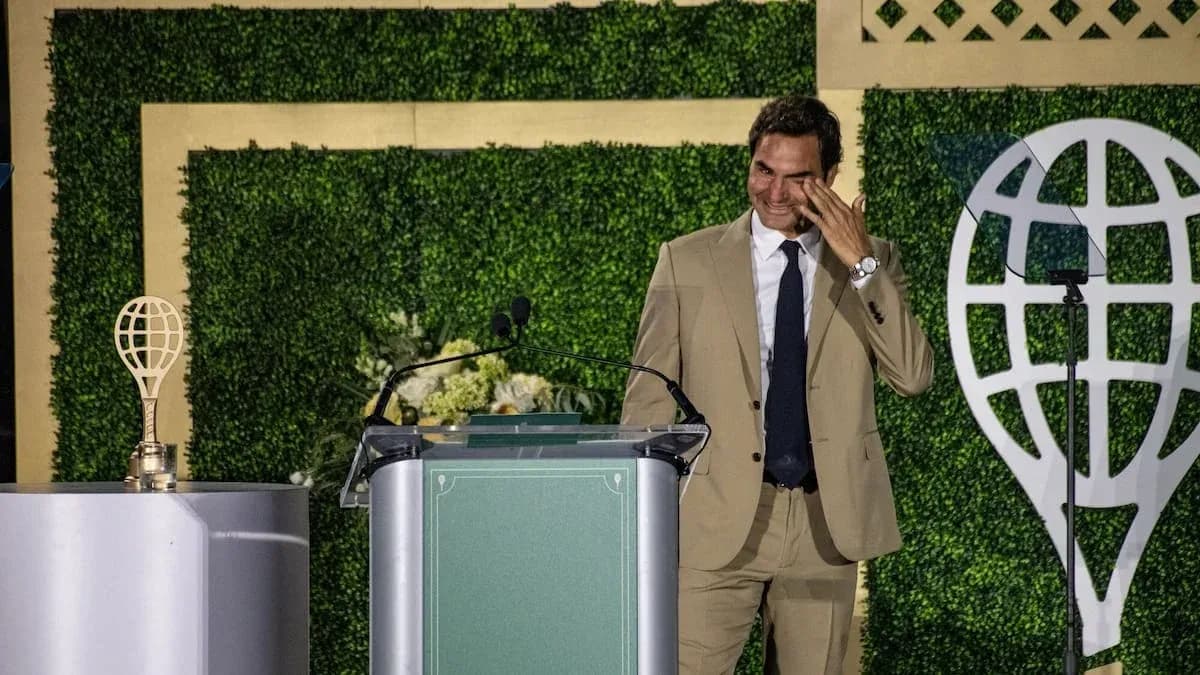
Roger Federer has always treated numbers differently. The sport obsessed over his 20 majors, his 310 weeks at world No 1, his eight Wimbledon crowns. On this night, as he stood at the International Tennis Hall of Fame, he chose a different ledger.
“Not the obvious stats like the number of majors or number of weeks at number one,” he said, almost brushing aside the very achievements that defined an era.
He went smaller. Funnier. More human.
Between his first steps onto the ATP Tour in 1998 and his farewell in 2022, Federer calculated that he wore more than 5,000 headbands. More, he pointed out with a grin, than Bjorn Borg and John McEnroe combined. The image fit him perfectly: the elegant champion turning a career of impossible precision into a playful anecdote about sweatbands.
Then he went lower still, all the way to his feet.
He reckoned he pulled on more than 7,000 pairs of socks in that time, “probably twice as many as most of my opponents, because I doubled them up.” A tiny detail, but exactly the kind of quirk that separates the distant icon from the man who spent his life chasing comfort on unforgiving hard courts.
The room laughed. Federer smiled. And then the tone shifted.
“But really, there’s no way to measure what it means to be here. It’s hard to put it into words,” he said, the lightness giving way to something heavier as he traced the line from a 13-year-old ballboy in Basel to the pinnacle of his sport.
He remembered where it started: not in royal boxes or under Centre Court’s roof, but at the edge of the court, towel in hand, watching idols from a few feet away. That memory framed the most pointed thanks of the night.
“I really want to thank every ball kid who ever stood through my matches or all our matches, for that matter, for hours on end,” he said. “I see you. I thank you. I was you.”
That “I was you” landed hardest. Federer has been the face of tennis for so long that it is easy to forget he once sprinted for balls, not trophies. On this stage, he made sure no one forgot.
The emotion caught him soon after. As he name-checked his idol Stefan Edberg, other greats of the game, and the family and support staff who carried him through two and a half decades, the famously composed champion suddenly fought the same battle as countless opponents: trying to hold on against a relentless tide.
He lost this one.
“I need tissues and sunglasses and everything to protect me right now,” he joked through the tears. “This is such a mess.”
The line broke the tension. The room exhaled. Federer has always understood timing—on serve, on return, in interviews—and he found it again here, using humour as a backhand slice to buy himself a moment.
Then he looked up and widened the lens.
“It’s been an incredible journey,” he said. “For me, the International Tennis Hall of Fame provides a great opportunity to look back, but also to look ahead.”
That last part mattered. This was not a man closing a book; it was a man turning a page. He described his relationship with the sport not as a completed chapter, but as an ongoing correspondence.
“As you can tell, I’m still writing my love letter to tennis,” Federer said. “My time as a player is done, but tennis will always stand at the intersection of everything I care most about: my family, our friendships, the past 40 years, the future we’re building. Tennis for me is responsible for it all.”
No trophy lift, no ace out wide, no forehand winner could quite match that admission. The headbands, the socks, the numbers—those can be counted. What tennis gave him, and what he gave back, cannot.
The statistics will always say Roger Federer stopped playing in 2022. Listening to him in Newport, it sounded like the story of Roger Federer and tennis is nowhere near finished.