.svg&w=384&q=75 "logo")
Roger Federer: The Emotional Journey to the Hall of Fame
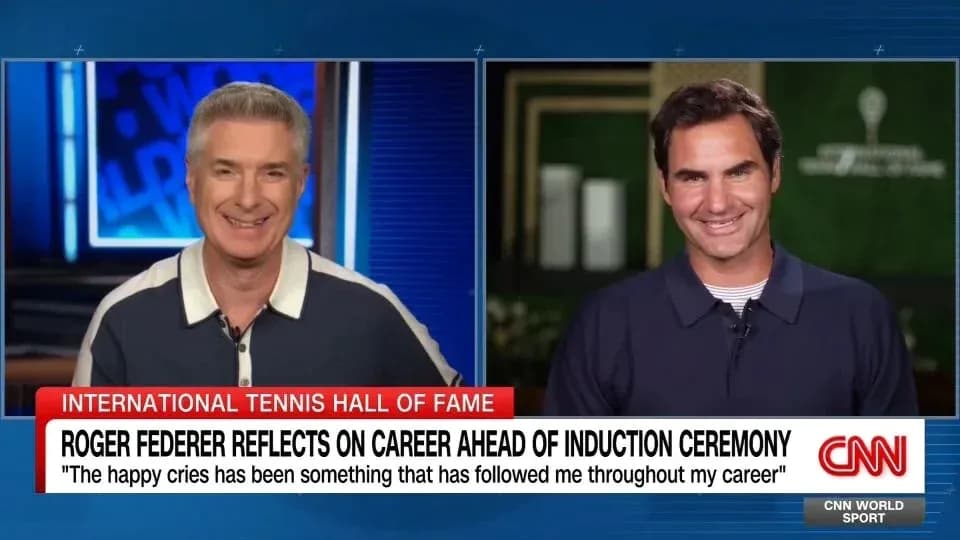
Roger Federer has cried on plenty of courts. The first time, he didn’t even recognise himself.
Wimbledon, 2001. Centre Court. A 19-year-old with a ponytail has just knocked out Pete Sampras, the four-time defending champion, in his first match on that hallowed lawn. He drops to his knees, then walks to the net to shake hands with his idol. And suddenly, the tears arrive.
“I go to my knees, (then) I shake hands with Pete and he's my hero … and these emotions came all over me,” he told CNN Sports. “And I was like, 'What is going on?' This is not who I am normally."
From that bewildering outburst to the sobs in London and Melbourne, New York and Basel, all the way to that raw, shared farewell alongside Rafael Nadal in 2022, Federer turned emotion into a kind of signature. The most elegant player in the sport also became, almost by accident, its most famous crier.
This weekend, the tears may return one more time.
A career built for the Hall
In Newport, Rhode Island, Federer is being inducted into the International Tennis Hall of Fame, a ceremony that has felt inevitable for two decades. He sounds ready for the stage. Less certain about keeping it together on it.
"If I'm speaking about the game and all the gratitude that I have, and having my entire family there – from my parents to my wife to my four children and my whole team from coaching staff and physios, etc. I think it could hit home very hard," he said in the hours before his induction.
"If it happens, it will be more memorable for me personally, but I hope I get through the speech without too many hiccups. We'll see."
For everyone who watched his rise, Newport is not a surprise, it’s a destination long mapped out. The route became obvious in 2004, when Federer ripped through the tour, winning three of the four grand slam singles titles and climbing to No. 1 in the world. He then refused to move.
Federer stayed at the top of the rankings for 237 consecutive weeks, a record that still stands. Four and a half years of dominance.
The numbers from that era remain staggering. In 2005, he won more than 95% of his matches. Then came 2006, the season many still call his peak: three more majors, 12 titles in total, and a 92-5 win-loss record. That’s a 94.8% winning rate, achieved not by grinding opponents into the dust, but by gliding past them.
Pete Sampras’ mark of 14 grand slam titles had once looked untouchable. Federer hunted it down and passed it on the lawns of Wimbledon in 2009, then kept going. For a long time, he stood alone as the sport’s major benchmark.
He did it with a kind of grace that made the violence of the sport look like art. The balletic footwork, the liquid forehand, the serve that appeared effortless until you looked at the scoreboard. Off the court, he was relaxed, approachable, and disarmingly normal for a global superstar.
The illusion of ease
Federer insists there is only one thing that ever really bothered him: the idea that it all came too easily.
"It looked like I wasn't actually hitting the ball so hard," he recalled of his junior days. "But it was kind of flying off of my racket with a lot of power. People always thought, like, 'It's so simple for you,' because it looked like elastic. But it wasn't the case. There was a lot of work and effort put into it.
"When I would lose, they say, 'Why don't you try harder?' And when you win, they would say, 'Oh my God, it's so easy for you!'"
The public saw the genius. They missed the grind. Buried in that contradiction is probably the real source of those famous tears.
"The sacrifice was massive and I was holding a lot of pressure in."
He carried that weight for two decades. Now, he has finally put it down.
Peace after the pressure
Federer does not sound like a man searching for a second act to match the first. There is no hint of a void, no restless talk of comebacks or the need to replicate the old adrenaline.
"I'm actually really happy going through everyday life at a lower pace," he said.
Lower pace, yes. Quiet life, not exactly.
He is a father of four, a philanthropist, an investor, a businessman. The schedule still fills up quickly. And he has not lost his old appetite for movement.
"I've always been a guy who loves being on the road."
The Hall of Fame weekend gives him license to look back, to step into the museum that now houses his peers and imagine himself across the net from them. If time and the Tennis gods allowed it, he already knows who he’d want to face.
"I would have a little list," he said, before reeling off the names: Rod Laver, Bjorn Borg, John McEnroe, Stefan Edberg, Boris Becker, and Sampras again. "I think these would be my favorite players to play against. I've always admired their personalities, what they have achieved, and what they represent in the game."
His own tally of 20 grand slam singles titles has been overtaken by both Rafael Nadal and Novak Djokovic. The numbers now belong to an era of three giants, not one. Yet for a huge share of fans, Federer remains the sport’s purest expression, the player they still call the greatest of all time, regardless of the arithmetic.
Life after greatness
Asked what he’s good at now, away from the white lines and the speed guns, Federer’s mind drifts to new and old challenges.
"I'm trying to get better at golf," he said. "I would love to start with an instrument again. I used to play the piano, so when I have more time, I'd like to dive into that because my four children and my wife play the piano."
The goals sound smaller, but the standard hasn’t changed.
"I hope I'm a good listener and a good decision-maker. Hopefully I'm a guy who people enjoy being around. I'm a big family guy. I love being surrounded by my friends – that's really the priority in my life."
In Newport, they will list the titles, the records, the weeks at No. 1. They will talk about Wimbledon and Melbourne, New York and Paris, about the rivalries that defined an age.
Federer will stand there, trying to hold it together one more time.
If the tears come again, they will not be a mystery this time.