.svg&w=384&q=75 "logo")
Rinky Hijikata and Maya Joint Shine at US Open
Rinky Hijikata walked into Flushing Meadows as the underdog. Within minutes, he had the world No.4’s full attention.
Felix Auger-Aliassime burst out of the blocks, racing to a 2-0 lead in the opening set and looking every bit the heavyweight in this first-round clash. The Canadian was striking cleanly, dictating early and threatening to turn it into a routine night.
Hijikata refused to play along.
The Australian steadied on serve, his body language unflustered, his movement sharp. Point by point, he dragged himself back into the contest, matching Auger-Aliassime from the baseline and seizing on any short ball he saw. By the time he nudged ahead 5-3 in the first set, the dynamic had flipped: the favourite was suddenly the one searching for answers, the “underdog” stalking around the grandstand court as if he owned it.
It is Hijikata’s first outing on that stage. He looks like he plans on staying a while.
Joint’s breakout fightback
Over on court 9, Maya Joint delivered the sort of performance that can change a young career.
She dropped the first set 6-3 to Liudmila Samsonova despite trading in long, bruising rallies and moving with real authority. Samsonova held firm, absorbed the pressure and banked the opener.
Joint’s response was ruthless.
Backed by a crowd that grew louder with every game, the Australian surged through the second set 6-2, feeding off the noise and out-hitting her higher-ranked opponent. Her energy spiked, her footwork sharpened, and Samsonova suddenly looked the one under siege.
The momentum didn’t just swing; it crashed to the other side of the net. Joint dominated the decider, again 6-2, closing out a 3-6, 6-2, 6-2 victory that had her grinning uncontrollably at match point. She could barely contain her excitement as she sealed a place in the second round, the crowd roaring her off the court.
Earlier, she had trailed 6-3, 1-3 and looked in a fight just to extend the contest. By the end, she was dictating everything.
Popyrin pushed, Dimitrov sharp
On the outside courts, Alexei Popyrin’s task was as tough as it sounds on paper: Grigor Dimitrov, in rhythm and in charge.
The Bulgarian started crisply, striking with the easy power and variety that has defined his late-career resurgence. He moved to a 4-2 lead in the opening set, keeping Popyrin pinned and playing catch-up. The Australian has built a reputation on resilience and heavy hitting, but Dimitrov’s early form left him little margin for error.
Wawrinka’s farewell and a flashpoint
Inside the stadium, another storyline took centre stage. Stan Wawrinka’s grand slam career came to an emotional close under the New York lights.
The three-time major champion, a US Open winner in 2016 after that famous four-set win over Novak Djokovic, bowed out in the first round to Matteo Berrettini, 7-6, 7-6, 6-0. The scoreline barely touched the emotion that followed.
Tournament organisers rolled a career highlights montage on the big screens at Flushing Meadows. The crowd rose, applauding a man who spent two decades trading blows with the very best. Berrettini stayed on court, clapping alongside them, visibly moved.
“It’s been more than 20 years since I first came here,” Wawrinka told the crowd, his voice cracking. He recalled arriving to play qualifying as a young hopeful, spoke of the special bond he feels with New York, and admitted one of the reasons he kept playing until 41 was to experience nights exactly like this. Ten years after lifting the trophy, he closed his grand slam chapter on the same court.
“I am going to miss it. I love the game so much,” he said, thanking the fans for their support over the years. The ovation told him the feeling was mutual.
Berrettini, who had never faced Wawrinka in his career until this season and has now done it twice in back-to-back majors, called it a dream to share the court with “this legend” again. For a moment, the result felt secondary.
Not that the match passed without controversy.
Early in the third set, Wawrinka flicked a ball over the net in a reflex exchange, appearing to make contact twice. Berrettini immediately appealed, insisting it was a double hit and should be called illegal under the rule that demands a single continuous motion.
“You could see his two motions,” the Italian argued with the chair umpire, pointing out the apparent pause and second flick.
Wawrinka, 41 and smiling through the tension, joked at the net: “I’m 41, that’s why I am slower than you.” The pair shared an embrace as the video review team checked the incident.
The replay, shown at full speed, cleared the shot as legal, leaving Berrettini visibly frustrated. Australian great Jelena Dokic later noted that slow-motion footage from the broadcaster’s cameras clearly showed a double hit, but the US Open review system does not use slow motion. “It does show that he did hit it twice, so Berrettini is actually right. But when you look at it in normal speed, it doesn’t look like that,” she said.
Wawrinka kept the point and the advantage, but still lost that opening game of the third set. Berrettini, already two tiebreaks to the good, ran away with the match, surging to 7-6, 7-6, 3-0 and never looking back.
Khachanov’s blunt verdict on Kyrgios
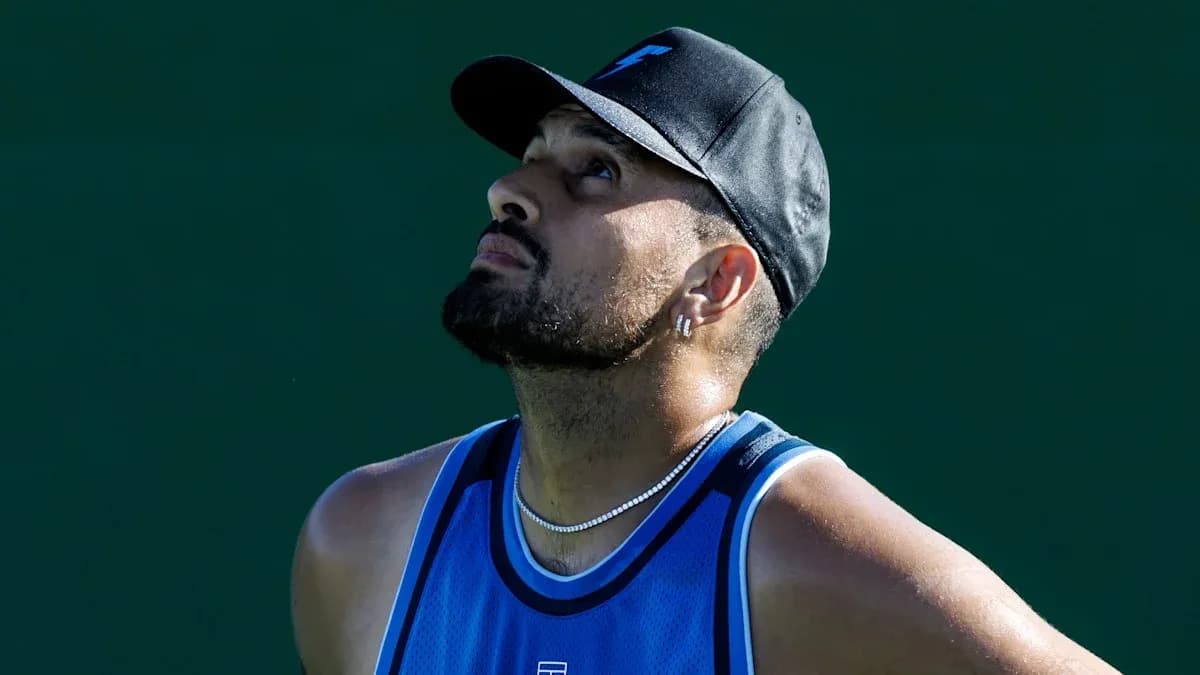
Away from the courts, the shadow of Nick Kyrgios’ suspension still hung over the tournament.
Karen Khachanov, who has shared high-stakes battles with Kyrgios in the past, did not hold back when asked about the Australian’s cocaine ban, which came after a positive test in June. Kyrgios, 31, had publicly accepted responsibility last month, calling it a “huge mistake” and saying he would step away from the spotlight to work through personal issues.
Khachanov pointed to Kyrgios’ long history of outspoken comments on doping and drug bans.
“Even when he wasn’t playing, he always liked to pick on someone, writing things on Twitter and so on,” Khachanov said at the US Open. “And now, when all that has turned against him… what do you want me to say? In the end, you reap what you sow.
“Honestly, it’s not just that I’m not surprised, but to some extent, I can’t feel too much pity either. What he got caught for was ultimately his choice. And in the end, look what happened. It backfired on him.”
It was a stark assessment, and it echoed a sentiment shared quietly in more than a few corners of the locker room.
One legend exits, a new wave rises
As Wawrinka walked away from the grand slam stage for the final time, the US Open offered a snapshot of tennis in transition.
A 41-year-old warrior received a standing ovation. A young Italian star fought for every call. An Australian prodigy in Maya Joint stormed into the second round with a three-set statement. Another in Rinky Hijikata took the fight to a top-five seed under the lights. On the outside courts, Alexei Popyrin wrestled with Grigor Dimitrov’s class.
The sport rarely pauses. One era closes, often in tears. On the next court over, the next one quietly begins.