.svg&w=384&q=75 "logo")
Peyton Watson's Departure: Denver Nuggets Face Tough Choices
The Denver Nuggets knew this summer would bring hard choices. One of the toughest is already gone.
Peyton Watson, the long, springy forward who grew from project to pillar in a single season, is heading to the Cleveland Cavaliers. The move came in a multi-team sign-and-trade, reported by ESPN’s Shams Charania, that quietly reshaped three rosters in one stroke.
Cleveland gets Watson.
The LA Clippers get Max Strus.
Denver gets draft capital: an unprotected 2031 Cavaliers first-round pick and a 2032 Kings second-rounder.
The headline on Cleveland’s side is the contract. Watson will sign a new four-year, $88 million deal with the Cavaliers, complete with a player option and a trade kicker. That’s the kind of number that tells you exactly how the league now views him: not as a flier, but as a core piece.
Denver simply couldn’t reach it.
The One That Got Too Expensive
Watson hit restricted free agency at the perfect time for his bank account and the worst time for the Nuggets’ books.
According to Bennett Durando of The Denver Post, Denver’s ceiling for Watson sat at four years, $72 million. Respectable money, and a clear sign they wanted to keep him. Just not enough. Not in this market. Not for a 22-year-old who just averaged 14.6 points, 4.9 rebounds and 2.1 assists per game while holding together key stretches of the regular season.
The gap between $72 million and $88 million is not just about dollars. It’s about tax penalties, roster flexibility, and the cold math that hits every contender eventually. The Nuggets chose their line. Cleveland crossed it.
The cost for Denver is more than statistical. Watson had become something else in that locker room: proof that their developmental pipeline still worked, and that they could refresh a title core on the fly. Now he becomes the kind of loss you feel twice — once in the rotation, and again when he walks back into Ball Arena wearing another jersey.
Gordon Loses a Teammate, Keeps a Brother
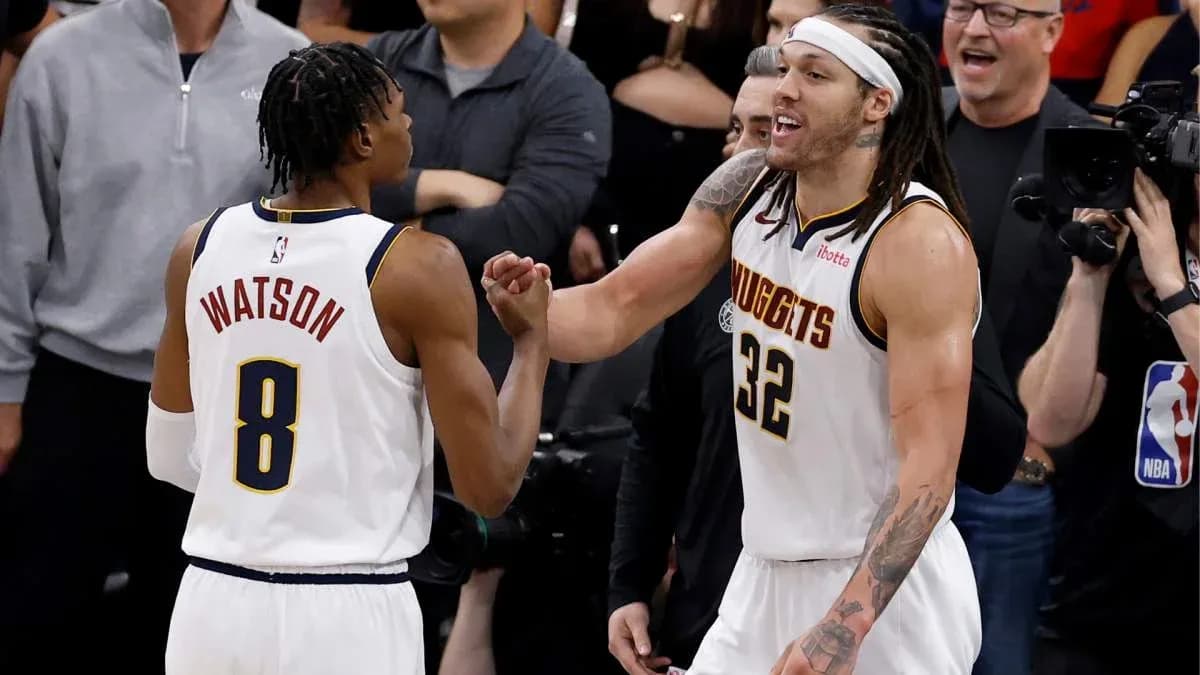
If anyone on the Nuggets felt Watson’s rise up close, it was Aaron Gordon.
Gordon missed big chunks of last season. Watson stepped into the space he left behind and didn’t blink. There were stretches — notably when Nikola Jokic went down with a knee injury and missed roughly a month — where Watson was not just filling in. He was Denver’s second-best player behind Jamal Murray.
That sort of leap can create tension when contracts come up. Not here.
Speaking at his youth camp, Gordon made it clear there’s no resentment, only respect.
“That’s my dawg, but it’s deeper than basketball with Peyton and I,” Gordon said, via DNVR Nuggets. “Our families members go to the same church, Peyton’s just like my brother. I’m happy for him, the situation that he’s in. Obviously, we would’ve loved to have him, but it worked out the way it should’ve. That it was supposed to.”
There’s honesty in that. The Nuggets would have loved to keep him. The cap sheet wouldn’t let them. Gordon understands the business, but he also sees the human side: a young player cashing in on a breakout year, stepping into a larger role, and securing his future.
For a locker room that prides itself on continuity and chemistry, losing someone that close to a cornerstone like Gordon stings. It also underlines how real Watson’s impact became in just four seasons.
From Naive Rookie to Core Contributor
Watson arrived in Denver as a raw product out of UCLA, drafted by then-general manager Calvin Booth. Length, athleticism, flashes of feel — the classic “if it all comes together” pick.
Last season, it came together.
When Jokic went down, the Nuggets needed someone to absorb usage, defend, and run the floor with Murray. Watson answered. The numbers — 14.6 points, 4.9 boards, 2.1 assists — tell part of the story. The eye test did the rest. He attacked closeouts, finished in transition, and held his own on the defensive end. There was a stretch where his presence felt non-negotiable.
Those weeks changed how the league viewed him. They also changed his market.
Denver, stuck between ambition and reality, chose to step back and collect picks. Cleveland, chasing its own rise in the East, chose to pay.
A Goodbye With Gratitude
Watson didn’t slip out of Denver quietly. On Instagram, he left a long, thoughtful message for the city and the fan base that watched him grow.
“Nuggets Nation and the city of Denver, thank you for having me for the first four years of my career,” he wrote. “As a young NBA player, who was a bit naive and hadn’t seen much of the real world, you guys took care of me better than I could have ever imagined. Thanks for that. Playing this game every night on the national stage is difficult on both the body and the mind, but the love from the fans always makes it so worthwhile.”
He went on to thank Booth for drafting him out of UCLA, the Kroenke family, former Nuggets coach Michael Malone, current coach David Adelman, and both current and former teammates. It read less like a standard farewell and more like a young player fully aware of how many hands helped him get to that $88 million deal.
For Denver, those names mark an era. For Watson, they mark the foundation of whatever comes next.
What’s Left in Denver, What Awaits in Cleveland
The Nuggets move forward with their core still intact: Jokic, Murray, Gordon and the championship expectations that follow them. They add future draft assets but lose a 22-year-old who looked ready to be part of the next version of this team.
Cleveland, meanwhile, bets big on upside. Watson’s length, versatility and newfound confidence slide into a roster that already leans on Donovan Mitchell, Darius Garland and Evan Mobley. If he keeps climbing, this contract will look less like a gamble and more like timing.
Denver couldn’t afford to find out. Cleveland is paying to see the answer.