.svg&w=384&q=75 "logo")
Novak Djokovic's Surprising First-Round Exit at the U.S. Open
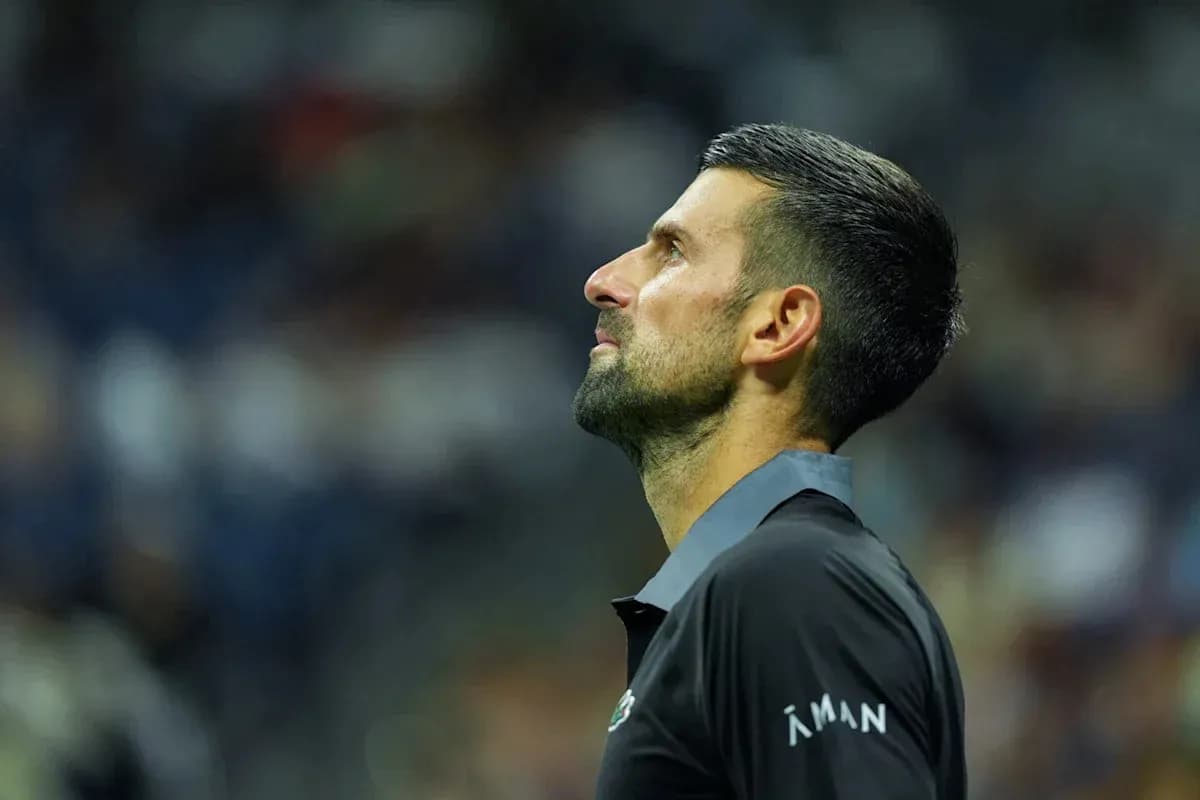
NEW YORK — Novak Djokovic has walked out of Arthur Ashe Stadium a beaten man before, but never like this.
The king of the opening round, owner of 77 straight first‑match wins at Grand Slams, was pushed to the edge of his body and then over it on Sunday night. In four hours and 36 minutes of surreal, punishing, often uncomfortable tennis, he lost to Argentina’s Mariano Navone — a gritty top‑50 regular, but no member of the sport’s pantheon — 7-6(5), 5-7, 4-6, 6-2, 6-1.
For the first time since the 2006 Australian Open, Djokovic is out of a major before it has really begun. Back then he was 19, ranked 76th, a kid figuring out how to survive. This time he is 39, the most decorated hard‑court player the sport has known, staring straight at his limits in the tournament that has so often showcased his defiance of age and logic.
On this night, the logic won.
A giant’s body gives way
The match began as Djokovic has begun so many nights in New York: under the lights, under the roof, under control. Three aces in his first two service games. A 3-0 lead. The familiar feel of Ashe as his personal stage.
Then the script tore.
Navone started to bite into rallies, dragging points into the long, grinding exchanges where he lives and Djokovic no longer comfortably can. The air was thick and humid, but not brutal. The weather soon stopped mattering. Seven games in, the rain came, the roof slid shut, the air conditioning hummed to life — ideal conditions for Djokovic, historically almost unbeatable indoors at night. Yet by then, he had already surrendered his early break and was bending, visibly, in ways that had nothing to do with the scoreboard.
The first set stretched to 73 minutes and a tiebreak. Once, that scenario was a Djokovic specialty: squeeze, suffocate, steal. This time Navone held his nerve, took the breaker 7-5, and the night took on a strange, queasy tone.
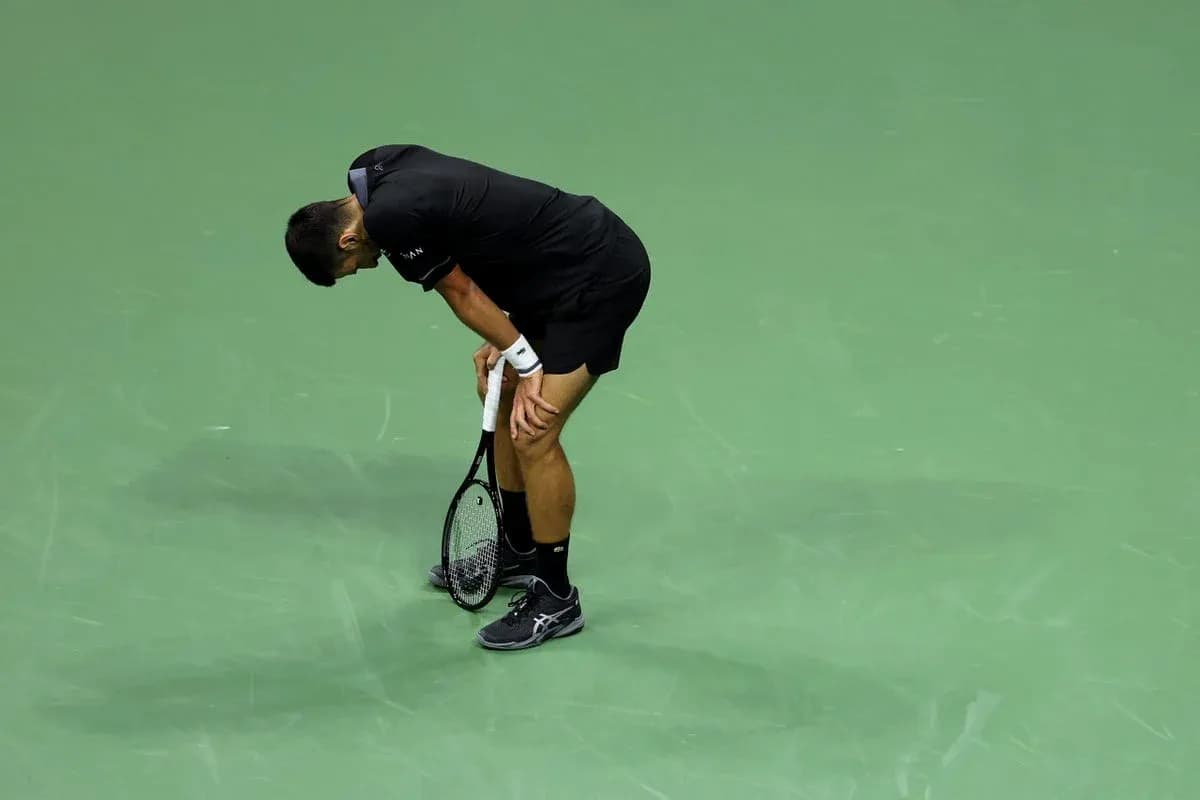
Djokovic fought back on instinct. He clawed out the second set 7-5, then the third 6-4, the scoreline disguising the cost. In the seventh game of that third set, he bent over a courtside bin and vomited mid‑game. Between points that ran beyond six, seven, eight strokes, he leaned on his knees, drawing breaths that seemed heavier with each rally.
The pattern was stark. On points decided in four shots or fewer, Djokovic still looked like Djokovic. When he could end with a serve, a first strike, a return lasered to the baseline, he controlled the night. When Navone forced him into the trenches, the advantage flipped. Every extended rally seemed to drain a little more of what he had left.
By the start of the fourth set, the physical toll could no longer be disguised as rust or discomfort. It was something more ominous.
The fifth set that felt like a farewell
Djokovic had one path. Attack, shorten points, trust his instincts and his patterns from a career of dominance. For a moment, it looked as if that might be enough. He broke early in the fourth set, coaxing errors, nudging Navone off balance. The finish line appeared, faintly, in the distance.
Navone refused to play the supporting role. He broke right back, then again, as Djokovic’s body began to unravel in real time. The Serb’s movement stiffened, his footwork lost its usual precision, and the fourth set raced away 6-2.
He took a medical timeout before the decider. A trainer worked on his lower back, trying to squeeze one more surge out of a frame that has carried him through two decades of five‑set wars. The effort looked less like routine treatment and more like a last stand.
Then came the second game of the fifth set, the moment that felt like a turning point in a career, not just a match. Navone pushed Djokovic from corner to corner, then dragged him forward. As Djokovic advanced, the Argentine ripped a backhand down the line. Djokovic lunged, tried to half‑volley, and failed. On the next few steps he staggered, then limped, wincing through the following games as the stadium’s roar turned uneasy and then, at times, almost mournful.
By the fifth game, tears gathered in his eyes. The scoreboard read 4-1, Navone. The larger story read something harsher: a champion running out of time in a format he once bent to his will.
Navone, a clay‑courter by trade whose lone ATP title has come on the red dirt, barely flinched. This was just his third U.S. Open main draw. He had never played on Ashe, never won more than a single match in this tournament. Across the net stood a man with 101 titles, four of them here, who has treated this court as a second home for 15 years.
None of that mattered now. Navone kept sending ball after ball back, kept asking the same question of Djokovic’s legs, lungs and back. The answer grew more painful with each point. The fifth set flashed by 6-1.
“An awful feeling on the court”
Shortly after walking off, Djokovic stood outside the locker room, spent and hollowed out, and tried to put words to what had just happened.
“An awful feeling on the court for me,” he said. “It’s something that I’ve been carrying unfortunately pretty much every match this year. Vomiting, throwing up, a serious issue there. And then my whole body, you know, starts to collapse. Cramping, pain. The back just gave up in the end, and the shoulder, and I couldn’t close it out.”
He said the struggle had started as early as the fourth game of the match. He also tried to keep the spotlight on Navone’s effort, calling him “a nice guy, a fighter.”
As for the underlying problem, the condition that has been stalking him for the last couple of seasons?
“I’m trying, man, I’m trying,” he said. “Let’s, let’s see.”
The words matched what he had hinted at in recent weeks. At the Cincinnati Open earlier this month, in his first event since losing in straight sets to Jannik Sinner in the Wimbledon semifinals, he looked off the pace and out of sorts, losing his opening match to Thiago Tirante and struggling in the heat. He alluded then to a medical issue he has been managing for “the last couple of years,” but declined to go into detail.
In New York, on the eve of the U.S. Open, he insisted that the early exit in Cincinnati had given him a valuable two‑week training block.
“Two weeks, to really train and get my body and mind into the right state, prepared for what’s coming up,” he said. “If you ask me if I’m prepared, I feel like I am, you know, as best as I can be, but it’s different training and then getting out on the Arthur Ashe Stadium and playing best of five. You don’t normally play best of five in practice sessions.”
He also acknowledged how treacherous the opening hurdles had become.
“Hopefully I can overcome, you know, the first hurdle and build from there,” he said.
The hurdle proved higher than he knew.
A long reign meets a harsh format
Djokovic has spoken often over the past two seasons about the unique demands of Grand Slam tennis. Best‑of‑five, he has said, no longer offers him unlimited hours to solve problems. Every extra set in the first week eats into reserves he needs for the second.
On Sunday night, that calculation turned brutal. Even if he had somehow survived Navone, the way his body deteriorated by the middle of the third set made any deep run feel fanciful. The gas tank, once seemingly bottomless, now has a visible gauge.
This is not how he has usually looked on the big stages. Just seven weeks ago, he reached the Wimbledon semifinals, beating Félix Auger-Aliassime in a classic five‑setter that felt like a throwback to his peak. Yet that run ended with a flat loss to Sinner that appeared to cut deeper than most defeats. Late in that match, when a fan tried to reassure him that he could still hang with the world No. 1, Djokovic’s reply was telling.
“Maybe 10 years ago,” he muttered.
After Wimbledon, he disappeared from the tour, went on vacation, stayed mostly within the circle of his family. He hit casually with his wife, Jelena, and his children, Stefan and Tara. The hard‑court grind could wait.
It did not wait for him.
On Sunday, as the fifth set slipped away and his family watched courtside, their faces darkening with each game, Djokovic’s career felt like it had entered a new, uncomfortable phase. This was not the defiant veteran outlasting youth through guile and endurance. This was a legend trying to will a body that no longer obeyed.
The wolf in winter
Earlier this summer, Djokovic released a documentary titled “The Wolf in Winter,” an exploration of his refusal to bow to the inevitable end of one of tennis’s greatest careers. It painted him as the predator who still believes in one more hunt, one more title, one more improbable run.
On Sunday night, as he left Ashe, he paused and turned, offering his now‑familiar heart gesture with his fingers to every corner of the stadium. Five years ago, in this same arena, he had wept after losing a shot at the calendar Grand Slam in the final, overwhelmed by a New York crowd that had finally, fully embraced him.
This time, the emotion was quieter but no less stark. The greatest hard‑court player of the modern era had just lost a first‑round match at a major for the first time in 20 years. He had done so not in a blaze of shot‑making from across the net, but in a slow, visible breakdown of the body that carried him to 24 Grand Slam titles.
The wolf is still fighting the winter. After a night like this, the question is no longer whether the cold is coming.
It’s how many more nights he has left to hold it off.