.svg&w=384&q=75 "logo")
Naomi Osaka's Resilient Journey at the US Open
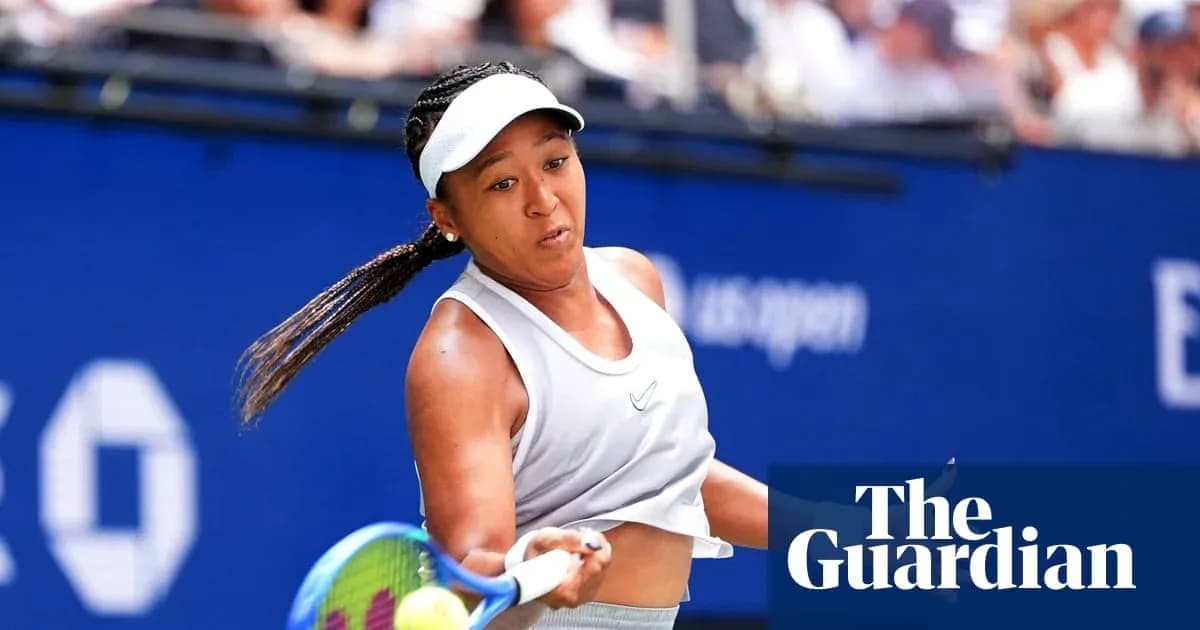
Naomi Osaka had the match in a headlock. Again.
For the second straight outing at this US Open, the two-time champion looked as if she might stroll through the night. A set in front, a break up on Katerina Siniakova, her power and timing in sync, an untroubled return to the third round on the horizon.
Then the tension arrived.
What had been a controlled performance suddenly tightened. Osaka’s arm, so loose and lethal for a set and a half, stiffened in the closing stages of the second set. The errors crept in, the serve lost its sting, and Siniakova, who had been hanging on, found a foothold. The lead vanished. The match, once routine, veered into dangerous territory.
Osaka dropped the second set 7-5. A decider, again. The kind of situation that once rattled her, that once sent her spiralling into doubt.
Not this time.
She reset, stripped the match back to its basics, and then tore through the third set with ruthless clarity. The final score – 6-2, 5-7, 6-1 – tells the story of a player who briefly lost her grip, then remembered exactly who she is.
A contender again
This North American swing has always been Osaka’s natural habitat. The hard courts of late summer and early autumn are where she built her legend, with US Open titles in 2018 and 2020. For years, the calendar felt like a long wait for this stretch: clay and grass served more as an endurance test than a stage.
This season has been different.
She didn’t just survive the clay and grass; she excelled. A fourth-round run at the French Open. A quarter-final at Wimbledon. On paper, those are solid results. In context, they were a statement.
Her grass-court level at Wimbledon – historically her most awkward surface – was a breakthrough. Beating world No 1 Aryna Sabalenka in the fourth round was not a nostalgic echo of her prime; it was a reminder that her ceiling remains as high as anyone’s. The tank finally emptied in the quarter-finals, fatigue catching up after a run to the Bad Homburg final the previous week, but the quality of her tennis there was the best she had produced since lifting the Australian Open trophy in 2021.
She arrived in North America not searching for her game, but armed with it.
With that, of course, comes expectation. And expectation weighs.
Her first-round win in New York – 7-6 (6), 7-6 (3) over Anastasia Zakharova – carried the same pattern of dominance interrupted by doubt. She led by a break in both sets, twice allowed it to slip, and had to grind through two tight tie-breaks, dragging herself over the line rather than sprinting through it.
Against Siniakova, the nerves cost her more than just comfort. They cost her a set.
Yet this is where experience shows. Osaka has lived these moments before, on far bigger stages, under far harsher lights. She spoke about it plainly afterwards: when a match stretches into a deciding set and she needs to gather herself, her mind goes straight to the 2019 Australian Open final, when she steadied herself after a meltdown to beat Petra Kvitova in three sets. That memory is not nostalgia; it’s a tool. A reference point she can pull from “the memory bank” whenever a match threatens to unravel.
That is the luxury of scars earned at the top of the sport. You don’t just have titles; you have templates.
“I think that’s the best thing about being a more experienced player,” she said. Different matches. Different crises. Different ways out.
Here in New York, a city where she has already built a rich archive of “good memories”, she is trying to add more.
The noise around the tennis
With Osaka, though, the story rarely stays inside the tramlines.
Her tennis has sharpened this year, but each grand slam appearance has also become a kind of runway. Walk-on outfits, match kits, deliberate visual statements – all of it draws attention before a ball is struck. At this US Open, her look is a tribute to Allen Iverson, the former NBA star whose style and swagger changed basketball culture.
The clothes are not an afterthought; they are part of the performance. That, inevitably, has split opinion.
For a player as naturally reserved and gentle in manner as Osaka, the fury she provokes can feel wildly out of proportion. She is painted by some as an attention seeker, told to “focus on tennis”, as if the two were mutually exclusive. Critics drag up her mental health struggles from 2021, using them as a cudgel, accusing her of contradiction for embracing bold fashion and public expression now.
The context – that she is older, in a different space, with a different relationship to the spotlight – is conveniently ignored. So, often, is the subtext: a lingering resentment towards her outspoken anti-racist stance during the early 2020s. Much of the backlash is not about skirts or colourways. It is about who she is and what she represents.
Osaka, though, has grown into her own contradictions. She remains introverted, still uncomfortable with some elements of fame, yet she has found in fashion a way to speak without speaking. Clothes as language. Outfits as punctuation.
She also understands the core truth of her profession. She is, at the end of the day, an entertainer who runs, slides and swings for the enjoyment of others. This is sport, not a moral referendum. Wearing an elaborate dress while hitting forehands at Flushing Meadows is hardly an outrage.
A brutal road ahead
The draw has not indulged her. Among the many title contenders, Osaka’s path is one of the most unforgiving. Second seed Elena Rybakina looms as a possible fourth-round opponent, a collision of two of the cleanest ball-strikers in the game.
Osaka’s first job is simply to get there.
Elsewhere in the women’s draw, another former champion moved with far less fuss. Iga Swiatek, the eighth seed and winner here in 2022, eased into the second round with a composed 6-3, 6-2 win over Nadia Podoroska, her game tightening and sharpening with each outing in New York.
For Britain’s Harriet Dart, the main draw proved a step too far this time. The qualifier was swept aside 6-2, 6-2 by 25th seed Marie Bouzkova, who controlled the baseline exchanges and never allowed Dart a foothold.
On the men’s side, Félix Auger-Aliassime’s campaign unravelled in worrying fashion. The third seed and last year’s semi-finalist struggled with dizziness and illness as Karen Khachanov turned their match around to win 6-7 (5), 6-3, 6-2, 6-2. What began as a tight contest became a physical ordeal, and another reminder of how quickly a fortnight’s ambitions can evaporate in New York.
Osaka knows that better than most. She has seen this tournament lift her to the summit and spit her out early. Now, back in the second week’s sights, playing some of her best tennis in years, she stands again on the edge of something significant.
The question is no longer whether she belongs in the conversation. It is how far, and how fast, she can drive it.