.svg&w=384&q=75 "logo")
Monza Prepares for ‘Weird’ 2026 F1 as Drivers Confront Energy Challenges
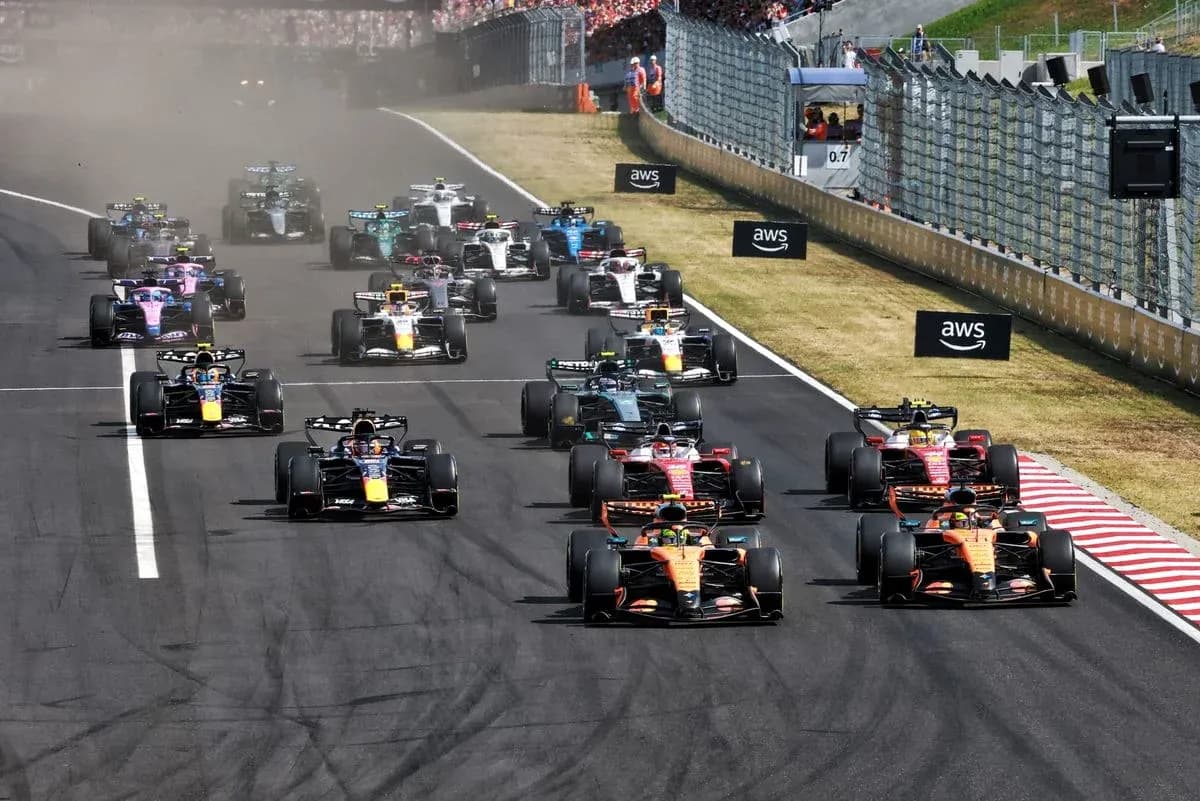
Monza is supposed to be Formula 1’s temple of speed. This weekend, it might feel more like a laboratory.
Drivers are openly preparing for what they describe as a “weird”, “confusing” and “not fantastic” experience as the 2026-spec cars face their toughest test yet on the fastest layout on the calendar. The challenge isn’t grip, downforce or drag. It’s energy. Or the lack of it.
The most extreme low‑energy circuit so far is about to expose every quirk of the new rules.
Top speed… slower than Hungary?
When the 2026 regulations first hit the simulators, Monza quickly emerged as a problem child.
Early runs painted a bizarre picture: cars rocketing out of corners, then running out of battery halfway down the straights. Speed would fall away so dramatically that drivers were reportedly having to shift down mid‑straight just to keep the power unit in its operating window.
Tweaks since then – trimming recharge limits and capping deployment – have reshaped that profile. The old fear of a brutal 30–40km/h drop-off from traditional peaks of 350–360km/h has eased. The new reality is stranger.
Instead of charging to a huge top speed and then falling off a cliff, the cars simply never get there. They hit a plateau and stay there.
As Racing Bulls rookie Arvid Lindblad summed it up: “There's just not much battery. We don't actually go slower on the straights. We just don't use any.”
The knock-on effect is even more counterintuitive. McLaren’s Oscar Piastri revealed that in the simulator, Monza’s front straight wasn’t even the benchmark for Vmax.
“I think in our sim running we were actually quicker on the front straight in Hungary than we were here,” he said. “It doesn't make a whole lot of sense, but it's more that we just don't have the energy to spend.”
So the “Temple of Speed” could see cars that are effectively energy‑limited, not drag‑limited. Simulations suggest drivers may no longer need that awkward downshift halfway along the main straight into Turn 1, but they could still be forced to drop to seventh on the uphill run into Ascari as the power tails off.
It’s not the Monza anyone grew up with.
No ‘super clipping’ spectacle killer
One of the big pre‑weekend fears was that teams would be forced into extreme “super clipping” – aggressively harvesting energy on the straights and in fast corners – turning iconic sections like the Lesmos and Ascari into neutered, half‑throttle zones.
That scenario has been checked, at least partly, by the FIA’s decision to impose a 5MJ harvesting limit for this event. With energy recovery capped, the scope for brutal clipping is much smaller.
Piastri explained the difference clearly: “If the harvest limit was higher, we would be super clipping everywhere, probably losing 30 or 40 km/h at the end of each straight, but with the [5MJ] harvest limit, the super clipping is a normalish amount, or a reasonable amount.”
So the cars will still feel slow at the end of the straights, but not because drivers are visibly coasting or lifting everywhere. The limitation is more invisible: there simply isn’t enough energy to deploy.
Monza will look fast. Onboards will tell a different story.
No clever tricks to game the system
At other energy‑starved venues this year, the grid has already learned how to play the game.
Spa-Francorchamps was the prime example. Drivers discovered that being slower in some corners could actually make them faster overall. Lift through Pouhon. Coast earlier. Short‑shift out of medium‑speed turns. All to harvest more energy, then unleash it on the Kemmel Straight or down to Blanchimont.
It was counterintuitive, but it worked.
Monza doesn’t offer the same luxury. The layout is brutally simple: long straights, hard braking, a few chicanes, and not much in between to recharge.
Lando Norris laid out the problem: “I think the difference to Spa was that you had two big straights but you had lots of corners in-between that you could charge up and then deploy everything.
“Unfortunately here you have two long straights back-to-back, but even between them there's not really any corners. So, there's just no energy, there's just no power. You don't have an ability to charge, so it's just slow.”
In other words, there’s no clever workaround. No hidden time to be found by sacrificing one section to gain on another. The track layout itself leaves the cars exposed.
Painfully slow cool-down laps on the cards
If qualifying at Monza is usually a high‑speed chess match of tows and track position, this year it adds a new dimension: battery state of charge.
Teams will need to arrive at the start of each flying lap with the battery as full as the rules allow, while still getting the tyres into their narrow operating window. That’s already a delicate balance. Now it comes with hard limits.
Out-laps are restricted to 9MJ of recharge. That’s enough to encourage drivers to keep some pace, work the tyres, and still be ready to attack.
Cool-down laps are a different story.
They’re capped at 5MJ, the same as race running. So a classic push‑cool‑push sequence in qualifying risks running into an energy ceiling if drivers don’t crawl around on their cool laps to avoid over‑charging.
Lindblad doesn’t sound thrilled about what’s coming.
“I think the out-laps will be slow, but I don't think they'll be stupid,” he said.
“I think what won't be enjoyable is going to be cooldown laps, because the rules are different between out-laps and cool laps. So, in cool laps you'll be going very slow to try to charge the battery.”
Expect some jarring images: modern F1 cars trundling around Monza, not because of yellow flags or traffic, but to babysit a battery.
The start of the lap: a new kind of risk
If the middle of the lap is about managing what little energy exists, the start of the lap is about gambling with it.
Teams and drivers need to decide how much battery to spend blasting out of Parabolica to the line, and how much to save for the rest of the lap. Use too much early, and the car arrives at the final sector underpowered. Use too little, and you leave free lap time on the table.
Earlier this season, drivers had to manually judge where to get on the throttle and how to trigger deployment before the timing line. That created unpredictability and the odd scare, as cars approached the line at very different speeds and power levels.
To calm that chaos, the FIA and teams agreed an in‑season tweak for Miami, introducing the now‑familiar ‘auto‑K’ function. Teams can pre‑program where along the track the battery kicks in, taking that decision out of the driver’s hands in real time.
At Monza, the exit of Parabolica is one of those trigger points. Drivers will stamp on the throttle as usual, but the battery will only deploy where the software says so.
Lindblad sees danger in that, particularly in qualifying, when some cars are finishing laps at full tilt and others are only just starting.
“We saw it a bit in Zandvoort, but it was okay because of the banking,” he said.
“There was a 50-60 km/h speed delta, so you could get out of the way and let the guys through.
“Here it's even more - and it could become a bit dangerous. So, starting the lap won't be easy, to have it full, have the tyres ready.
“But even just from traffic, from safety, it's not great. We need a better battery.”
That’s the nub of it. Monza, the track that once defined F1’s raw power, is about to become the place that exposes its new limits. The drivers know it. The engineers know it. The question now is whether the “Temple of Speed” will still feel like one when the lights go out.