Mikel Arteta's Anfield Challenge: Lessons from History
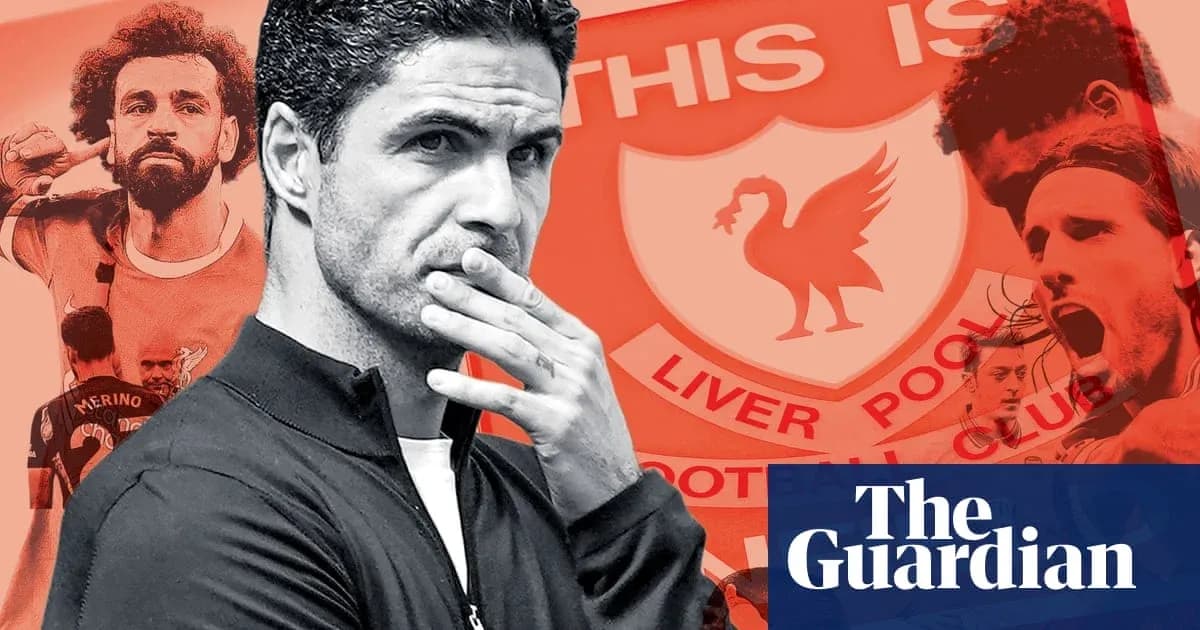
Mikel Arteta has a word for what Anfield can do to a footballer.
Bajar.
“A cyclist is going up and looks amazing, then in one kilometre he goes ‘boom’ and he’s struggling again,” he once explained. For him, that collapse came in blue, not red – an Everton midfielder suddenly swallowed by a sea of Liverpool shirts, the game rushing past, his legs and brain unable to keep up. “I only had that feeling in my career once, and it was at Anfield.”
He goes back there again on Sunday, this time as the architect of a title‑winning Arsenal, facing his boyhood friend Andoni Iraola and a Liverpool side still taking shape. On paper, the champions should arrive with a certain swagger. In reality, Anfield has a way of stripping away illusions.
Arteta knows that better than most.
A ground that bruises memories
His playing record on that pitch is littered with scars. He finally won there with Arsenal in September 2012 after five failed attempts in the Merseyside derby, only to end the night in hospital with concussion after a collision with Jordan Henderson – an episode he has called “the biggest fear of my life”.
Six months later he was on the pitch again as Lukas Podolski and Santi Cazorla fired Arsenal to another league win at Anfield. That was the last time the club left there with three Premier League points. Thirteen league games have passed since without a victory, a sequence that now equals Arsenal’s longest winless run away to Liverpool. The only success in that time came in the League Cup in 2020, on penalties, early in Arteta’s managerial reign.
His attempts to change the story have not always landed. In November 2021 he tried to inoculate his squad against the occasion by pumping “You’ll Never Walk Alone” through the training ground speakers. Anfield’s response was a 4-0 lesson.
Last August, when Dominik Szoboszlai’s late free-kick ended a run of three Arsenal draws there, the criticism cut deeper. Arteta was accused of being too cautious, of failing to release the handbrake after starting Mikel Merino as his No 10. Gary Neville questioned Arsenal’s “mentality to go and win big matches at big away grounds”, a charge that lingers while the club’s last league win at Manchester City’s Etihad Stadium dates back to 2015 under Arsène Wenger.
Those words will be ringing in his ears this weekend, especially after what happened at Fleetwood.
From Fleetwood to Anfield in five days
Arsenal’s midweek Carabao Cup exit to a side 84 places below them in the pyramid was more than a shock; it was an embarrassment. A ground of fewer than 6,000 people watched the champions labour, miss their chances and then lose on penalties, reopening the wounds of May’s Champions League final defeat by Paris Saint‑Germain.
Arteta’s selection was bold on paper. Kai Havertz and Viktor Gyökeres started together up front, a rare tandem that looked designed to ease the creative strain on Martin Ødegaard. Instead, both forwards looked short of confidence and rhythm. The problems around them were just as worrying.
Bukayo Saka is out with a thigh injury. There are concerns over Noni Madueke’s ankle. Arsenal’s failed appeal against Max Dowman’s red card means the teenager will miss three matches. The squad that already looked stretched by deep Carabao Cup runs in the past two seasons – semi‑final, then final – has lost another competition and a little more energy.
Arteta will never admit that elimination might help the league campaign. But with the schedule easing slightly, Sunday’s trip feels even more loaded. This is not just another away game. It is a chance to tear up a script that has haunted Arsenal managers for decades.
Learning from 1989
If Arteta is looking for a template, he does not need to search far in the club’s history.
Thirty‑seven years ago, George Graham took his Arsenal team to Anfield needing a 2-0 win on the final night of the 1988‑89 season to steal the title from Liverpool. The narrative demanded a gung‑ho charge. Graham refused to play along.
“I told my players to keep things tight in the first half – it was imperative we did not concede,” he recalled years later. “The papers were saying we’d have to attack from the off, but I was adamant that was wrong. If Liverpool had scored an early goal it would have been over. But they did very little attacking and played into our hands.”
Michael Thomas’s stoppage‑time surge and finish delivered the title and ended an 18‑year wait. The images from that night – the yellow shirts, the stunned Kop, the clock ticking over 90 minutes – are etched into Arsenal folklore.
So is what happened before kick‑off. In the wake of the Hillsborough disaster a month earlier, Arsenal’s players ran to all four corners of the ground to hand flowers to Liverpool supporters, a gesture of solidarity conceived by the club’s long‑serving director Ken Friar, who died this month. It was a night of steel and empathy, calculation and courage.
Graham was 44 when he lifted that first league title. Arteta was the same age when he guided Arsenal to last season’s Premier League crown. The parallels do not stop at the birth certificate.
“1-0 to the Arsenal”, reborn
Graham, a former Scotland midfielder who scored almost 80 goals for Arsenal and helped deliver the 1971 Double, built his managerial reputation on defensive rigour. “1-0 to the Arsenal” became both terrace chant and tactical manifesto, especially as his reign wore on.
Arteta has dragged that phrase back into relevance. Since taking over in December 2019, he has overseen 32 1-0 wins in the Premier League, a total bettered only by Everton. His Arsenal may be packed with technical flair, but the foundation is familiar: organisation, structure, a collective obsession with defending.
“Collectively, we acknowledge the importance of defending,” Arteta said last year when asked about comparisons with Graham. “We know that if we excel in that part of the game, the chances and the probabilities to win more matches is going to be very, very high.”
That mindset will shape his approach on Sunday. The temptation, after a humiliating cup exit, is to respond with bravado, to prove a point by going toe‑to‑toe in one of the most febrile arenas in English football. The smarter play is probably the opposite.
Arsenal’s first set‑piece goal of the season arrived in a controlled 2-0 win over Everton last weekend. Liverpool have shown vulnerability from dead balls under Iraola as they adjust to new demands. A tight shape, aggressive pressing in select moments, and ruthless exploitation of corners and free‑kicks: it is not glamorous, but it fits the occasion.
The pressure, at some point, will tell. It always does at Anfield. The question is whose nerve holds when the noise swells and the game starts to tilt.
Facing the old feeling
When Arsenal flew back to London after the shootout defeat at Fleetwood, the mood on the plane would have been heavy. No manager as driven as Arteta shrugs off a night like that. It will sit with him, just as that cycling metaphor from 2011 has stayed lodged in his memory.
Anfield once made him feel as if the game was passing him by, red shirts swarming while he stood rooted in place. On Sunday, with his own team wobbling and old doubts resurfacing, he walks back into the same arena, this time with a title to defend and a reputation to protect.
Graham’s Arsenal walked out there in 1989 needing perfection and found it in the final seconds. Arteta does not require a miracle this weekend. He needs something simpler, but no less demanding: control, clarity and the courage to trust the cautious instincts that have taken him this far.
If he gets that right, bajar becomes someone else’s problem.