.svg&w=384&q=75 "logo")
The Madring: F1’s Bold New Circuit in Spain
Formula 1 rolls into unknown territory this weekend. The Madring, wrapped around Madrid’s IFEMA Exhibition Centre by the city’s main airport, is the championship’s first fresh layout since Las Vegas in 2023 – and it wastes no time making a statement.
Half-street track, half-permanent facility, it feels like two circuits stitched into one. The early walkabouts have already told drivers enough: this place is going to be demanding, spectacular and, at times, unforgiving.
La Monumental steals the show
Every new track needs a signature. Madring has La Monumental.
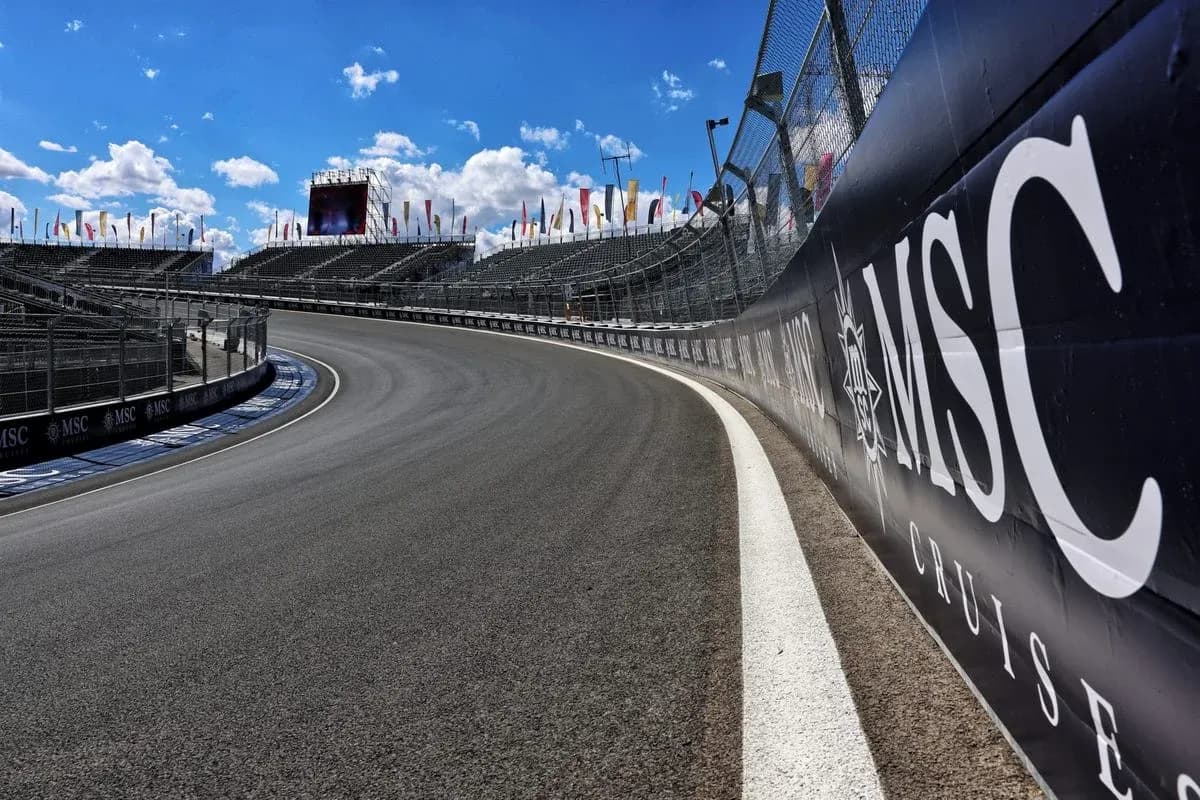
The vast, 550-metre banked corner has dominated every conversation since the first drawings leaked out. Now the asphalt is down, the barriers are in, and the scale of it is startling. Grandstands stack high above the banking, hospitality towers loom on the inside, and the whole thing feels less like a corner and more like an arena.
It’s got that amphitheatre vibe, the kind you get on the start-finish straight at Interlagos when the crowd is on its feet. Only here, the action will be pinned to a single, sweeping curve.
Teams, drivers and Pirelli have all circled La Monumental as one of the most technically demanding corners of the season. The big unknown now is the racing line. If multiple grooves open up across the banking, this could become the place where races are won, lost and ripped apart in a single, committed move.
Trouble lurking at Turn 5
La Monumental may grab the headlines, but it might not be the corner that causes the most chaos.
The circuit is dotted with potential traps. Turn 17, a right-hander that follows a fast left sweep, will ask a lot of the cars under heavy braking. Any misjudgement there will be punished.
Yet the real flashpoint looks set to be the Turn 5/6 chicane.
It sits at the end of the quickest run on the circuit, the long, flowing blast from Turn 3. Drivers will arrive there fully loaded, then be forced to flick through a tight, awkward change of direction. F3 testing has already left its signature on the tarmac: black tyre arcs, scuffs and scrapes that mark where the limit lies.
The kerbs demand respect, but the real sting is the barrier angle on exit. It narrows the track, creating a pinch point just when drivers are trying to get back on the throttle. Get greedy, and there’s nowhere to go. That’s where mistakes turn into broken suspensions and safety cars.
Smooth surface, sharp edges
Street circuits often mean bumps, patches and compromises. Madring breaks that trend.
A lap on foot reveals a surface that looks and feels silky. The freshly laid asphalt is uniform, with no obvious ripples or surprise compressions. Teams shouldn’t have to crank ride heights skyward just to keep the floors in one piece.
The walls do most of the work in defining track limits, hemming the cars in around large parts of the lap. Where the concrete steps back, painted kerbs take over, nudging drivers away from the grey areas.
To make the boundaries crystal clear, the FIA has brought in the now-familiar painted rib lines seen at Jeddah, Miami and Austin. They’re subtle, but they give drivers a visual cue: step beyond this, and the white line – and your lap time – is gone.
So the surface is kind. The margins are not.
A paddock on a different scale
If the track is dramatic, the paddock is just plain outrageous.
Dropped into the IFEMA exhibition complex, the F1 operation has been stretched, split and reimagined. The garages don’t form the usual neat, continuous row. Instead, there’s a 150-metre void in the middle between Williams and Racing Bulls, filled by the media and TV pen.
Behind the garages, the layout gets even more unconventional. Trucks and engineering offices are scattered according to the quirks of the exhibition halls. Some teams operate from cool, air-conditioned buildings. Others, including McLaren and Mercedes, work outside in the heat, their set-ups exposed to the elements.
The result is a paddock where the usual neighbours are suddenly distant. The short stroll between Williams and Racing Bulls that exists at most tracks now takes more than two minutes. For teams and media alike, simply navigating the place has become an unexpected part of the weekend’s workload.
A punishingly long pitlane
Strategy calls will carry extra weight here, because the pitlane is a monster.
The official distance between the pitlane speed limiter lines is 562 metres – one of the longest runs of controlled speed on the calendar. And that’s not the end of it. The exit drags on, then funnels cars towards a right-hand concrete barrier before they merge back onto the racing line at the exit of Turn 3.
It’s a tricky blend point. Drivers will be accelerating hard, eyes flicking between their mirrors, the barrier and the cars already at full speed on the racing line. Any misjudgement there could be costly.
Pirelli reckons a stop will cost around 25 seconds, the blow softened slightly by the fact that the pitlane doesn’t rejoin at Turn 1 but further along at Turn 3. Even so, that’s a big chunk of time. Teams will think twice before gambling on an extra stop.
Madring, then, isn’t just another new dot on the F1 map. It’s a bold, complex stage built to test the drivers, stretch the engineers and give the fans a show. Now the question is simple: when the lights go out, who will tame the amphitheatre, and who will be thrown to the walls?