.svg&w=384&q=75 "logo")
The Madring: F1's New Circuit Brings Challenges in Madrid
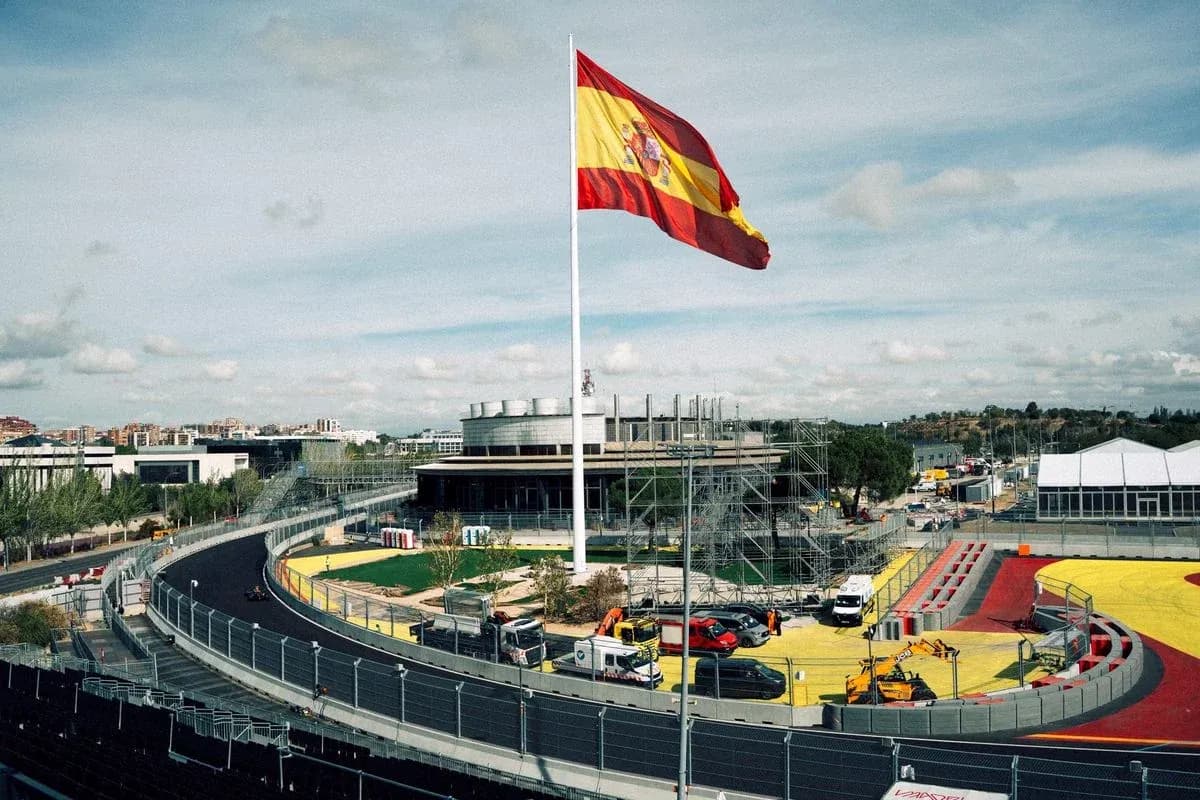
Formula 1 rolls into Madrid this weekend with a new circuit, a new skyline, and one very old-school problem: walls, kerbs and corners that do not forgive.
The Madring, hosting the Spanish Grand Prix for the first time, has already earned a brutal nickname in the paddock. “A track that kills cars,” warned Williams team principal James Vowles after watching junior drivers try to tame it. That wasn’t hyperbole.
During a two-day Formula 3 test, there were 19 red flags. Three broken chassis. A long list of smashed suspensions. And a lot of uneasy glances from F1 engineers now counting the cost of every mistake under the looming 2026 cost cap.
A Street Circuit With Teeth
Drivers who’ve sampled the place describe a Frankenstein’s monster of a layout: a slice of Monaco, a dash of Macau, a hint of Jeddah. High walls. No runoff. Rhythm constantly broken by chicanes that punish even a half-hearted lift of the throttle.
“It’s a track that kills cars,” Vowles told Spanish outlet Sport, summing up the mood among the teams who watched their F3 counterparts burn through parts at an alarming rate. Some of those F3 outfits were distinctly unimpressed at having to test there. The repair bills told their own story.
Yet the test did exactly what the organisers wanted. It served as a live shakedown for F1’s Madrid debut, a pre-emptive strike to avoid a Las Vegas-style embarrassment where loose drain covers wrecked Carlos Sainz’s Ferrari and shredded the timetable.
This time, the warning signs are clear before the main act arrives.
You Have to Push – Or You’re Nowhere
On paper, the Madring starts gently enough: a slow-speed opening chicane, reminiscent of Jeddah’s fiddly first sector. But that’s where the generosity ends.
From there, the lap explodes into a flat-out run through Turns 3 and 4, and straight into the first real trap: a high-speed chicane that became a scrapyard for F3 machinery.
Audi-backed F3 championship leader Freddie Slater, who left the test both impressed and bruised, broke down the challenge.
“The corners that are there, they're so tight and they're not forgiving and also the walls come at you on the exit of the corners,” he told The Race. “They don't go away from you like most tracks.”
You don’t drive away from danger at the Madring. You drive along the edge of it.
“You have to push otherwise you're slow,” Slater said. “So I think that's why it creates so many crashes because if you don't push you're just not on the limit.”
He still loved it. Called it one of the best tracks on the calendar. Old-school. Macau vibes. A proper finale venue for the F3 title fight. That’s the contradiction at the heart of Madrid: the very things that make it thrilling are the things that make it terrifying for teams and accountants.
That second chicane, the first major danger zone, is the essence of the circuit. High-speed entry. Walls closing in on exit. Kerbs that bite instead of yield. Get it slightly wrong and the trajectory is simple: head-first into the wall.
It’s an even nastier cousin of the old Singapore Sling, stripped of its gimmicks and left only with consequences.
To make matters worse, the approach is one of only two “straight mode” zones on the lap. Drivers will arrive at around 340km/h (211mph). Any failure there – like the straight-line issues that struck Max Verstappen’s Red Bull earlier this season – doesn’t bear thinking about.
Survive that, and the lap doesn’t exhale. It dives under an underpass and climbs into another sequence that claimed more F3 victims.
La Monumental: Spectacle With a Hidden Sting
The showpiece is La Monumental, a colossal 24% banked corner that makes Zandvoort’s banking look modest. But as F3 drivers quickly discovered, the real traps lurk just before it.
A tight chicane, then a rapid right-left through Turns 10 and 11. Easy to misjudge. Hard to perfect. And if you miss the rhythm there, you’re thrown into La Monumental off-line and out of sync.
Pirelli’s chief engineer Simone Berra has already circled it in red. He called it “the most severe turn” on the calendar. Compared to Zandvoort, he estimates La Monumental will load tyres with 20–30% more energy. That’s enormous in modern F1 terms.
Unlike Zandvoort’s power-limited banking, this one is grip-limited. The tyres and suspension do the heavy lifting. The exit is completely blind. Drivers lean on faith and feel, not sight.
Slater’s verdict?
“It feels like I'm in an IndyCar [on an oval],” he said. In F3, it’s “just about flat”. In F2 and F1, that calculation becomes far more delicate.
He also flagged a nasty quirk: where the crest runs, the cars can bottom out badly. From the outside, La Monumental looks like a hero corner. On the inside, it’s a technical minefield.
And remember, that’s only halfway round the lap.
No Room to Breathe
From there, the Madring keeps squeezing. Tight right-handers like Turn 17 offer no respite. Drivers barely get a moment to reset.
Monza F3 sprint race winner Taito Kato summed up the basic equation: “If you want to gain laptime, you have to push until you’re close to the wall, so it’s risky but fun to drive.”
Conservative driving doesn’t work here. You’re either on the edge or off the pace.
That’s why the spread of red flags in F3 worries F1 teams. The accidents weren’t clustered in one obvious black spot. They were scattered across the lap. There isn’t a single corner to tiptoe through. There are many.
For teams managing tight development budgets and part allocations, the prospect of a car-killing weekend is more than a sporting risk. It’s a financial one.
Dangerous – Or Just Demanding?
By the time the paddock reached Monza, the Madring was already a hot topic on the drivers’ parade.
Carlos Sainz, Madrid’s local hero and an ambassador for the grand prix, admitted “everyone seemed quite shocked by the track that Madrid has come up with”. Shocked, he stressed, in a positive sense: F1 has added a circuit with real character, not another anonymous street layout built around hospitality suites and long straights.
He’s fully aware of its F3 reputation, yet still cautious about stamping the same label on F1. What he does expect, though, is chaos in short bursts. “We are all expecting safety cars, red flags and yellow flags in qualifying,” he said.
Audi F1 driver Gabriel Bortoleto called it “a very interesting track, dangerous track, but at the same time very challenging and it's nice to race in a new track like that.”
Sergio Perez, who knows all about high-speed walls from Jeddah, downplayed the danger slightly. “I don't think it's any more dangerous than Jeddah, to be honest,” he said.
That’s not exactly reassuring. Jeddah has already produced some huge shunts, including Mick Schumacher’s violent qualifying crash in 2022 that destroyed his Haas and ruled him out of the race.
So “not any more dangerous than Jeddah” still leaves plenty of room for the Madring to chew through cars.
On the flip side, the layout is technical, busy and filled with low-speed sections where drivers can make the difference. Red Bull junior Arvid Lindblad called it “a real drivers’ track”, and the paddock expects a wild qualifying session, margins sliced to nothing, and the potential for an upset.
That’s Saturday.
Will the Race Deliver?
The fear is simple: edge-of-the-seat qualifying, follow-the-leader grand prix.
With so many tight corners, very few proper straights and almost no heavy braking zones, the obvious passing spots are thin on the ground. The lap offers plenty of energy-recovery opportunities, which should help keep battery deployment manageable, but tactically it points toward a more processional style of race. Think Hungary, not Monza, Silverstone or Spa.
Alex Albon didn’t bother dressing it up. “I don’t think there’s going to be any overtaking,” he joked. “I hope you guys got your fix in [Monza] and ignore next weekend.”
Safety cars and red flags could shake things up, of course. They usually do on tight walls-and-concrete tracks. And this weekend, F2 and F3 will pound around the Madring for five races before the main event, with F3 deciding its championship. That alone raises the odds of incidents, debris and a rapidly evolving track surface.
There’s a precedent. When F1 first raced in Baku in 2016, GP2 – F2’s predecessor – had one of its wildest weekends ever. Seventeen retirements across two races. Multiple accidents. Chaos.
The F1 drivers saw it all and dialled down the risk. The grand prix that followed was surprisingly dull. The fireworks in Baku only came in later years, once drivers trusted the walls and understood the limits.
Sainz remembers it well. “The grand prix was boring, right? Yeah, I remember. I was there in 2016 in Baku,” he said. “I think F1 drivers, we tend to be a bit more disciplined in these things.”
He pointed to the responsibility they carry: thousands of people at the factory, parts constraints, the reality that F1 cars are faster and, in the wrong hands, easier to crash. Discipline becomes a survival instinct.
He also highlighted the role drivers can play in shaping the circuit as the weekend unfolds. Even after FP1, he believes they could flag problem kerbs or sections to the race director and the FIA, helping them tweak details that might otherwise trigger needless accidents.
A Circuit on Trial
It feels almost inevitable that someone will be caught out this weekend. There simply aren’t many corners where you can get it wrong and walk away with just a flat-spotted tyre and a bruised ego.
Sainz has urged his colleagues not to rush to a verdict. He wants a “good debrief” after the race, a clear-eyed look at what worked and what didn’t.
He’s open about the possibility that Madrid might produce “a bit too much” chaos. He expects some elements to “go greatly, and other things that don’t go as well.”
He’s seen this movie before. Miami’s debut in 2022 was, in his words, “a bit of a disaster”. Yet the event has since settled into a much more polished and competitive grand prix. Madrid, he argues, deserves the same patience.
Patience, though, is not something modern F1 calendars are built on. With cities queuing up to host races and governments ready to bankroll showpiece events, every new venue feels like it’s on trial from day one – even with a 10-year contract in its back pocket.
The Madring has one big card to play: personality. Its car-killing kerbs, blind exits and old-school walls give it a distinctive identity in a championship that sometimes threatens to blur into a series of similar street layouts.
Qualifying should be spectacular. The question that really matters now is whether Sunday in Madrid can match the promise of Saturday – or whether F1’s newest “car killer” will prove too sharp for its own good.