.svg&w=384&q=75 "logo")
LeBron James' Custom 32in Canyon Grizl CF Bike
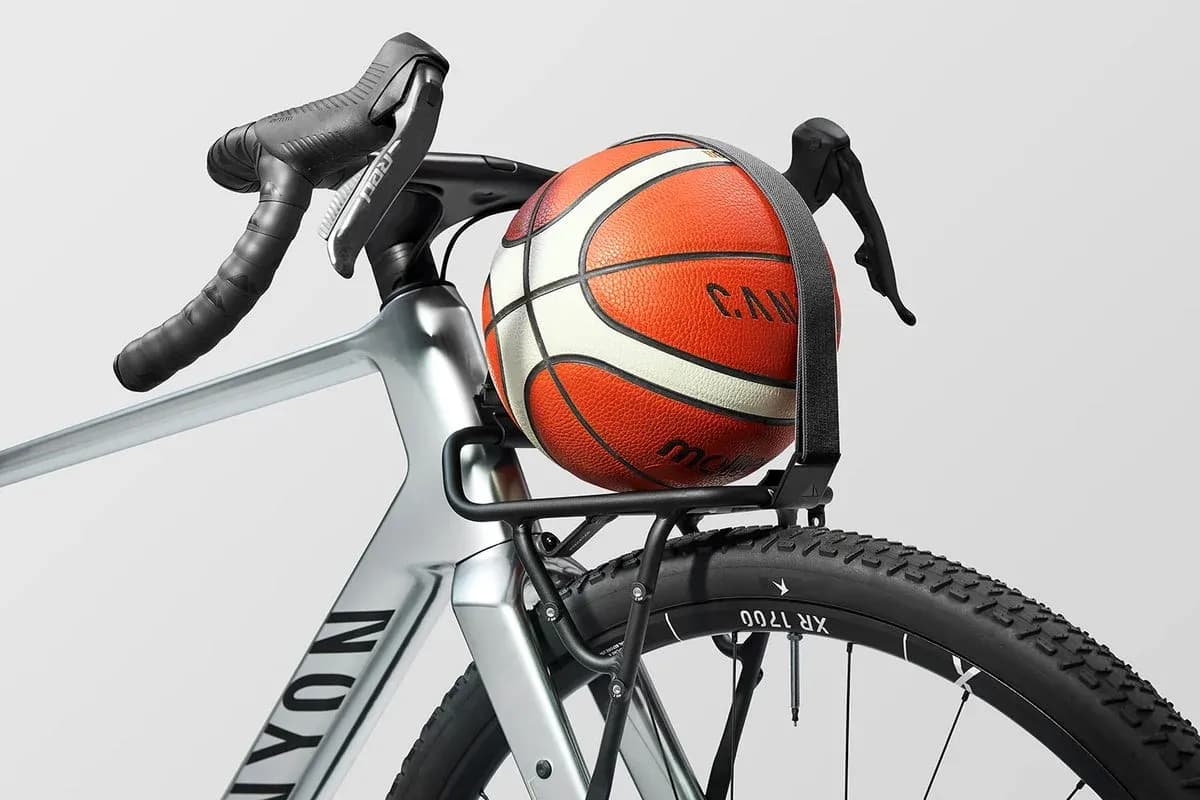
LeBron James gets a one-off Canyon Grizl CF with towering 32in wheels – and a whole lot of re-engineering behind it.
This isn’t a case of a brand slapping a superstar’s name on a stock frame. Canyon’s gravel lead engineer, Wolfgang Kohl, and his team in southern Germany had to start almost from scratch to build a bike that could properly carry – and respond to – a 6ft 9in NBA body.
They didn’t just stretch a Grizl. They rebuilt it.
Built for LeBron, from the carbon up
Kohl is blunt about the challenge. You can scale the geometry, but the forces don’t grow in neat proportion. Make a regular frame bigger and it might fit on paper, but it won’t ride like a Canyon.
So the 3XL Grizl CF for James gets its own special carbon layup, tuned to handle the loads he puts through the bike while still feeling alive under power. The frame is only part of the story. Custom CNC‑machined thru-axles with wider Boost spacing hold the oversized 32in wheels in place, and a bespoke seat clamp ties the giant package together.
Those wheels are the headline. At 32in, they dwarf the standard gravel setup, promising huge rollover capability and stability that should suit taller riders perfectly. Schwalbe’s prototype 32in G-One RX tyres wrap the rims, hinting at where the tyre market is heading next.
Canyon insists this machine is a “one of a kind”. It’s fully functional, but not a quiet teaser for an imminent product launch, at least not officially.
The 32in experiment gathers pace
If that line sounds familiar, it’s because we’ve heard it before.
Scott turned heads with its own 32in bikes, which Robin Gemperle rode to victory at the 2026 Unbound XL and Cameron Jones piloted over the 200-mile Unbound course. Those bikes proved their worth in the Kansas gravel, yet Scott still labelled them “pure prototypes” and shut the door on a retail version.
BMC followed a similar path. Its riders raced a 32in prototype at the Andorran round of the XC World Cup in July 2025. The message afterwards? No plans to bring a 32in bike to market.
So the pattern is clear. Big brands are playing with the concept at the sharp end of competition and in the custom lab, but they’re not ready to throw open the doors to the public. The commitment so far has come from smaller, bespoke outfits willing to bet on a radical wheel size before the mainstream follows.
Yet the tide is starting to turn.
Schwalbe, one of the sport’s major tyre players, said in January it is “fully convinced” by 32in and will release production tyres next year. Its faith is already rolling under James on those G-One RX prototypes.
Merida is moving too. Stephan Seitz confirmed in March that the company is developing both gravel and cross-country mountain bikes around 32in wheels. He went further, predicting that by next spring this size will be the performance standard.
If that timeline holds, today’s one-offs and “never for sale” prototypes could look more like early access than dead ends.
The perfect test pilot
Right now, though, the rider best placed to cash in on this wave is LeBron James.
For years, he’s had to work around bikes that never quite matched his frame. Even the biggest production sizes left him conscious of the compromises – where the fit wasn’t quite right, where he had to adapt his position rather than let the bike disappear beneath him.
On this Grizl, that feeling has finally gone.
“On most bikes I've ridden, I was aware of the bike, where it didn't fit me, what I was working around,” James says. “This is the first one that I didn't have to think about. That's what I love most about riding. It's just you out there and everything else is gone.”
That’s the point of all the engineering: not a talking point for social media, but a bike that lets a 6ft 9in rider forget about the hardware and focus on the ride.
For now, Canyon calls it a one-off. The big brands still describe 32in as an experiment. Tyre makers and a few bold voices say it’s the future.
If LeBron’s custom Grizl is any indication, the next standard for tall riders might already be rolling. The real question is how long the industry can keep calling this size a prototype once the rest of the peloton starts asking for the same thing.