.svg&w=384&q=75 "logo")
Lando Norris Claims Unexpected Pole Position in Barcelona
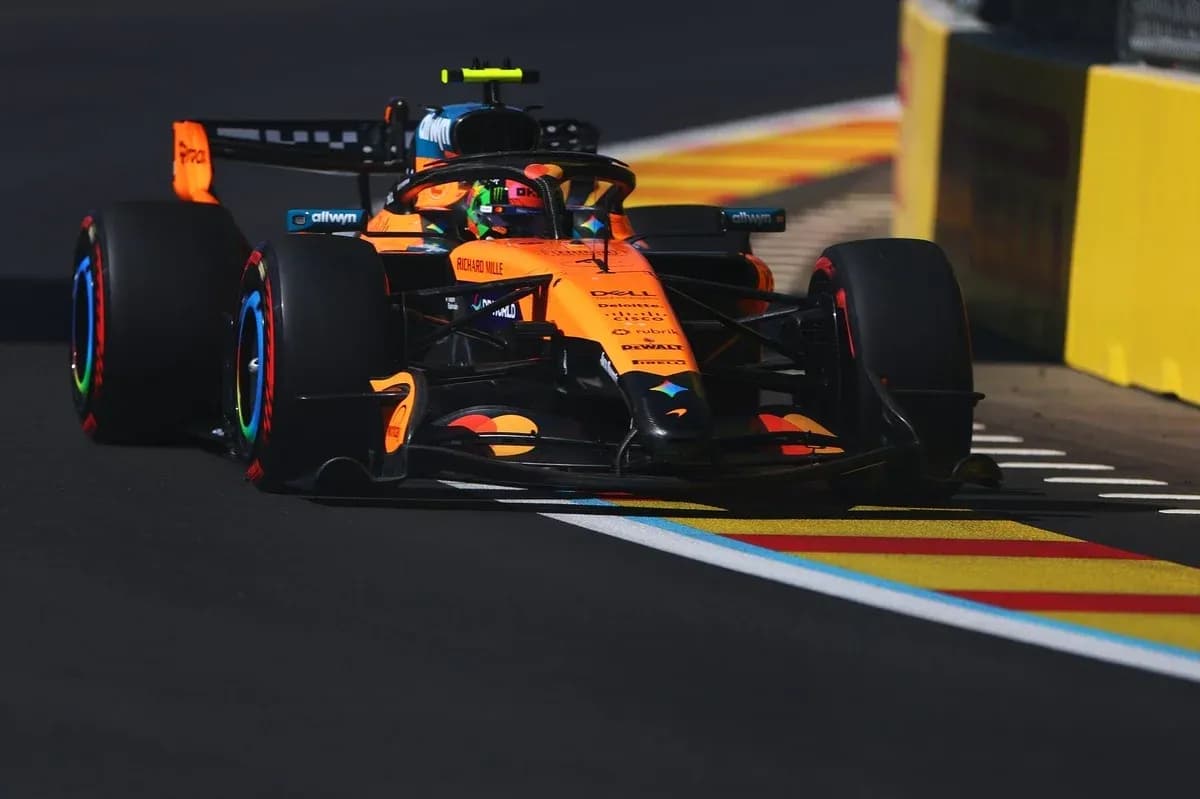
Lando Norris climbed out of the McLaren in Barcelona thinking he’d blown it.
“Sorry, I fucked up man,” he told race engineer Will Joseph over the radio, convinced that a wild snap of oversteer at the final corner had ruined his best shot at pole. When Joseph urged him to wait for the times to come in, Norris doubled down on himself: “Fucking idiot.”
Minutes later, he was on pole position for the Spanish Grand Prix by 0.011s. A lap that began as a near miss ended up being described by his team principal as a masterpiece.
A pole nobody saw coming
All weekend, McLaren had been lurking rather than leading. Mercedes set the tone in every practice session, Ferrari sat in close attendance, and Red Bull hovered as the usual threat. McLaren? A couple of tenths shy, every time the stopwatch mattered.
Q1 and Q2 told the same story. The Silver Arrows trading blows with Red Bull at the top, Ferrari in the frame, McLaren nibbling at the back of that group but never quite biting. On raw evidence, Norris and Oscar Piastri were outsiders for pole, not favourites.
Then came Q3, and the lap that tore up the script.
Norris’s first run left him only sixth, 0.446s behind Lewis Hamilton’s benchmark. Nothing in that opening attempt hinted at what was coming. The McLaren looked solid, not spectacular. The deficit felt too big, the competition too sharp.
On the second run, Norris found 0.701s. Not a tweak. Not a tidy little gain. A transformation.
It was just enough to edge ahead of Kimi Antonelli, who had looked untouchable, by the slimmest of margins: eleven thousandths of a second.
“One of the most impressive laps”
Andrea Stella has watched telemetry for 450 grands prix. That’s a lot of laps, a lot of data, a lot of drivers at the edge. This one, he said, stood apart.
“That’s a masterpiece,” the McLaren boss told his team, before expanding on just how unlikely this pole really was.
“We were not honestly performing to the level of scoring a pole position,” he admitted. “At no stage during the weekend we demonstrated that the car was performing at the level of being the best car. We were lacking quite significantly in the first sector, low-speed [corners] and kerbing, and for the drivers it was a very difficult car to nail a lap.”
McLaren had seen flashes of potential. Nothing sustained. Nothing that looked like a full, flawless qualifying lap. Piastri’s result underlined that reality: seventh on the grid, 0.470s slower than Norris in identical machinery.
So where did this come from?
Stella pointed at the details. The kind of details that don’t leap off a timing screen but jump out when you stare at the traces.
“The thing that makes the lap unique, when you look especially at the telemetry, is the precision, the braking, the speed you carry in entry, the striking of the kerb, the going on power. Everything is executed with a pretty unique level of precision.
“For me, that's if anything the main attribute that I would associate to this lap: just incredible precision in the metre-by-metre execution.”
In other words, this wasn’t a scruffy, heroic save of a lap that had gone wrong. It was a near-perfect attack, with one glaring, human moment at the end.
The mistake that almost cost everything
Norris himself thought that moment had wrecked everything.
“By the last corner, I just had a bit of a, I don’t know, a little moment,” he said. “I think I got a bit excited in the car and I just overpushed the entry and, honestly, I thought I was in the wall. So, yeah, luckily a short run to Turn 1.
“But the lap really was just perfect, from good exits, good kerbs, just getting all the little things that are very important around here correct. And I did that only on my last lap and it all worked out.”
Joseph’s message over the radio summed it up neatly: “It wasn’t your best final corner, but it’s still pole, so well done.” Norris needed a few beats to accept he wasn’t being wound up.
Stella later put numbers on that final-corner drama. McLaren’s analysis suggested Norris lost “three-and-a-half tenths in the last quarter” of the lap. In a session decided by 0.011s, that’s an enormous chunk of time.
The irony? Without that error, this would not just have been pole. It would have been a dominant one.
“The most impressive thing is the fact that it's a pole position despite having lost three-and-a-half tenths in the last quarter, which means that it would have been a pretty convincing pole position without this issue,” Stella said.
The mistake, he argued, was the natural consequence of the ferocity of the rest of the lap.
“He just paid the price of the fact that the lap was coming, like, one second faster than any other lap, therefore there was quite a lot more that was extracted from the tyres,” Stella explained. “I mean, the tyres were tired and somehow Lando did not take this into account and he entered the corner with the same impetus that he had in some other corners.
“He oversteered in entry, and this means that he loses completely the racing line, and like I said, he lost more than three tenths. It's nothing calculated; if anything, he's not taking enough into account that the tyres were tired.
“I don't think he knew [he was going to be in trouble]. I think he just was in attacking mode, but it was a bit too much for what the tyres had left.”
Precision, risk, and a new ceiling
Strip away the radio drama and the self-criticism, and the story of Norris’s pole in Spain is simple: a driver trusted his feel, ignored the weekend’s form book, and delivered a lap his car had no right to produce on paper.
McLaren’s weaknesses in low-speed corners and over kerbs remained. The car didn’t suddenly turn into the class of the field. Norris simply threaded it through the demands of Barcelona with a level of accuracy that stunned even his own engineers, and then almost threw it away by refusing to back off at the last corner.
That blend of precision and risk is what separates a tidy qualifying lap from a pole lap. On this occasion, the risk very nearly tipped into disaster. Instead, it carved out one of the standout single laps of the season.
If this is the standard Norris can hit when everything comes together, the real question isn’t how he found 0.701s in one run.
It’s how often he can reach that level again in a title fight that’s only getting tighter.