.svg&w=384&q=75 "logo")
Kimi Antonelli's Rise: A Verstappen-Like Charge in F1
Kimi Antonelli is starting to look alarmingly familiar.
The way he slices through a field, the way his pace hardens rather than fades as the laps tick by, even the flaw that still nags at his profile—it all echoes the early years of his friend Max Verstappen. There is, for now, one crucial difference. But at Monza, that gap felt smaller than ever.
A Verstappen-style charge from nowhere
Winning a Grand Prix from 19th on the grid used to be Verstappen territory. His trademark. Start at the back, shrug, win anyway.
Antonelli just did the same thing in Italy.
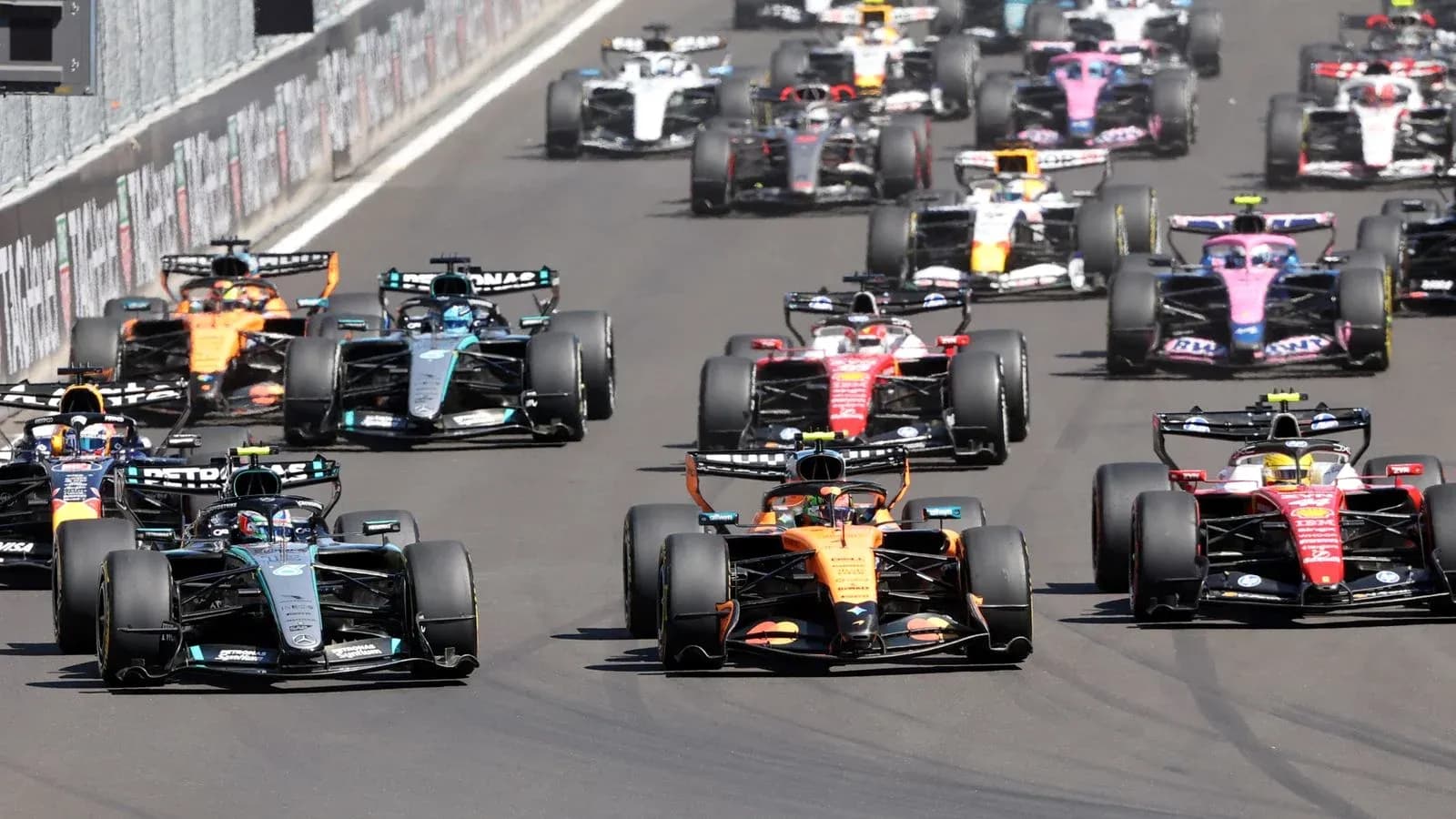
From P19, he tore through the pack with a calm brutality that looked eerily familiar. He was ruthless in traffic, decisive in his moves, and within what felt like moments he was among the leaders. The red flag and restart helped his cause, yes, but nobody leaving Monza truly believed that without that interruption the result would have been different. The Italian GP looked destined to be his.
For George Russell, it was a nightmare in broad daylight.
At the end of 2025, Russell spoke like a man on the brink of a title run. The performances in 2026 have torn that belief to shreds. Against Antonelli, he has looked less like a future world champion and more like the kind of compliant number two usually cast opposite Verstappen—think Sergio Perez, think Valtteri Bottas. This was the sort of afternoon you simply would not associate with Lewis Hamilton or Verstappen in their primes. They do not get dismantled like this by the driver in the other garage.
That says plenty about Russell. It says even more about the teenager alongside him.
A 19-year-old dismantling a “future champion”
This is only Antonelli’s second season in Formula 1. He is still just 19. Yet he is systematically taking apart a teammate who, not long ago, many believed could anchor a title project.
The dynamic is uncomfortably reminiscent of Daniel Ricciardo’s final days at Red Bull. Ricciardo saw what Verstappen was becoming and chose not to stick around to be the benchmark that got broken. Russell does not have that escape hatch. After holding the upper hand for much of 2025, he has been overwhelmed in 2026.
Race day is where the gulf yawns widest.
Strip out the Belgian GP, where Russell retired early, and look at the remaining 12 races. On pure race pace, Antonelli has been quicker than Russell in 10 of them. Only in China and Austria did Russell have the edge, and even then the margin was tiny—less than a tenth of a second on both occasions.
Across those 12 Grands Prix, the average tells the real story: Antonelli has been 0.380 seconds per lap faster than his teammate on Sundays. Over a stint, over a race distance, that is enormous.
That kind of profile in a second year on the grid places him in rare company. It is Verstappen, it is Fernando Alonso. When Hamilton and Sebastian Vettel arrived, their first calling card was explosive one-lap speed. Verstappen’s gift was different: he bent the race to his will. Antonelli is cut from that cloth.
The Saturday weakness that still lingers
Just like Verstappen in his early seasons, Antonelli’s weak spot lies on Saturdays.
Verstappen needed time alongside Carlos Sainz and Ricciardo before he started dominating both qualifying and races from 2018 onwards. Antonelli is in that earlier phase. Over a single lap, Russell still represents his biggest threat.
The numbers underline it. Antonelli leads their qualifying head-to-head 7–6. He has been the quicker of the two more often, and that shows up in the average gap as well, but only just. His mean advantage is 0.093 seconds—nothing like the chasm he opens on race day.
So the pattern is clear: on Saturdays, Russell can live with him. On Sundays, he cannot.
Where Verstappen still stands alone
There are two major caveats to any direct comparison.
The first is obvious. Verstappen owns multiple world titles and a stack of wins. He has been operating at this ferocious level for years. Antonelli is only now piecing together his first sustained campaign at the front. He still has to show he can carry this standard all the way through a season, under pressure, with a target on his back.
The second is more subtle, and more important.
Verstappen’s wheel-to-wheel racing is the gold standard. His judgement in combat—when to commit, when to wait, where to place the car—is unmatched. Even at Monza, his edge came not just from pace but from the way he attacked and defended when it mattered. That ability to put himself in positions no one else can reach is what separates him.
Antonelli does not have that yet.
At times, his racecraft in direct duels can look untidy. Against Russell at Monza, he ran off the track in a way you almost never see from Verstappen. Earlier this season, Charles Leclerc openly criticised his wheel-to-wheel work. Those are not small warnings at this level.
The flip side is that Antonelli is learning quickly. The rough edges are being sanded down, week by week, while the raw pace remains.
What is beyond doubt now is that Antonelli is a special talent. His race pace is imperious, his Sunday performances increasingly suffocating for those around him, and the Verstappen parallels no longer feel lazy. A first world title, in only his second year, already looks less like a dream and more like an expectation.
Verstappen is still the benchmark. But for the first time in years, there is a 19-year-old in the paddock who looks capable—given equal machinery—of making his life genuinely difficult.