.svg&w=384&q=75 "logo")
Kimi Antonelli: Italy's New Racing Sensation in Silver
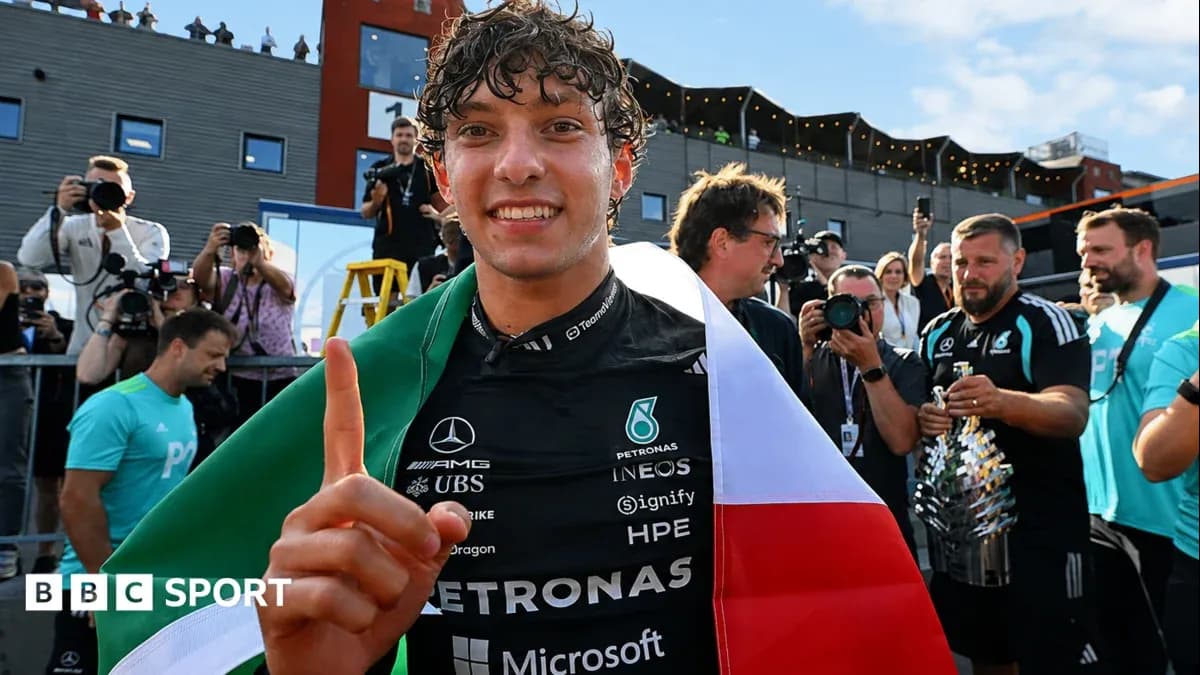
At Monza, faith usually wears red.
The banners, the flares, the songs rolling down from the grandstands – all of it orbits around Ferrari, the team that, in Italy, sits somewhere between sporting institution and state religion. Yet this weekend, as the Italian Grand Prix crackles into life, the country’s most compelling racing story is dressed in silver.
Kimi Antonelli, 19 years, seven months and four days old when he took the championship lead with victory in Japan in March, has not let it go since. Six wins, a 59-point cushion, and a season that has him on course to become the youngest world champion Formula 1 has ever seen.
There is just one problem for the tifosi: he drives for Mercedes.
A nation in love with red, flirting with silver
Walk through the Monza fanzone and the conflict is written on shirts and scarves. Alessandro is soaked in Ferrari red. His girlfriend, Emma, stands next to him in Mercedes silver.
“Of course, I am a little bit of a Ferrarista because I'm Italian. But honestly, I love Kimi, I support him,” she says, voicing a dilemma repeated all over the circuit.
For generations, the script has been simple. Ferrari wins, Italy rejoices. When a Ferrari driver takes a title, the bells ring in Maranello, the spiritual home of the Scuderia. Streets fill, church bells peal, strangers hug. Kimi Raikkonen’s 2007 crown – the last Ferrari world title – still lives in the collective memory like a national holiday.
But an Italian world champion? That belongs to another era. Alberto Ascari, back-to-back titles in 1952 and 1953, is a black-and-white photograph, not a living reference point. For most Italians, the idea of seeing a driver draped in il Tricolore on the final day of a season has been fantasy.
Antonelli has cracked that dream open.
A generational talent, raised in silver
The numbers tell the story of why Italy is so captivated. Youngest-ever championship leader. Youngest pole-sitter. Youngest winner in China. Youngest winner of the Monaco Grand Prix. A season built on relentless speed and startling composure, punctured only by an engine failure in Barcelona, a low-key 15th at Silverstone, and now a grid penalty at Monza that drops him to the back for Sunday’s race.
His rise has been no accident. Mercedes signed him to their junior programme at 11. After a single season in Formula 2, Toto Wolff tore up the usual apprenticeship, promoting him into the seat vacated by Lewis Hamilton for 2025. The seven-time champion heads to Ferrari in a blockbuster move; Antonelli is the teenager expected to anchor Mercedes’ future.
The path has not been smooth. His first taste of F1 last year was brutal: a bruising European run with four retirements, only three points, and a final position of seventh in the championship. Two years ago, in his first practice at Monza, he stuck the car in the wall. On the radio, Wolff came back instantly: “All good, Kimi. All good.”
That tone has defined the relationship. Protection, patience, a long-term view.
“I think Kimi is in the right place at the moment,” says Giulia Toninelli of La Gazzetta dello Sport. “Mercedes is a family he has known for a long time, one that has nurtured him as a driver and given him a level of protection that would be impossible for him to have at Ferrari right now.”
Davide Valsecchi, 2012 GP2 champion and now a familiar F1 voice, agrees that distance from home helps.
“Sometimes in Italy, we lack a bit of patience,” he says. “We just push for you when you are strong and then underline with red pen every time as soon as you make little mistakes. For this reason, as a rookie, it is better to be away and to be on another side, and then come to Ferrari only when you are a big man with already a championship and a complete driver.”
Right now, Antonelli is writing that first chapter. If he finishes the job this year, he will beat Sebastian Vettel’s record as the youngest world champion. Vettel was 23 years and 134 days old in 2010. Antonelli would be three years younger.
Old loyalties, new hero
Inside Italy, that prospect is reshaping fandom.
“Antonelli is disrupting the traditional rules of fandom in Italy,” Toninelli says. His “strong personality” has struck a chord, especially with younger fans, and “the fact that he is racing for Mercedes matters very little to them.”
In the grandstands, the split is visible and vocal. Daniele, at Monza with his sons Tommaso and Demis, does not hesitate.
“We support Hamilton and Leclerc – we support Ferrari,” he says. Young Demis, still loyal to the Scuderia, quietly admits Antonelli is “really good”.
Thomas, Monza-born and raised, gestures high above his head when asked to rank his allegiances.
“I'm happy for Kimi, of course. But I'm not supporting him like Ferrari, because Ferrari is up there.”
Yet even among the hardcore, there is little resentment.
“It would be very nice to have an Italian driver in Italian colours winning races and championships,” says Adrian Hussain of the Scuderia Ferrari Club Silverstone. “Everybody within the club, certainly in our group chats, everyone's supportive of Kimi winning races. There's no animosity towards him.”
Marco Melandri, five-time MotoGP race winner and now co-host of the Chiacchiere da Box podcast with Valsecchi, sees the same internal tug-of-war.
“I think Kimi is living the dream, even of the Italian fans,” Melandri says. “But in Italy, a lot of people are very close to Ferrari, they are pushing for Ferrari. So sometimes they are fighting themselves to understand, to choose who is their favourite driver. But I think Kimi is doing something amazing.”
Valsecchi calls it “a big surprise for everyone” to see an Italian, this young, leading the championship and looking so mentally strong. “At the moment, everything is perfect for us,” he says.
Leclerc, Hamilton and the shifting Ferrari narrative
While Antonelli surges, Ferrari’s own story is more complicated.
Charles Leclerc, fluent in Italian and emotionally welded to the team since 2019, has become the Scuderia’s adopted son. Two wins at Monza, a new long-term contract, and an open declaration that bringing titles back to Maranello is what drives him.
He is, as Antonelli joked in Belgium when asked whether he or Jannik Sinner is more famous in Italy, “probably the most famous man in Italy right now”.
Yet the numbers nag. Nine wins in 162 grands prix for Ferrari. Near-misses, strategy missteps, and now the arrival of Hamilton, whose presence naturally invites comparison.
“I start to see, after many years, for the first time, some fans start to say, maybe he's not as strong as we think before,” Melandri observes. “Because Hamilton is doing better than him, and Antonelli is doing much better with another car.”
That is the crux for many tifosi. Ferrari remains untouchable as an idea. Its drivers, less so. If an Italian teenager in a Mercedes is outscoring the men in red, old certainties begin to wobble.
Melandri, though, can already picture a future where those worlds collide.
“It should be a dream to see Antonelli get a victory in Ferrari in the future. That's for sure,” he says.
A title bid from the back of the grid
On paper, this weekend should belong to Ferrari. Antonelli’s grid penalty for a new power unit dumps him at the back. Leclerc and Hamilton have clear track, home support, and a car capable of delivering a one-two.
Yet the championship context refuses to fade. Antonelli’s lead has swollen and shrunk in recent rounds, but a win in Belgium and podiums in Hungary and Zandvoort have rebuilt his buffer over team-mate George Russell and Hamilton, who sit level on 183 points behind him.
A recovery drive into the top three from the rear at Monza, against that backdrop, would carry the weight of a statement. A Ferrari one-two, with Antonelli climbing through the field to join them on the podium, feels like the result that could keep everyone happy.
“Of course, sharing the podium with a Ferrari would make it even more special, but regardless of that, he will have the full support of his fans,” Toninelli says. “Part of the Italian audience may indeed favour Ferrari over Kimi, while another section may feel the opposite, but that won't stop the Italian celebration at Monza, which will bring both fanbases together.”
This is the paradox of Italy’s new racing age. The Temple of Speed still worships Ferrari. The bells in Maranello still wait for red. Yet somewhere between the Curva Grande and the Parabolica, an Italian in silver is forcing a nation to ask itself a question it has not faced for more than 70 years:
When the title is on the line, what matters more – the colour of the car, or the flag on the podium?