.svg&w=384&q=75 "logo")
Jaylen Brown's Emotional Farewell to Boston: A Love Letter to the City
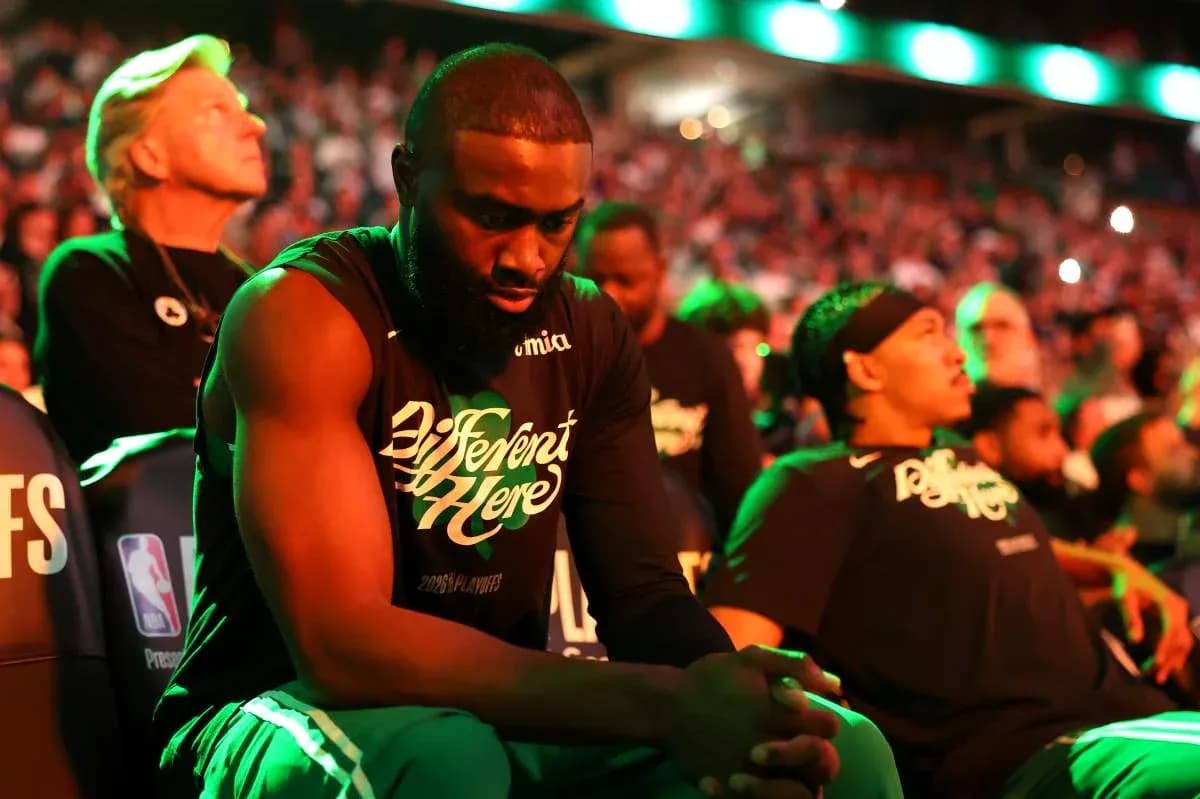
Jaylen Brown came back to Boston on Sunday without the green jersey, without the parquet beneath his feet, without the roar that usually follows a made three or a chasedown block.
He got something else instead.
He got a goodbye.
A Love Letter on the Common
On the Boston Common, near the Charles Street entrance, thousands gathered for “741 Frequency Fest: A Love Letter to Boston Block Party,” a free, all-ages event that looked on paper like a brand activation and felt in reality like a chapter closing.
Music thumped across the lawn. Kids lined up for carnival games and back-to-school giveaways. Merch from Brown’s 741 brand moved through the crowd. It could have been any late-summer festival.
Then someone lifted a replica Larry O’Brien Trophy above the sea of people, and the afternoon snapped into focus.
That trophy, the one Brown helped bring back to Boston in 2024, hovered over the crowd like a reminder: this wasn’t just about a player leaving town. This was about a champion coming back to say thank you.
When Brown finally took the microphone, the five-time All-Star who has stared down playoff pressure for a decade needed a moment.
“Listen, I’m at a loss for words,” he told the crowd. “When I got to the city, I said I’m going to go to war for this city.”
He had. Ten seasons of it.
A Career Cut, a Connection Intact
The emotional weight of the day came from how abruptly the basketball part ended.
In July, Boston traded Brown to the Philadelphia 76ers for Paul George, two first-round picks and two second-rounders. The deal broke up his nine-year partnership with Jayson Tatum and sent a franchise cornerstone to one of the Celtics’ oldest rivals.
The move blindsided him. At his introductory press conference in Philadelphia, Brown admitted he threw his phone across the room when he got the news. He made no secret of the fact that leaving Boston was not his choice. He has spent roughly a third of his life in this city and wanted to remain a Celtic.
Sunday gave him something the transaction never did: control over the goodbye.
“I’m seeing all these people out here, and honestly, I love each and every one of y’all,” he said. “I appreciate y’all for coming.”
He thanked those who had backed his community work, those who pushed him, those who stayed with him through shooting slumps, playoff heartbreaks and everything in between. Then he aimed his words squarely at the place that shaped him.
“I just want to say thank you to Boston. Thank you to the city.”
No qualifiers. No caveats. Just gratitude.
From Question Mark to Finals MVP
When the Celtics took Brown with the No. 3 pick in the 2016 NBA draft, he arrived as a 19-year-old with questions hanging over him. Could he shoot well enough? Handle the ball? Contribute to a contender that was already trying to climb back to the top?
He answered all of it.
Across 10 seasons, Brown evolved from raw athlete to complete star. He leaves Boston as an NBA champion, a Finals MVP and a five-time All-Star. During his time in green, the Celtics piled up more combined regular-season and playoff wins than any other franchise in the league. With Brown as a constant, they reached the Eastern Conference Finals seven times and the NBA Finals twice.
The defining stretch came in 2024. Brown took home Eastern Conference Finals MVP and then NBA Finals MVP as Boston claimed its record 18th championship. The doubts from draft night felt a lifetime away.
His imprint, though, was never limited to TD Garden.
Beyond the Garden
Brown invested himself in Boston’s underserved neighborhoods as deeply as he invested in the Celtics’ playbook. He launched initiatives aimed at education and economic inequality, and he used his platform to push the city to confront its racial history rather than skirt around it.
His Bridge Program connected Black and Latino students with opportunities in science, technology and entrepreneurship, opening doors that had long felt bolted shut.
That is why Sunday did not feel like a standard farewell appearance, a quick speech and a wave before the moving trucks arrive. It felt like the end of a shared project, a community acknowledging someone who had been more than just a leading scorer.
The festival started as a block party. It turned into a final, public handshake between a star and a city that grew up together.
The Next Time He’s Back
Brown will return to Boston soon enough, but the setting will be very different.
Next season, he will walk into TD Garden wearing a 76ers uniform, flanked by LeBron James, Joel Embiid, Tyrese Maxey and VJ Edgecombe on a Philadelphia team built to come straight at the Celtics’ throne in the East.
There will be boos. There will be cheers. There will be tension every time he touches the ball, every time he switches onto Tatum, every time that 2024 banner hanging in the rafters catches his eye.
That night will be about rivalry and repercussions, about what Boston gave up and what Philadelphia gained.
Sunday was not.
On the Common, there was no score to settle, no public airing of grievances, no attempt to relitigate the trade. Brown could have leaned into the sting of being moved after delivering a title. He chose something else.
He chose to stand in front of the people who watched him arrive as a teenager and leave as a champion, and he chose to say thank you.
The Celtics ended Jaylen Brown’s Boston career with a phone call and a trade package.
He ended it with a block party, a love letter, and a city that lifted a trophy replica to remind him what they built together.