.svg&w=384&q=75 "logo")
Hewett & Reid Reclaim US Open Doubles Title and Hewett Reaches Singles Final
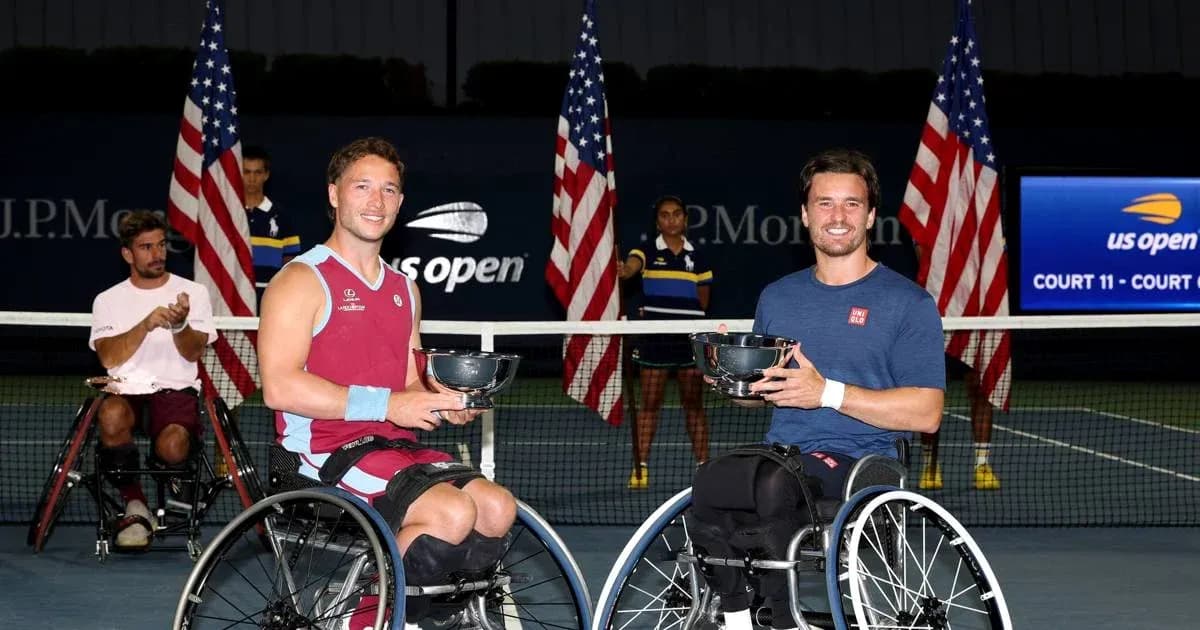
Alfie Hewett and Gordon Reid dug themselves out of a deep hole to reclaim the US Open men’s wheelchair doubles crown, then watched Hewett stride into yet another singles final on a landmark day for British wheelchair tennis in New York.
Hewett & Reid’s great escape
For a sixth time in Flushing Meadows, the most decorated partnership in the sport found a way. The scoreline – 2-6, 6-3, 10-7 over 2025 Wimbledon champions Martin de la Puente and Ruben Spaargaren – only hints at the trouble they were in.
They started sharply, racing to a 2-0 lead, then suddenly lost their grip. Seven games in a row went the way of De la Puente and Spaargaren. From apparent control to a set down and a break behind, their bid for a third Grand Slam doubles title of the season looked to be slipping away.
That is usually the point when champions show their teeth.
From a set and a break down, the world No.1 pairing wrestled back the initiative, reeling off the last four games of the second set. The pressure, the occasion, the familiarity of these courts – it all began to tilt towards the British duo again.
In the deciding match tie-break, they stepped on the gas. The second half of the breaker belonged to Hewett and Reid, who tightened their returns, took the ball earlier, and forced errors from the Wimbledon winners to close out a comeback that felt as much about history as it did about the night.
For Hewett, this was a first US Open doubles title since 2021 and Grand Slam doubles crown No.26, all of them alongside Reid. He made no secret of what it meant, calling it something they had been “desperate and highly motivated for” and promising there is “plenty more doubles to play in the future” with his long-time partner.
Reid, now a seven-time US Open doubles champion with 30 major doubles titles to his name, reflected on a partnership that has stretched over 13 years and, as he put it, still has “a few more years left in us”. Under the lights, with a vocal crowd packed in, it felt like a celebration of a team that has defined an era.
It also arrived in the 50th anniversary year of wheelchair tennis, a point Hewett underlined as he looked around at the stands and spoke of how far the sport has come. On this evidence, it is still surging forward.
Hewett cruises into singles final
There was barely time to draw breath before Hewett’s singles campaign took centre stage.
Chasing a fifth US Open singles title, he booked his place in a remarkable eighth final in nine New York appearances after leading 2025 runner-up Gustavo Fernandez 6-0, 3-0 when the Argentine was forced to retire.
Hewett had come out blazing, smothering Fernandez with aggressive returning and relentless depth. The one-sided scoreline at the moment of retirement underlined the control he had established before the match came to a premature end.
Waiting for him on Sunday is top seed Tokito Oda of Japan, the latest chapter in a growing rivalry that has started to shape the men’s game. A seasoned champion against the new standard-bearer: the stage is set.
Knoesen headlines a new wave
The day also belonged to the next generation.
Matthew Knoesen added his name to a fast-growing list of British success stories in junior wheelchair tennis, becoming the third Brit since 2022 to lift the US Open boys’ singles title.
The Kent player dominated Australian Sonny Renison 6-0, 6-2 in the final, dictating from the baseline and never loosening his grip on the match. Confidence intact, he then returned to court and left with a second trophy.
Partnering Japan’s Hirofumi Inoue, Knoesen swept to the boys’ doubles title as well, dismantling fellow Brit Will Barton and Italy’s Lorenzo Politano 6-1, 6-0. It was ruthless, efficient, and loud in its message: the production line is working.
On a night when Hewett and Reid reminded everyone they are still the benchmark, Britain’s juniors offered a glimpse of what might come next. With Oda waiting in the men’s final and a new crop already collecting silverware, the question now is not whether the bar will be raised again, but who will be the first to clear it.