.svg&w=384&q=75 "logo")
Harry Kane: The Striker Redefining Modern Football
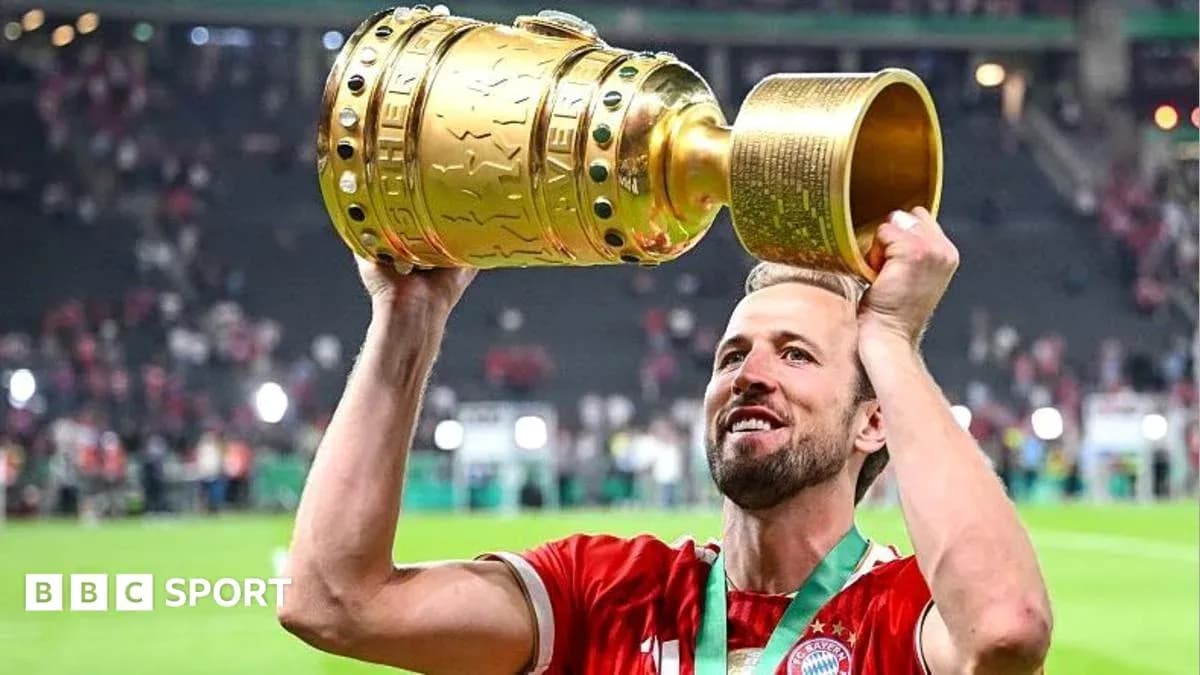
Harry Kane has never been more dangerous. Or more distant from goal.
At 33, England’s record scorer now spends as much time patrolling his own penalty area as he does the opposition’s. The old logic says a striker should live between the posts, high up the pitch, waiting for service. Kane just produced the most prolific season of his career – 73 goals for club and country – while drifting deeper than ever.
Mention that contradiction and he smiles.
"Until you really understand football and understand what we've been talking about, it's so easy to say 'stay high, you're going to score' but it doesn't work like that," he says.
This is the version of Kane that Bayern Munich bought and England lean on: centre-forward, playmaker, tempo-setter, problem-solver. A nine, a 10 and, on some days, a six.
The striker who looks like a coach
Watch him before a session and the evolution is obvious. Kane is one of the first out on the pitch. The younger players are juggling balls and laughing. He stands a little apart, talking with a member of staff, scanning, listening. From a distance he could be mistaken for a coach.
On the pitch, that’s almost what he is.
His style mirrors the person those around him describe: rounded, humble, obsessed with the details. The past year has brought a flood of goals, but there is no sign of him settling into that comfort. With just five days of pre-season in his legs, he played the full 90 minutes of Bayern’s 2-1 win over Borussia Dortmund to lift the German Super Cup, covering ground like a midfielder, finishing like a No 9.
The numbers behind that workload are startling. Over the past six seasons, STATSports – the sports technology company he has invested in – tracked an 8% rise in his distance covered, a 22% jump in high-speed running and a 42% increase in accelerations. At an age when many forwards trim their game down, Kane has widened his.
That spike hasn’t come in a vacuum. The game has changed around him.
"Over the last five or six years, man-to-man pressure has become bigger," he says. "European football is physical and top teams are trying to win the ball back high, trusting their defenders and midfielders to defend man for man to win their battles."
Top sides have responded by recruiting sprinters and dribblers who can beat their marker when the game fractures into duels. Kane is not that archetype. He is, by his own admission, "not the fastest" and no one would confuse him with a touchline winger.
He has thrived anyway. On his own terms.
Beating opponents with the brain, not the feet
Against Dortmund, one moment captured the modern Kane in miniature.
He dropped deep, far from the penalty area, looking to arrive in space unmarked. Two Dortmund players immediately converged. This is where most strikers try to wriggle away with a flurry of touches. Kane went another route.
His dribbling is cerebral. He gets low, plants himself, uses his strength to shrug centre-back Waldemar Anton off. Then comes the detail that separates him: a slight rise, a tiny twist of the body to the right. These micro-adjustments are a trademark. With them he can tilt the whole pitch.
Daniel Svensson and Jobe Bellingham bite on the feint, their weight shifting the wrong way. Kane snaps the ball back across himself, suddenly opening the entire field from inside Bayern’s half. One movement, three opponents taken out of the game, the attack re-drawn on his terms.
Bayern manager Vincent Kompany has described Kane’s role as half-coached, half-instinct. The structure is there, the rest is his.
"I think it's partly instinct, using my football brain and getting the feeling on the pitch," Kane says. "If, for example, I want to drop and see if the centre-back really wants to commit, he might commit into midfield, but is he going to commit if I drop all the way to my box?
"After the first five or 10 minutes you really get an understanding of how the opposition are going to play, which dictates how I play."
That reading of the game underpins Bayern’s rotations. To the naked eye, players seem to swap positions at random. Inside the system, there is a clear map. Kane, with more licence than almost anyone, sits at the centre of it.
A No 9 who thinks like a No 10
"I feel like my position now is as one of two 10s, and you work together," he says. "You can double up on one side to overload, which causes the opposition centre-backs a problem of who to mark.
"If they want to mark both, they've got to go man-to-man and then that leaves space for our wingers or full-backs to run into.
"It's posing all these questions to the opposition but, personally, I love having someone close to me who I can link with."
For a player who built his reputation as a lone striker, that self-description is striking. The old Kane was the spearhead, the single reference point. The new one is part of a front two, but often behaves like a playmaker.
"When you're the number nine on your own you can get marked by two centre-backs and you struggle to get touches on the ball," he says. "You're relying on everyone else to find you with the ball."
Show him the clips and the thinking comes alive.
In one sequence from last season, Luis Diaz occupies one of those No 10 slots. Kane pulls off the front line, dragging attention with him.
"The thing with our formation is, as long as there's someone in each position, it doesn't really matter who it is. Lucho [Luis Diaz] in this clip is playing as one of those 10s.
"I've come off to try and create a bit of space and Lucho's gone through the centre."
One opposition midfielder takes the bait, stepping towards Kane. The gap opens. Joshua Kimmich drives a pass through to Diaz. Ahead of them, Serge Gnabry sprints in behind, stretching the back line.
"I think it's Serge making the run in behind which takes the defenders back, which allows me and Lucho that space in between," Kane says. "Lucho lays it off and whenever I'm in that position, around 20-25 yards out, I'm always looking if I can get my shot off."
It is a pattern that keeps repeating: Kane drops deep, shapes the move, then reappears on the end of it.
"By playing deep when the play develops, I end up coming into a number 10 spot when everyone's dropped," he says. "I can get shots off from the edge of the box, which is a big strength of mine, or I'm running off the back of players where no-one's picking me up – because the midfielder finds it hard to [track]."
The runs you don’t see
The second clip he breaks down comes from Bayern’s Champions League tie against Club Brugge. This time, Kane is not even the one finishing the move.
Usually he is tracked by a centre-back. Brugge switch it up, handing that job to their holding midfielder. Kane spots it quickly and goes to work.
Lennart Karl scores without Kane touching the ball, yet the striker’s fingerprints are all over the goal.
"These are the little runs, again, not everyone sees," Kane explains. "With Jamal Musiala and Lenny, they're so good at receiving the ball and dribbling so there'll be times where I will actually stay higher and let those guys get on the ball a bit deeper, and I'll try and make runs in behind."
"Without changing my game too much, I try and complement the players around me.
"I know Lenny is so good in those pockets and when he gets there, I'm more thinking of running in behind because, one, he can play me in and I can go through on goal, or two, he can dribble with the ball and do exactly what happened here.
"As soon as Lenny gets in that pocket I make the run and not always to get the ball, sometimes it is just to drag the defender away.
"Now he's one-against-one with a centre-back in the middle of the pitch and that's dangerous for any centre-back."
This is the other side of the 73-goal headline. The decoy movements. The manipulation of markers. The willingness to vacate the spotlight so others can step into it.
Beyond the numbers
With the Ballon d'Or announcement looming, Kane’s case will be framed around volume. Seventy-three goals in a season forces its way into any conversation. It puts him statistically alongside Cristiano Ronaldo, Lionel Messi and Erling Haaland.
Yet the raw count misses something essential. Kane is not just scoring at their rate; he is doing it while stitching together every phase of his team’s play.
He drops to receive like a deep midfielder. He creates and combines like a classic No 10. He finishes like a pure No 9. He has described himself as operating as a 10, a nine and a six, sometimes all in the same match.
In an era of hyper-specialised roles and rigid pressing schemes, that blend feels almost out of time. The modern game demands that players fit the system. Kane has become the rare forward who bends the system around his own intelligence.
The question now is not whether he can keep scoring from deep. It is how long defenders can keep pretending they know where, exactly, Harry Kane is supposed to be.