.svg&w=384&q=75 "logo")
Harriet Dart's Remarkable Comeback at the US Open
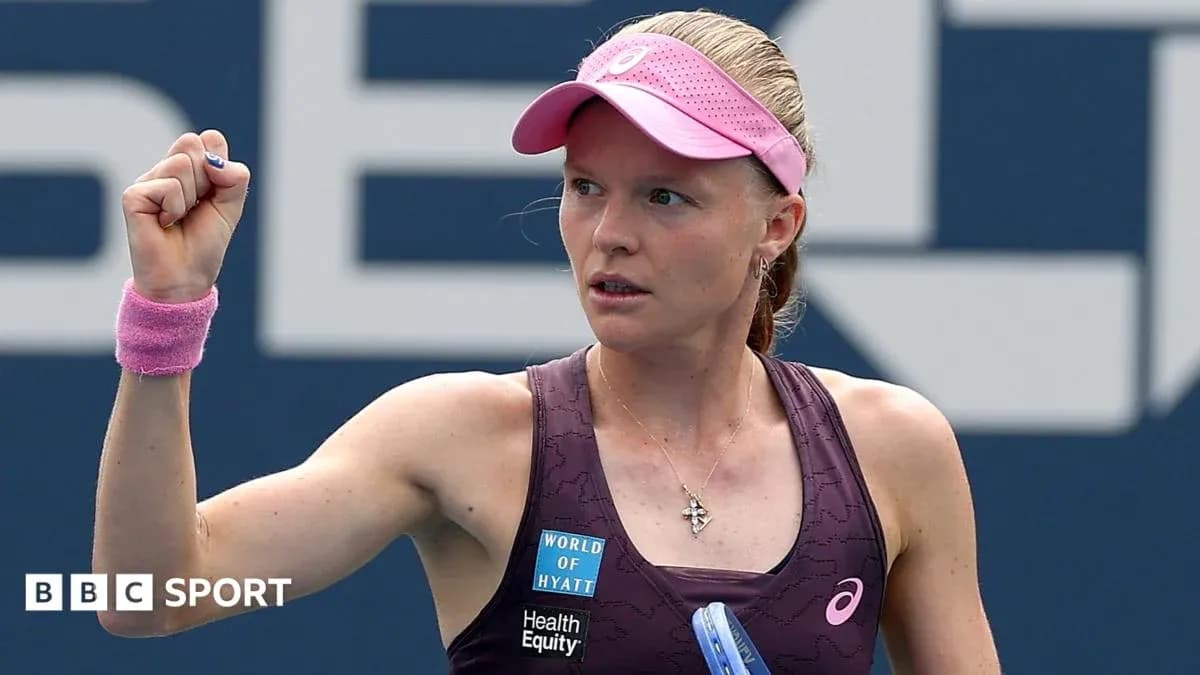
Harriet Dart finds her way home again – and this time it’s in New York.
Nineteen months after her last Grand Slam main-draw win, the Briton dug herself out of a deep hole at the US Open, overturning a set and a break deficit to beat American Peyton Stearns 3-6 6-3 6-2 and reach the second round.
It was a win built on stubbornness and noise. A lot of noise.
A comeback fuelled by “community”
On Court in Flushing Meadows, Dart’s “home away from home” sounded unmistakably like a corner of Britain. Her parents, uncle and a cluster of cousins roared for every point, every hold, every escape. When the final Stearns forehand drifted out and the match was finally hers after just under two and a half hours, Dart sprinted straight to them – and to the tight little team that has helped drag her career back on track.
At 30, and ranked 131 in the world, Dart has known too many early exits. She hadn’t won a main-draw singles match at a major since the 2025 Australian Open. Since then, four failed attempts to qualify for Grand Slams, two first-round defeats at Wimbledon despite wildcards, and a ranking that slipped while others surged.
New York has always felt different to her. This time it showed.
“My uncle and cousins live here, one of my cousins from the UK is over at the moment, my mum has been here since I started in qualifying, and my dad flew in last night,” she said. “New York always feels like a home away from home. It feels like a community for me and I really felt the support out there.”
Bartoli’s imprint and a harder edge
That “community” now includes a Grand Slam champion. Since January, Dart has been working with 2013 Wimbledon winner Marion Bartoli, and the Frenchwoman’s influence is starting to leave clear fingerprints on her game and mindset.
“From her experience, she knows what I'm going through, how I'm feeling, how the day starts, how it finishes – everything from the little things to the big things,” Dart explained. “To be able to soak up everything, all of her experience, and learn from her – I feel I'm learning so much every time we speak. I feel like I'm improving at a lot of things which motivates me.”
The recent results back that up: a run to the quarter-finals at July’s Challenger event in Vancouver, qualification for the Cincinnati Open in August, and now a gutsy win in New York over an opponent ranked more than 75 places above her.
Another long road at Flushing Meadows
Nothing about this US Open has been straightforward for Dart. She was taken to three sets in all three of her qualifying matches, twice coming back from losing the opening set – including against Kristina Penickova and fellow Brit Heather Watson.
Against Stearns, she took the scenic route again.
The match began with a warning of what might be coming. Dart carved out four break points in the opening game, set the tone with aggressive returning, but failed to convert any of them. Stearns escaped, settled, and then turned the screw on the Briton’s serve.
The American, feeding off the home crowd, hammered away at Dart’s delivery and finally broke in the eighth game. Dart couldn’t find a response and the first set slipped 6-3, with Stearns not offering another break chance.
When Dart was broken again in the first game of the second set, it looked bleak. Stearns was hitting freely, racking up winners, and Dart’s window seemed to be closing.
Then the match flipped.
Stearns’ aggression began to fray at the edges. The winners kept coming – 40 by the end – but the errors started to pour in behind them, 47 unforced in all. Dart, sensing the shift, tightened her margins, made more balls, asked more questions. She broke twice, dragged the American into longer rallies, and walked off with the second set 6-3.
Holding firm when it mattered
The decider became a test of nerve as much as ball-striking. Breaks were traded, three in a row at one stage, the match hanging on every service game. Midway through the third set, Dart finally imposed order.
She produced a vital hold in the sixth game to snap that run of breaks, a gritty stand that steadied everything – her own belief, the scoreboard, the crowd. From there, she seized control, reading Stearns’ increasingly erratic patterns and forcing the American to hit one big shot too many.
Dart needed four match points to close it, the tension obvious, but when she did, the celebration was instant and instinctive. Straight to her box, straight to the people who have ridden out the lean months with her.
This win does more than just end a 19-month Grand Slam drought. It puts Dart into the second round of the US Open, alongside compatriots Toby Samuel and Katie Boulter, and into a meeting with 25th seed Marie Bouzkova – a step up in class and another chance to test this new, hardened version of herself.
For a player who has spent the last year and a half on the outside looking in, that feels like the kind of opportunity you don’t let pass.