.svg&w=384&q=75 "logo")
Girls in Basketball: Breaking Barriers in Northern Nigeria
Abuja, Nigeria – In Kano State, the sound of a bouncing basketball was once a boys-only soundtrack. Girls watched from the sidelines, if they were there at all.
Khamila Sani Ibrahim refused to stay there.
As a child visiting her grandparents during school holidays, she learned to dribble around more than just defenders. She learned to navigate expectations.
“It is very hard for me to train in basketball,” she said. “I only go out to play when they are not around, or I tell them that I’m going to visit my friends, and from there I go to the court.”
In northern Nigeria, that kind of quiet negotiation is often the price of a girl’s place in sport. Basketball and football are widely seen as male territory. Courts are scarce, equipment scarcer, and coaching or funding for girls almost an afterthought. Competitive opportunities? Rarer still.
Yet a new generation is starting to carve out its own lane.
Building a court of their own
Grassroots To Greatness (G2G) is one of the reasons girls like Ibrahim now have somewhere to play, and something to play for.
Founded by youth sports advocate Jawahir Bello, the initiative set out to answer a basic question: if the talent is there, why aren’t the chances?
She saw the gap at local tournaments. Boys in full kits, structured teams, clear pathways. Girls, if they played at all, dropped into male squads where they were underestimated or ignored.
G2G flipped that script.
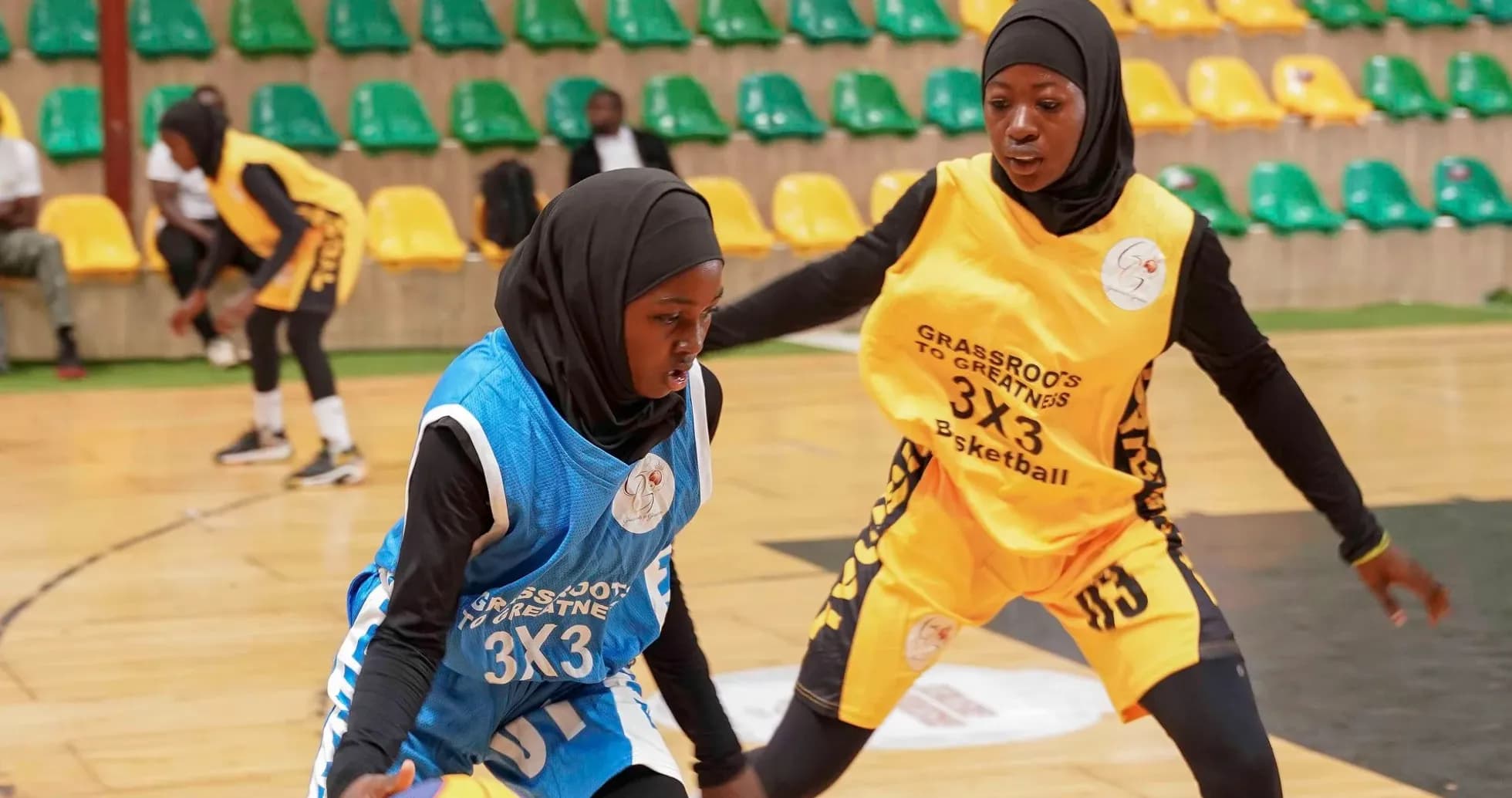
At its tournaments, the sight is striking: custom hijabs, long sports vests, athletic tights. Players fully covered, fully committed.
“Our core value is about participating in sports without doing anything that goes against our cultural values or our identity as Muslims,” Bello told Al Jazeera. “Whether you put on a hijab or innerwear under your jersey, modesty is key. You come out modest, decent and fully covered.”
Bello expected pushback when she launched female-only tournaments and community training sessions. She prepared for doors to close.
Instead, many opened.
Community stakeholders, often wary of girls’ sport, began to warm to a model that respected local norms while still giving girls real competition. G2G moved quickly, partnering with grassroots coaches already running community teams, using their trust and knowledge of the neighbourhoods to bring players in.
The result: girls who had never played beyond school courts suddenly found themselves part of something bigger.
Jerseys, hijabs, and a different kind of respect
When Ibrahim represented Kano State at a multi-state G2G tournament, she walked into a scene she had never experienced before: female players from up to nine different states, all there for the same reason, all given the same backing.
“What G2G did for us was incredible,” she said. “They provided jerseys, custom hijabs, basketballs, cover for our transport and even financial stipends for all the teams, regardless of who won or lost. It made us feel seen and valued.”
No scramble for borrowed kits. No playing in whatever shoes they could find. No sense that they were an afterthought.
For many, that alone was transformative.
In Abuja, 11-year-old schoolyard games were the starting point for another player, Fatima Diouf. She joined G2G to see how her skills measured up beyond her school team. The answer came quickly: the level was higher, the pressure sharper.
Her team missed out on the finals, but the experience stayed with her.
“I have learned a lot beyond just basketball. I learned teamwork, confidence, discipline and how to keep improving,” she said.
The scoreboard faded. The lessons did not.
The battles that start before tip-off
For Ibrahim, the challenge does not end when the whistle blows. It begins in the living room and the classroom.
She has had to push through the snide comments from male players who assume girls cannot keep up, the internal doubts that creep in when opportunities seem too few, and the daily juggle of training, domestic chores and schoolwork.
The reality for many girls in the region is that sport is something squeezed into the margins of the day, not something the day is built around.
That is where local coaches and community programmes step in.
Mansur Abdullahi, assistant coach of Nigeria’s U-20 women’s national football team, the Falconets, knows the gap between official structures and everyday reality.
“Official sports bodies have big structures, but local groups provide the actual trust and cultural understanding,” he said. “So it’s only through community-led initiatives that more professional teams will understand what’s acceptable for girls and boys and how to frame sports so it fits the existing values instead of clashing with them.”
The message is clear: federations may set the rules, but communities decide who gets to play.
Fathers in the stands, futures in sight
For all the resistance, minds are changing, sometimes one parent at a time.
Before G2G, Ibrahim’s father worried that competitive sport would clash with the family’s standards. The idea of his daughter travelling to tournaments, mixing in sporting circles, did not sit easily.
Then he went to watch her play.
He saw the hijabs, the long vests, the organised structure. He saw his daughter not just running up and down a court, but competing in an environment built around the values he recognised.
The doubts began to fall away. Support took their place.
With that backing, Ibrahim’s ambitions have grown bolder.
“I want to secure a college sports scholarship in the United States and eventually turn professional. More than that, I want other Muslim girls across northern Nigeria to see that sports build your health, strength, and confidence, and that nothing should hold you back from chasing your dreams,” she said.
Diouf’s horizons widened too. At the G2G tournament, she looked beyond the games in front of her and saw a network: coaches, organisers, stakeholders from different parts of the country. It allowed her to picture herself not just in Abuja, but on courts across Africa.
Keeping faith, keeping pace
For Bello and G2G, the aim is not simply to stage events and move on. The deeper goal is to redraw the mental map of what is possible for girls in sport in northern Nigeria.
Female-only tournaments are one part of that. Role models are another. The constant thread is a simple, firm message: you do not have to shed your identity to step onto a court.
“You can keep your identity, stay covered and still achieve something in life,” Bello said.
In a region where a girl once had to sneak out under the guise of visiting friends just to find a hoop and a ball, that statement is more than a slogan. It is a challenge.
The courts are still few. The obstacles are still real. But the next time a girl in Kano, Abuja or beyond picks up a basketball, she will know something her older sisters did not: there is a place waiting for her in the game, and it looks a lot more like home.