.svg&w=384&q=75 "logo")
FIFA Power Struggle Intensifies with $10 Million Payout Proposal
GENEVA — The battle for control of world football has moved from the shadows to the page.
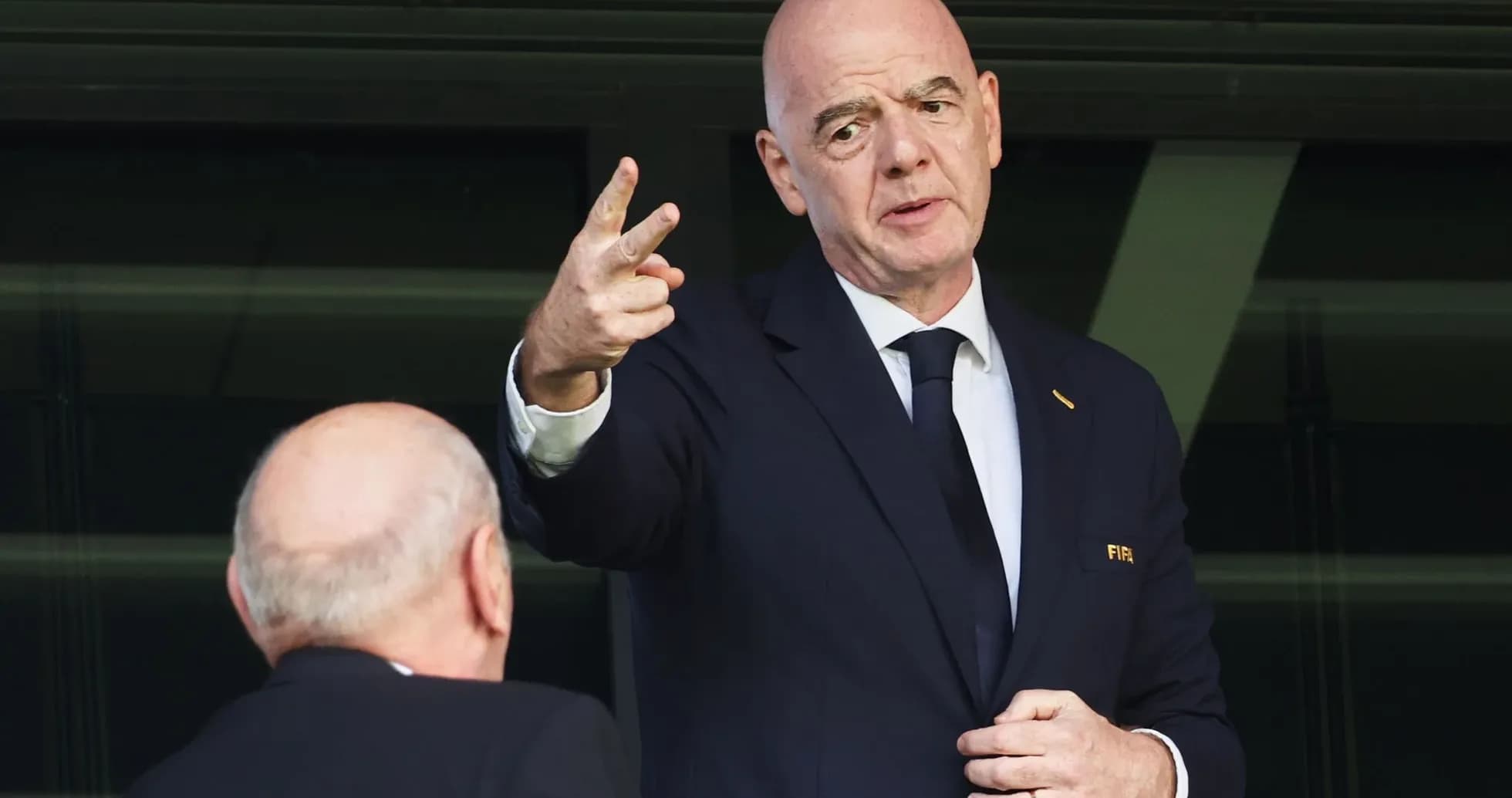
In a blunt letter to FIFA president Gianni Infantino, UEFA chief Aleksander Ceferin and CONCACAF president Victor Montagliani have called for every one of FIFA’s 211 member federations to receive an extra $10 million from the organization’s bulging reserves — and, at the same time, turned up the pressure to force Infantino out of office.
The timing is no accident. Nor is the number.
Cash on the table, power in play
According to the letter, seen by The Associated Press, FIFA’s coffers should stand at around $6 billion after a highly profitable World Cup in North America. Ceferin and Montagliani argue that level of reserves allows for a “one-off release” of $10 million per federation — a total of $2.1 billion — without jeopardizing the body’s financial stability.
Those same 211 federations will vote on FIFA’s next president in March.
Infantino had previously dangled a far bigger figure: $20 million per federation, tied to his now-abandoned plan to sell stakes in World Cup and commercial rights to a private equity vehicle led by Joshua Kushner. That project, dubbed FIFA Forward Enterprise (FFE), sparked a fierce backlash when it emerged in late July.
The new letter from Europe and North America is a direct counterpunch. The message is clear: the money can still flow, even if Infantino goes.
Infantino’s failed $20 billion bet
Infantino’s proposal centered on a $20 billion commercial spinoff, with Kushner’s investment firm at the heart of the deal. The plan was developed in secrecy and only came to light through media reports, igniting anger across several confederations.
UEFA and CONCACAF led the revolt. The Asian Football Confederation also voiced criticism in recent weeks. South America and Africa, by contrast, have largely lined up behind Infantino.
The fallout has been brutal for the FIFA president. After a World Cup in the U.S., Canada and Mexico that swelled FIFA’s revenues, he looked set to cruise to re-election next March in Rabat, Morocco, for a fourth and final term through 2031. No serious challenger was in sight.
Then the private equity storm hit. Now, even his grip on the ballot looks less certain.
A promise: more money, with or without Infantino
Ceferin and Montagliani’s letter does not stop at the $10 million proposal. They also underline that existing FIFA development commitments — $20 million for each federation through 2030 — “would continue in full as already committed.”
That line is designed for one audience: national associations wary of losing funding if they break with the incumbent president.
The two vice presidents have also demanded a “full and independent analysis” of FIFA’s finances before an October 15 meeting in Zurich. They want hard numbers on the table before any decision on how much money can be released to members.
FIFA was approached for comment.
Council showdown looming
The October gathering is no routine session. It will be the first meeting of the Infantino-chaired FIFA Council since the private equity plan surfaced. Ceferin and Montagliani will arrive as key power brokers, and they have already signaled their next move.
“Lastly, please note we will be informing the other four confederation presidents to support this motion,” they wrote.
That line opens a new front. Asia has already shown its displeasure with Infantino. South America and Africa, for now, remain in his camp. The Caribbean, traditionally a crucial bloc within CONCACAF, has been another battleground: Infantino traveled there last month to shore up support, despite Montagliani asking him not to visit.
The political map inside FIFA has rarely looked so fractured.
Election clock ticking
FIFA has set November 18 as the deadline for presidential candidates to declare. The vote will take place four months later in Rabat, a close ally of Infantino and a 2030 World Cup co-host alongside Spain and Portugal, both UEFA members.
Names have circulated for months in the corridors of power. Montagliani himself is regularly mentioned. So is Nasser al-Khelaifi, the Qatari president of Paris Saint-Germain, a member of UEFA’s executive committee and part of the Qatari government.
So far, neither has said publicly they intend to run. Infantino, meanwhile, still enjoys open backing from the Qatar Football Association and firm support from several confederations.
But the assumption that he will stand unopposed has evaporated.
UEFA takes the fight to U.S. courts
UEFA has gone beyond politics and into the legal arena. The European body has filed actions in courts in Manhattan and Florida, seeking authorization to obtain evidence from Kushner’s investment firm in New York and from FIFA itself regarding the FFE project.
It wants documents and communications linked to the $20 billion scheme. The stated goal: to assess a potential criminal complaint against Infantino in Switzerland, FIFA’s home country, for possible financial mismanagement.
If those documents surface, they could reshape not only the election campaign but the president’s future.
For now, the numbers are stark. $6 billion in reserves. $2.1 billion proposed as a one-off payout. $20 million already promised per federation through 2030. And one presidency suddenly in real jeopardy.
The next move belongs to FIFA’s members. Will they follow the money on offer from the man in charge, or the money promised by those trying to remove him?