.svg&w=384&q=75 "logo")
Ferrari F40: Lewis Hamilton's Dream Car Reborn
There are fast cars, beautiful cars, collectible cars. Then there is the Ferrari F40 – the one that makes Lewis Hamilton feel something.
Long before seven world titles, before the move that finally took him to Maranello, the F40 was the shape on his bedroom wall and the sound in his imagination. To him it wasn’t just a supercar; it was the distilled noise, history and emotion of the Ferrari badge he dreamed of racing for as a child.
A time capsule on four wheels
The F40 that eventually became Hamilton’s is not just any example. It is a 1991 car with a story that borders on the unbelievable.
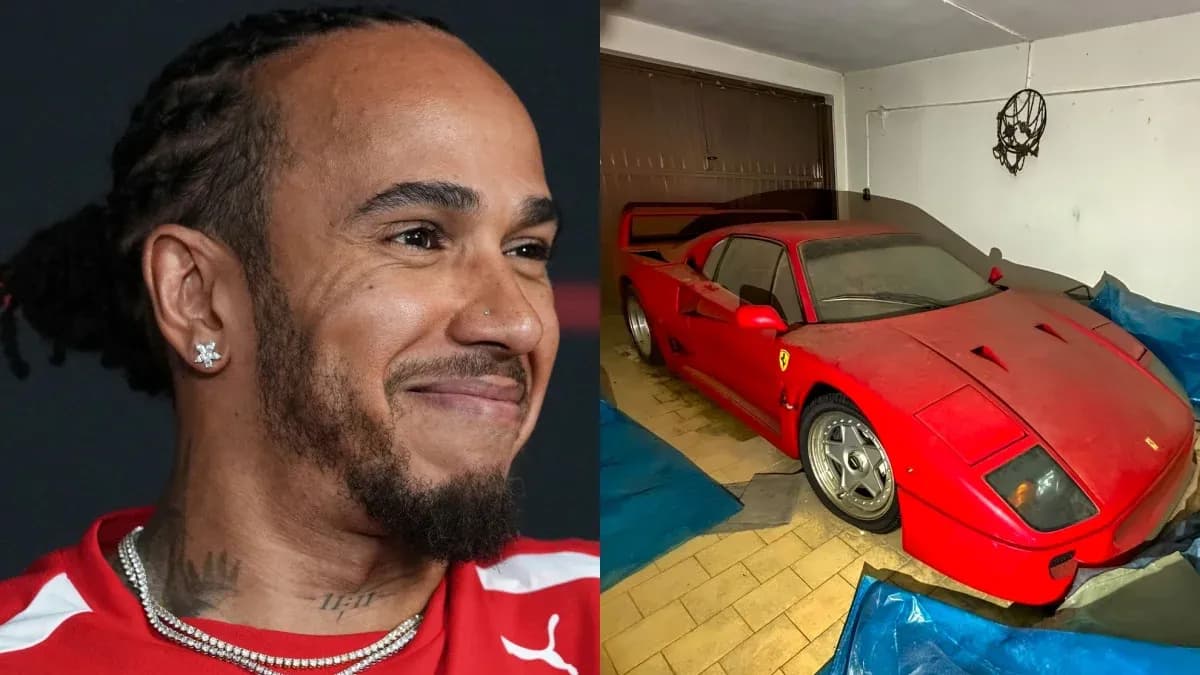
Tracked down in late 2025 by Azimut Automobile Heritage Enhancement, an investment fund that specializes in historically significant machinery, the car had effectively been frozen in time. Delivered new, rolled into a private garage within days and then left there. For roughly 35 years.
It still carried delivery mileage. No rebuilds. No modifications. No restoration. Not a single screw, according to those who inspected it, had ever been turned in anger.
Dust, dirt and dead insects had settled into the bodywork and grille over decades of silence, but the conditions had been kind. Beneath the grime, the original red paint and the car’s factory-fresh appearance had survived, intact and eerily untouched.
Azimut AHE secured the car first. Hamilton came next.
The one car he couldn’t let go
When Hamilton arrived for his first official day as a Ferrari driver in January 2025, he made one thing clear: this partnership was about more than a contract. For the photograph that announced his Ferrari era, he insisted an F40 be parked beside him. It was a visual statement of intent and of boyhood dreams finally aligning with reality.
Months later, he revealed he had sold off his vast, multimillion‑dollar car collection, saying his passion had shifted toward art. There was, however, one exception. The F40 stayed.
He didn’t just see it as a car. He called it a work of art in its own right.
Maranello brings it back to life
Once the deal for the 1991 time capsule was done, Hamilton sent the F40 back to where it truly belonged: Maranello.
Ferrari’s own engineers and mechanics took over. They carefully removed major components, including the engine, and set about the painstaking task of waking the car after three and a half dormant decades. This wasn’t a restomod or a reimagining. The mission was clear – make it safe, make it usable, and protect every ounce of originality that made the car so rare.
Week after week, they worked through it. Systems that had slept since the early 1990s were coaxed back to life. The car was not stripped and reborn; it was revived, with its history preserved in place.
When they finished, the F40 was no longer a museum piece trapped under dust. It was a running, breathing Ferrari again.
Hamilton, the F40 and the streets of Maranello
Now the car has finally been seen where it always seemed destined to be: on the streets of Maranello, with Lewis Hamilton at the wheel.
He eases the F40 along a narrow two‑way road, the car’s low, angular nose cutting through everyday traffic. A motorcyclist draws alongside, offers a brief greeting. Hamilton replies, calm and casual, then rolls on.
People begin to notice. Heads turn, phones rise, traffic slows. The red wedge is impossible to ignore. Hamilton can’t unleash its full fury there – no 200‑mph blasts, no long straights to let the twin turbos roar – but he doesn’t need to. The silhouette alone, that iconic rear wing and the raw, mechanical soundtrack of the F40, is enough to stop conversations mid‑sentence.
On that ordinary road, the car he once idolized has become the car that now carries him, in Ferrari red, through Ferrari’s own town.
The last Ferrari of Enzo’s era
The F40 carries weight far beyond nostalgia. Introduced in 1987 to mark Ferrari’s 40th anniversary, it became the final road car approved during Enzo Ferrari’s lifetime. That fact alone gives it a gravitas no successor can quite match.
Under its lightweight bodywork sits a 2.9‑liter twin‑turbocharged V8, sending 478 horsepower through a five‑speed manual gearbox. In period, Ferrari claimed a top speed of 201 mph – a headline figure that helped cement its legend as one of the defining supercars of its age.
Today, that same car, once sealed away in a private garage and forgotten by the world, now lives again in the hands of a driver who grew up worshipping it and now races for the badge on its nose.
For Hamilton, the F40 is no longer just a poster on the wall. It’s the loudest, clearest symbol that the boyhood dream of Ferrari has become his everyday reality.