.svg&w=384&q=75 "logo")
Elena Rybakina: A New Era in Women's Tennis
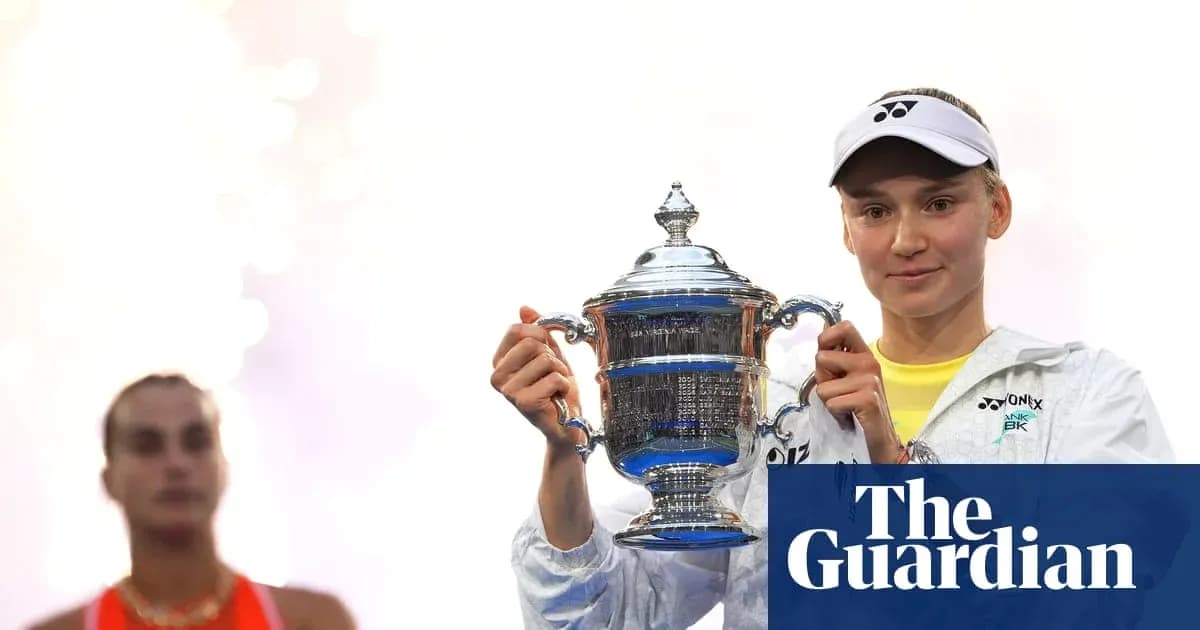
Elena Rybakina has spent years living in the shadows of her own brilliance. A Wimbledon champion, a major winner on multiple surfaces, a destroyer of serves and rallies alike – and yet always cast as the supporting act to the era’s headline names. The power was never in doubt. The consistency, the steel, the aura? Those, people said, belonged to others.
Not any more.
Rybakina walks out of New York as the undisputed No 1, both on the ranking list and in the imagination. She has taken Aryna Sabalenka’s top spot, taken her US Open crown, and taken control of the women’s game with a 6-4, 5-7, 6-2 victory that felt like a passing of the torch rather than just another final. On the biggest hard-court stage of them all, she backed up the numbers with nerve.
A title run built on grit, not just glamour
The tennis this fortnight was not always the liquid, effortless power that has defined her best runs. In truth, this US Open will be remembered as the most demanding mental campaign of Rybakina’s career.
An achilles injury left her unsure she would even make it to the start line, let alone the second week. She arrived in New York with doubts in her body and a calculator in her head, reminded daily of the exact results needed to strip Sabalenka of the No 1 ranking. Then came the draw: four consecutive opponents who had already won either a grand slam or an Olympic title in the second week alone.
Every time the stakes rose, she cleared the bar. Not with theatrics. With a cold, unwavering belief that this was her tournament to claim.
That furnace of pressure hardened her. By the time she stepped on to court for another showdown with Sabalenka, her biggest rival and the two-time defending champion, Rybakina carried herself like a player who knew she belonged at the very top of the sport – and intended to stay there.
A final that lived up to the billing
This was no ordinary championship match. It was only the second time in the 38 years since both the Australian Open and US Open moved to hard courts that the same two players had contested both finals in the same season. It was also a rare meeting of the top two players in the world with the No 1 ranking guaranteed to change hands by night’s end.
Every time Rybakina and Sabalenka share a major stage, the level spikes. This was their third grand slam final together, and once again they produced a contest that felt like the sport at full throttle.
They came out swinging. The pace was ferocious from the opening games, but one truth emerged quickly: the purity of Rybakina’s ball-striking cut through the noise. The surprise was where the problems lay. The best first serve in the women’s game – by numbers, by reputation, by fear factor – deserted her in the opening set. She landed just 27% of first serves, only eight of 30 attempts finding the box.
It should have been a disaster. It wasn’t.
With her biggest weapon misfiring, Rybakina simply leaned on the rest of her arsenal. She tore into Sabalenka’s serve with a savage, aggressive return, turned baseline rallies into target practice, and stitched together backhand after backhand with almost eerie precision. Sabalenka, usually the one dictating, found herself suffocated, pushed back, given no air.
Sabalenka’s struggle to settle
Sabalenka’s route to the final had been a triumph in itself after a turbulent summer. She had steadied her game just enough to give herself a shot at a third straight US Open title. But from the first games of this final, the tension sat on her shoulders.
At 2-3 in the opening set, a double fault handed over the crucial break. The frustration boiled over. She struck a ball into the crowd and collected a code violation warning, a flash of the volatility that has always lurked beneath her power. The body language told its own story: tight shoulders, clenched jaw, a constant battle with herself as much as with the woman across the net.
The most damning detail? Faced with a stream of second serves from a struggling Rybakina, Sabalenka could not turn opportunity into control. The return, usually her weapon of choice, never quite matched the moment.
Still, she refused to go quietly.
Sabalenka bites back
The second set gave Sabalenka a foothold. Her serve, ragged early on, began to find rhythm and depth. Rybakina’s first delivery improved too, but the baseline patterns loosened. For the first time, errors began to creep into the Kazakhstani’s groundstrokes. The rallies became more chaotic, more emotional, and that chaos suited Sabalenka.
At 5-4, with Rybakina serving for the title and the finish line in sight, the pressure finally bit. Sabalenka pounced, cracking a backhand return down the line to earn her first break points of the entire match – double set point. Two more second serves floated her way. Two more chances to flip the script. She couldn’t take them, but the tone had changed. She was now standing on top of the Rybakina second serve, hammering away, refusing to retreat.
At 6-5, she carved out a third set point. This time, she didn’t blink. Another backhand return, another clean strike, and the match spun into a decider. The two-time champion roared. The crowd sensed a shift. For the first time all night, Rybakina looked vulnerable.
Reset, reload, dominate
Many players would have carried the weight of that missed opportunity – serving for the title, broken, dragged into a third set by a surging champion. Rybakina did the opposite. She walked back to her chair, reset, and came out for the decider with the calm of a player starting a new match.
The serve, so unreliable early, suddenly snapped into focus. The precision returned. The pace cranked up. She began to rattle through her service games, firing aces, landing first serves on lines, and forcing Sabalenka into a desperate race just to hold on.
The dynamic flipped again. Now it was Sabalenka straining, trying to keep up with a scoreboard that galloped away from her. She has done this to so many opponents over the past two years: overwhelm them with relentless power and emotion. In this set, she was the one drowning in someone else’s surge.
Rybakina’s composure never wavered. The ball-striking remained brutal and clean. The decisions stayed bold. She didn’t protect the lead; she attacked it, using her serve as a hammer rather than a shield. By the time the final game arrived, Sabalenka had run out of answers.
A new ruler of hard courts
This victory does more than hand Rybakina a trophy and a ranking. It redraws the map of the women’s game.
She now holds the three biggest hard-court titles in tennis: the Australian Open, the US Open and the WTA Finals. She has joined Lindsay Davenport, Jennifer Capriati, Ash Barty, Angelique Kerber and Virginia Wade as a three-time grand slam champion, a group defined by staying power as much as peak level.
Her major collection now reads: Wimbledon 2022, Australian Open 2026, US Open 2026. One missing piece glows on the horizon. A French Open title would complete the career grand slam and confirm, in the most literal sense, her mastery of every surface the sport can throw at her.
For now, though, the story belongs to hard courts and to this rivalry. Three grand slam finals between Rybakina and Sabalenka, three brutal, high-quality battles that have pushed both to the edge. The margins remain thin. The stakes keep rising.
This time, on this night, it was Rybakina who stood tallest. The question now is not whether she belongs among the best of her era.
It’s how long everyone else will need to chase her.