.svg&w=384&q=75 "logo")
Elena Rybakina Overcomes Coco Gauff to Reach US Open Final
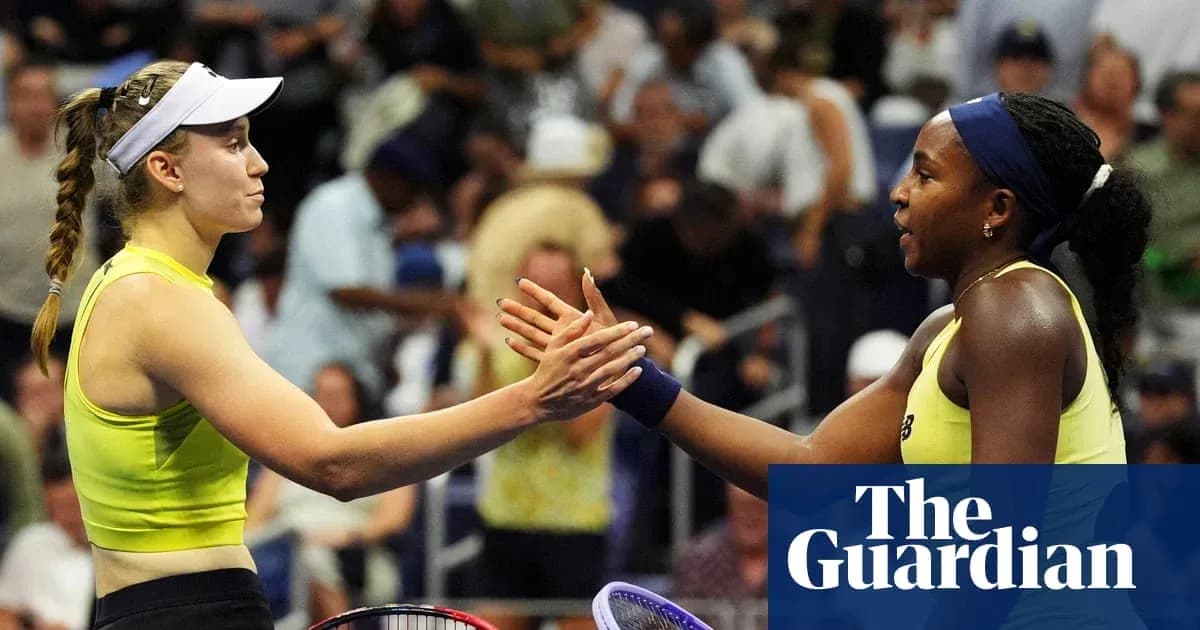
Elena Rybakina walked out for her first US Open semi-final looking as if the moment might swallow her. One set in, it almost had.
Coco Gauff, roared on by a full Arthur Ashe Stadium desperate for American momentum in the night session, flew through the opening set 6-3. She hunted down everything, turned defence into attack, and left Rybakina flailing from the baseline. The Kazakhstani’s greatest weapon, that heavy, metronomic serve, deserted her. The forehand sprayed. The rhythm was nowhere.
But champions don’t need their best day to win. They need a way.
Rybakina found one, and then some, clawing back from a set down to overpower Gauff 3-6, 6-4, 6-4 and reach her first US Open final – the fourth Grand Slam final of her career and a fresh statement of authority on hard courts.
From chaos to control
For much of this tournament, Rybakina has been winning on grit rather than gloss. Six matches in, she still hasn’t strung together a full, flowing performance, yet she keeps solving problems. That, more than any booming ace or flat backhand winner, has become the defining feature of her rise.
She arrived in New York with a rare, glittering chance: become world No 1 and crack one of the sport’s great milestones. The build-up was anything but smooth. An Achilles scare, a poor history at the US Open, doubts about her physical state. She pushed through all of it, and her tense quarter-final win over Zheng Qinwen locked in the ranking breakthrough.
Most players would have allowed themselves a moment. Rybakina didn’t. She made it clear the ranking was only a waypoint. She wanted the trophy.
Now she is one match away, and the final has a familiar edge: a showdown with the departing No 1 Aryna Sabalenka, a renewal of the rivalry that has framed this season and a rematch of the Australian Open final that Rybakina claimed.
Gauff’s weapon misfires
If Gauff’s 2024 has been a story of transformation, the serve has been the headline. The shot that broke her down in tears on this same court a year ago has become a strength, a platform for aggression rather than a trigger for panic.
On this night, the serve was not the villain. The forehand was.
Under the weight of Rybakina’s pace and depth, Gauff’s forehand cracked. Fifteen unforced errors came off that wing, many of them at brutal moments, as Rybakina hammered the ball into that corner and refused to let up.
The match began with Gauff answering the questions that had followed her from the quarter-finals, where she survived Mirra Andreeva, saved two match points, but coughed up 12 double faults. Against Rybakina in the opening set, those serving demons stayed away. She hit her spots, held firm in tight games, and used her movement and defence to draw error after error from the No 2 seed.
The crowd sensed blood. So did Gauff. For a set, Rybakina looked lost.
The tactical turn
The shift came quickly in the second set. Rybakina stopped trying to hit through Gauff down the middle and started tearing open the court. She went wider, especially off the backhand, carving sharp angles that dragged Gauff off balance and out of her comfort zone.
The change was subtle at first, then decisive.
Rybakina raced to a 4-1 lead, finally finding some range off the ground. The set was far from clean from either player, but the pattern hardened: Gauff’s forehand grew tighter, her swing shorter, her margin slimmer. Rybakina kept asking the same question, over and over, to that side.
Serving at 4-5, Gauff’s game finally imploded. Three forehand errors and a double fault handed Rybakina the set and, with it, control of the match. The noise inside Arthur Ashe dipped. Rybakina’s shoulders loosened.
Serve awakens, pressure mounts
For years, Rybakina’s ascent has been powered by one of the most destructive serves in the women’s game. It had been oddly muted for a set and a half. In the decider, it roared back.
At 1-1, she closed out a hold with two thunderous aces, a statement that the match would now be played on her terms. From there, her service games shortened. She walked to the line, hit her spots, and marched through points. Gauff, by contrast, had to scrap for every hold.
By 2-3, the American was clinging on. Facing two break points, she summoned a couple of big first serves and fought her way to 3-3, a defiant stand that kept the crowd alive. The reprieve didn’t last.
At 3-4, the dam broke. Rybakina stepped in, attacked the second serve, and ripped through the game to claim the decisive break. Serving for the match at 5-3, she looked ready to close.
Gauff, as she so often does, refused to go quietly.
A final surge, a ruthless answer
Down 3-5, 30-30, Gauff lasered a stunning backhand passing shot, then broke Rybakina for 4-5 with a flurry of fearless hitting. The stadium erupted, sensing another miraculous escape, another night of Gauff rewriting the script.
Rybakina didn’t blink.
She walked back to the return position, reset, and immediately went after Gauff’s serve. Feet inside the baseline, she crushed returns, stepped into rallies, and suffocated any hint of a comeback. The final game was a ruthless, attacking masterpiece, a refusal to let the match drift into chaos.
One last flurry, one last strike, and it was over. Rybakina had her 3-6, 6-4, 6-4 win, her first US Open final, and a place in a showpiece that will pit the two world No 1s against each other.
A heavyweight era taking shape
This semi-final was part of a historic night for the women’s game. For the first time in 51 years, all four top seeds reached the US Open semi-finals. It hasn’t happened at any major since Wimbledon 2009. It says everything about the strength and stability at the top of the sport that nobody was particularly shocked.
Strikingly, despite the density of elite clashes in recent seasons, Rybakina and Gauff have mostly circled each other rather than collided. Their meeting at the Canadian Open last month, also a three-set win for Rybakina from a set down, was only their second career encounter. This semi-final underlined the dynamic: Gauff’s athleticism and resilience against Rybakina’s clean, heavy first-strike power.
This time, the power won.
Rybakina has already waited four years between her first and second major titles. Now, with Wimbledon in the bag and New York in her sights, she stands one match from doing something different: turning a solitary breakthrough into a true era.