.svg&w=384&q=75 "logo")
Elena Rybakina’s Dominant 2026 Season at the Majors
Elena Rybakina’s 2026 season at the majors reads like the résumé of a dominant champion, punctured by just two sharp jolts of reality.
Three Grand Slam titles. Seventeen wins. Two defeats.
The numbers are ruthless, the story less so.
A Year of Hard Edges and One Soft Spot
Rybakina has turned 2026 into her personal statement year. She began by lifting the Australian Open trophy, added the US Open crown in New York, and already had Wimbledon 2022 in her collection. The big stages suit her, the weight of expectation even more so. At the US Open, she underlined that status again, taking down Aryna Sabalenka in the final to claim her third major title.
On hard courts, she has looked almost untouchable. On grass, she carries the aura of a former Wimbledon champion. But on clay, the picture shifts.
Clay remains the one surface where the Kazakh looks human. Not helpless, never that, but less inevitable. Even this year, she arrived at Roland Garros with real momentum: a title in Stuttgart, her fifth on clay, and a run to the quarter-finals in Rome. The warning signs for the rest of the field were there.
She opened in Paris like a contender, brushing aside Veronika Erjavec 6-2, 6-2. Clean, efficient, ominous. Then the tournament turned.
Starodubtseva Strikes in Paris
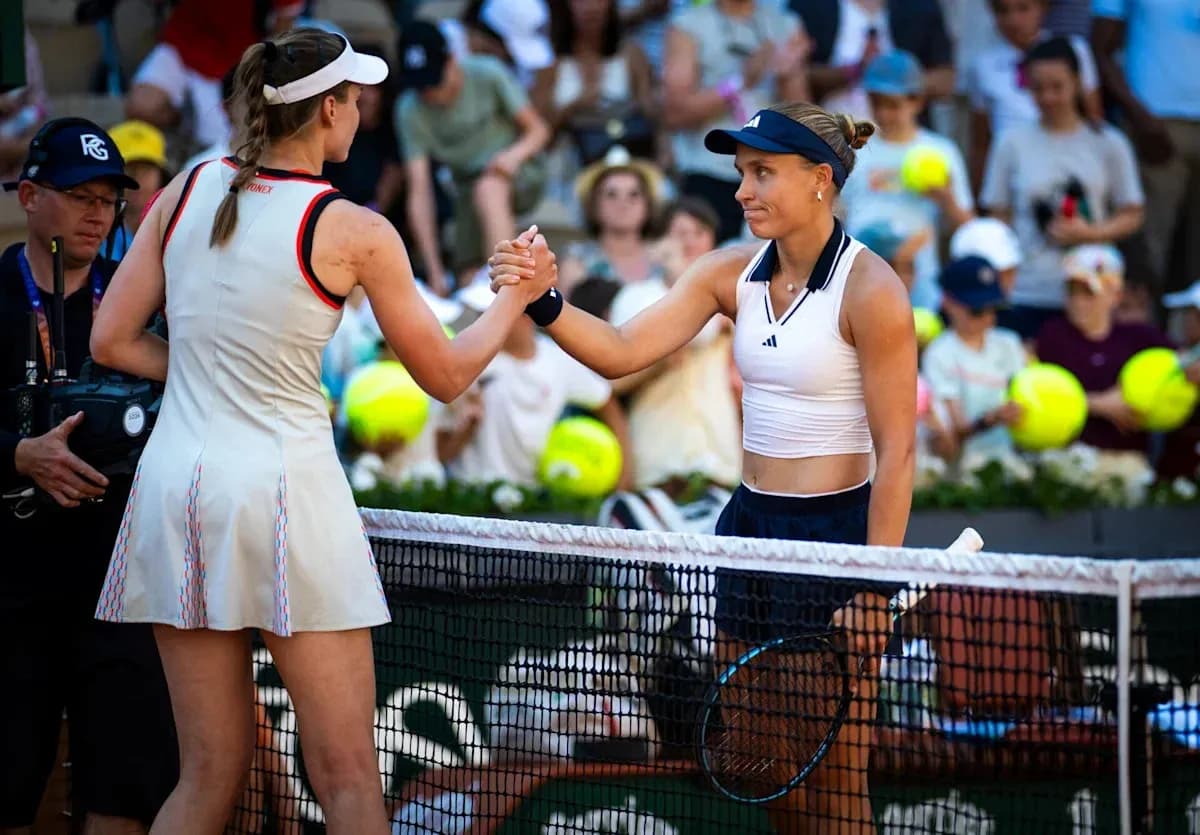
In the second round, Rybakina ran into Yuliia Starodubtseva, a Ukrainian ranked 55 in the world, still feeling her way into the sport’s elite. Starodubtseva had never gone beyond the second round of a Slam. On paper, it was a mismatch. On court, it became one of the shocks of the year.
Rybakina took the first set 6-3. Order restored, or so it seemed.
Starodubtseva refused to fold. She surged through the second set 6-1, then dragged the match into a deciding-set tiebreak. Under pressure, she played bolder, not smaller, and closed out a 3-6, 6-1, 7-6(4) victory that stunned the tournament and handed Rybakina her earliest Grand Slam exit since she withdrew from the 2024 US Open with a back injury.
For Starodubtseva, it was a breakthrough. For Rybakina, it was a reminder: even in a career season, there is no such thing as cruise control at the majors.
Revenge in New York
Starodubtseva’s own year has swung wildly. A six-match losing streak dragged her outside the top 70, the momentum from Paris seemingly evaporating. Then came another Grand Slam run, this time in New York, where she reached the third round of a major for just the second time in her career.
Waiting there: Rybakina.
The rematch carried an edge. Rybakina, now deep in her stride at the US Open, played with the authority of a champion who had not forgotten Paris. Still, Starodubtseva pushed again, forcing a tight first-set tiebreak. This time, the world-class firepower held firm. Rybakina edged it 7-6(6), then pulled away 6-3 in the second set, a controlled and pointed piece of revenge on her way to the title.
Starodubtseva left New York with more than just a respectable defeat. Her joint-best Grand Slam performance will propel her into the top 50 for the first time, up to a new career-high of No. 43. The upset in Paris was no one-off quirk; it has become the foundation of a rise.
The Other Upset: Mertens at Wimbledon
The only other player to beat Elena Rybakina at a Grand Slam in 2026? Elise Mertens.
Wimbledon should have been Rybakina territory. A former champion on grass, she arrived as one of the clear favourites. The numbers backed her up. Against Mertens, the 25th seed, she had won seven of their eight previous meetings. The matchup, historically, tilted heavily her way.
Yet on the lawns of the All England Club, that history meant nothing.
In the third round, Mertens played with clarity and freedom, dragging Rybakina into a tense first-set tiebreak and stealing it 7-6(4). The shift was immediate. With the lead in hand, the Belgian tightened her grip, racing through the second set 6-1 to seal one of Wimbledon’s standout shocks of the year.
Rybakina, knocked out early at the major where she once ruled, looked briefly vulnerable. Only briefly.
A Season of Power, and Two Sharp Lessons
From there, she reset. The sting of Wimbledon did not linger. By the time she lifted the trophy in New York, that grass-court stumble had become a footnote to a towering season.
Seventeen wins. Two losses. One to a rising Ukrainian who turned a Parisian upset into a ranking surge. One to a seasoned Belgian who flipped a lopsided head-to-head on its head at Wimbledon.
For Rybakina, 2026 has been the year she stamped herself as a serial Grand Slam threat. The question now is not whether she can win majors. It’s who, on any surface, can stop her when the next one comes around.