.svg&w=384&q=75 "logo")
Coco Gauff's Serve Transformation Leads to US Open Victory
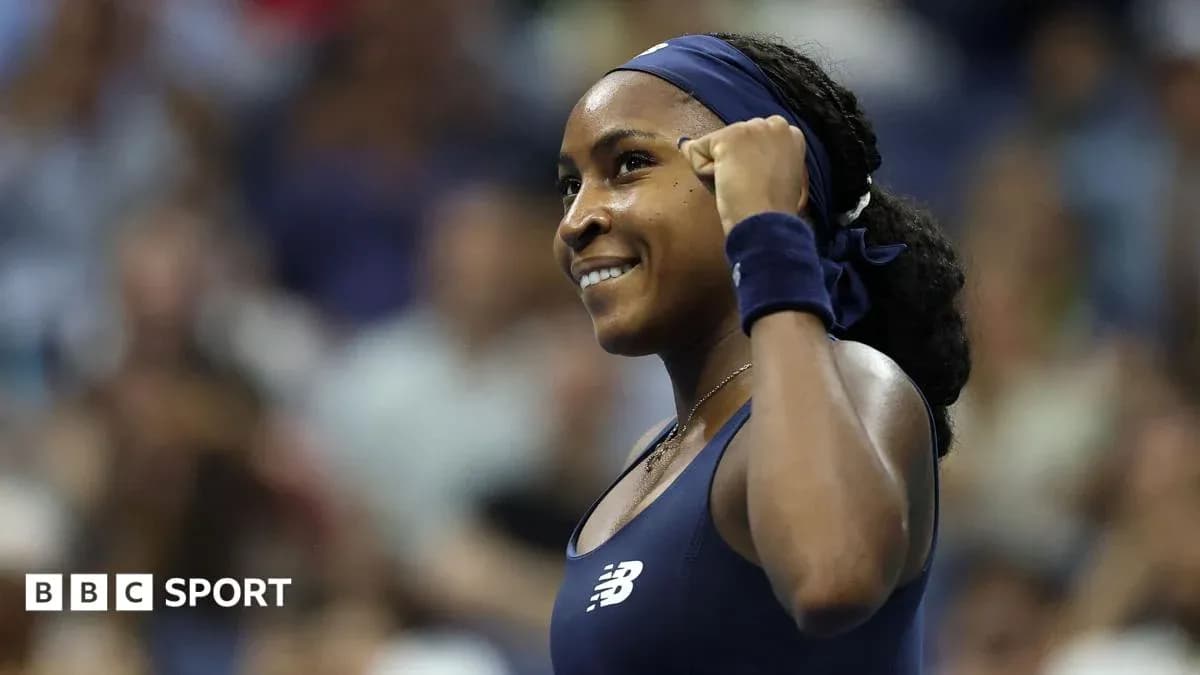
Twelve months ago, Coco Gauff stood alone in the rain on the US Open practice courts, stubbornly tossing ball after ball into the grey New York sky. Her serve had turned from a platform into a trapdoor, and the image of a drenched, frustrated two-time major champion became a symbol of a game wrestling with itself.
On Tuesday, under clearer skies and with a far clearer mind, she walked back into Flushing Meadows with that same serve transformed into a weapon. The result: a controlled, businesslike 6-3 6-4 win over Turkey’s Zeynep Sonmez in the first round, built on the shot that once betrayed her.
Gauff opened with a statement. A swift hold to love, finished in under 90 seconds, set the rhythm for the day. A 112mph ace down the middle, an unreturned first serve, another ace. No drama, no searching glances at the box. Just clean, confident execution.
This is what a rebuild looks like when it finally takes.
“Now it’s like I can look back a year on and think, ‘Oh, wow, it’s a big difference’,” said the 22-year-old, seeded fourth this year. “It feels good to come into a tournament feeling confident on that shot finally.”
Last summer, on the eve of her home Slam, Gauff made a call that many players would have delayed: she tore up her serving blueprint. She reshuffled her coaching team and brought in biomechanics expert Gavin MacMillan, the specialist who had previously helped Aryna Sabalenka tame her own serving crisis.
It was not a cosmetic tweak. It was triage.
The warning signs had flashed in Cincinnati, where a pile-up of double faults forced the issue. To change technique before the US Open, with the spotlight fixed firmly on her, was always going to be a gamble. The cost showed quickly. Gauff exited in the fourth round, played tight, looked burdened, and at times was reduced to tears on court.
“Obviously last year I knew all the eyes were going to be on the serve,” she admitted. “Gavin is so great at what he does, I felt a lot of pressure to kind of prove that. It didn’t really show within the first two weeks, which is normal.”
The process took time. The result is now obvious.
MacMillan’s adjustments sound simple on paper: more consistent toss, no chasing the ball too far in front, a straighter wrist through contact. On court, they’ve given Gauff a delivery she can trust. The numbers from her recent Cincinnati Open title run told the story: she’s hitting closer to the lines, keeping her pace, and tightening the margins that once unraveled her.
Against Sonmez, the improvement wasn’t theoretical. It was brutal.
In the first set, whenever Gauff landed a first serve, the world number four was almost untouchable. She won 93% of those points, repeatedly pushing Sonmez back with heavy pace and precise placement. The Turkish player struggled just to get the ball back in play, let alone start neutral rallies.
Gauff broke for 4-2 and never looked back in the opener, using her serve as a springboard rather than a test of nerve. The old tension simply wasn’t there.
The second set, though, asked a harder question.
Gauff broke immediately for 1-0, but the smooth dominance faded as Sonmez dug in. The Turkish player began reading the patterns better, stepping into returns, and soon the scoreboard tightened. Gauff’s first serve wobbled. Sonmez levelled at 2-2 and then carved out three break points for a 4-2 lead.
This was the kind of game that haunted Gauff a year ago: tight scoreline, serve under siege, doubts creeping in.
The response underlined just how far she has come. A precise ace out wide. A 115mph first serve that never came back. The hold was not pretty, but it was gutsy, and it shifted the air around the match. What felt like a likely break against her turned into a defiant stand.
From there, the pressure flipped. Gauff broke immediately for 4-3, then stepped on the gas with the finish line in sight. Serving for the match, she didn’t roll the ball in and hope. She attacked. Three unreturned first serves, all just under 120mph, teed up three match points. Sonmez cracked on the first after a short rally, and Gauff walked to the net with the calm of a player who now expects to serve matches out.
“Psychologically, I’m now going to go for the ace, or I know I can hit the serve and the return is probably not going to come back,” she said. “Last year I literally was like I hope I make it in. It’s such a big difference knowing almost every serve I’m trying to basically hit 110, 115, 120mph if I can.”
There are still double faults. The serve is not flawless, just far more formidable. The key is that the balance has flipped: the aggression now outweighs the anxiety.
Her Cincinnati title earlier this month felt like confirmation that the new mechanics would hold under pressure. New York is the real examination room. Here, every toss, every hitch, every second serve is magnified. Last year, the scrutiny exposed a weakness. This year, it may amplify a strength.
Next up, Gauff will face either Spain’s Paula Badosa or Australia’s Daria Kastakina in the second round. A year ago, the conversation around her was whether the serve might derail another deep run. Now the question is different.
If this new delivery holds, who in this draw will really want to stand across the net and try to handle it?