.svg&w=384&q=75 "logo")
Cathy Engelbert Retires as WNBA Commissioner After Transformative Tenure
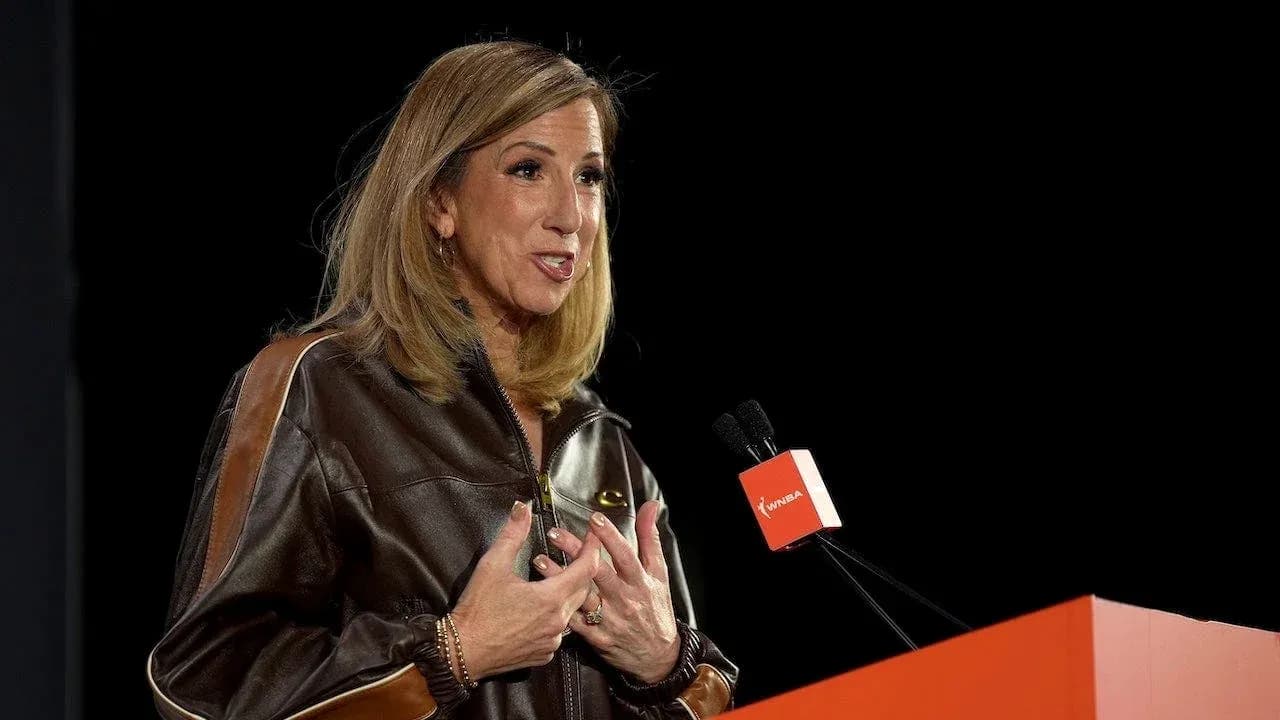
Cathy Engelbert, the first commissioner in WNBA history and the architect of its most aggressive era of growth, will retire at the end of the calendar year, closing a seven-year run that reshaped the league’s business and competitive landscape.
The announcement came via NBA commissioner Adam Silver, who framed Engelbert’s tenure as a turning point for the 30-year-old league.
“Cathy has presided over the WNBA through the most significant period of growth in the league’s 30-year history,” Silver said in the league’s statement. “We are grateful for Cathy’s leadership and unwavering commitment to the advancement of women’s basketball.”
Engelbert, 61, steps away at a moment when the WNBA sits squarely in the national spotlight — and under a harsher glare than ever. A season dominated by debate over the treatment of Caitlin Clark and Indiana Fever guard Sophie Cunningham’s public comments about trans athletes in women’s sports has kept the league in the headlines, often for reasons that stretched well beyond the court.
The timing only sharpens the focus on her legacy.
A commissioner hired to build, not just maintain
When Engelbert took the job in 2019, the league gave her a different title than her predecessors. She was not a “president.” She was the WNBA’s first “commissioner,” a deliberate signal that the league wanted a more expansive, commissioner-style mandate and a more forceful presence in boardrooms and broadcast negotiations.
“In 2019, I had the privilege of being appointed the league’s first commissioner and to lead a league with enormous potential yet untapped awareness and significant undervaluation,” Engelbert said in a statement. “Over the years, it has been amazing to watch WNBA players thrive and lead the massive cultural surge around women’s sports.”
The numbers back her case. Under Engelbert, the WNBA moved from 12 to 18 teams, a dramatic expansion for a league that had previously inched forward more cautiously. She oversaw new media-rights deals, a collective bargaining agreement, and a reworked calendar that pushed the product into more homes and onto more screens.
League metrics have spiked across the board. The WNBA credited Engelbert with helping drive increases in viewership and “historic highs” in digital engagement, game attendance, League Pass subscriptions, merchandise sales, corporate partnership revenue, and franchise valuations. The business side of the league, long considered underdeveloped relative to its talent, finally started to resemble its potential.
Innovation and criticism in the same frame
Engelbert did not just add teams. She altered the rhythm of the season itself.
In 2021, the WNBA rolled out the in-season Commissioner’s Cup, a tournament designed to inject competitive stakes and sponsorship value into the early and middle parts of the schedule. By 2025, the regular season expanded to 44 games, with plans already in place for a record 50-game slate in 2027.
Those moves signaled a league intent on behaving like a major property, not a niche one.
Yet the same tenure that produced growth also drew pointed criticism. Some fans and commentators accused Engelbert and the league office of failing to fully capitalize on the star power of its biggest names, with Clark often at the center of that debate. In a year when the rookie guard’s presence transformed ratings and attendance, questions about how the league marketed her and protected her on the floor became a running theme.
Engelbert’s office, often praised for its corporate execution, found itself pulled into culture-war crossfire as well. Cunningham’s comments on trans athletes and the broader conversation around inclusion and women’s sports added a charged political layer to an already intense season, placing the commissioner’s leadership under constant scrutiny.
Leaving on her terms
Despite the noise around the league, Engelbert framed her decision as the natural close to a long career in business and sports.
“After more than seven years at the WNBA and more than 40 total years in business, I have made the decision to retire as WNBA Commissioner,” she said. “I retire knowing we have built something bigger, stronger and more enduring than we could have imagined. I am grateful to the WNBA and NBA team owners and staff, players, investors, fans and the powerhouse league office staff, who believed in what this league could become. I retire with immense gratitude and tremendous optimism for the future of the WNBA, with the best yet to come.”
Her departure leaves a substantial vacancy. The next commissioner will inherit a league that is no longer fighting for basic relevance, but wrestling with the demands that come with rapid growth: expansion markets to stabilize, an upcoming 50-game schedule to manage, a new media-rights cycle to navigate, and a star ecosystem that demands savvy, nuanced handling.
The WNBA has not yet named a successor or outlined a timeline for the appointment.
Whoever steps into Engelbert’s chair will find a league transformed — richer, louder, more visible, and more contested than at any point in its history. The question now is not whether the WNBA can grow.
It’s who will be trusted to control the next surge.