.svg&w=384&q=75 "logo")
Carlos Alcaraz Makes Strong Return at US Open
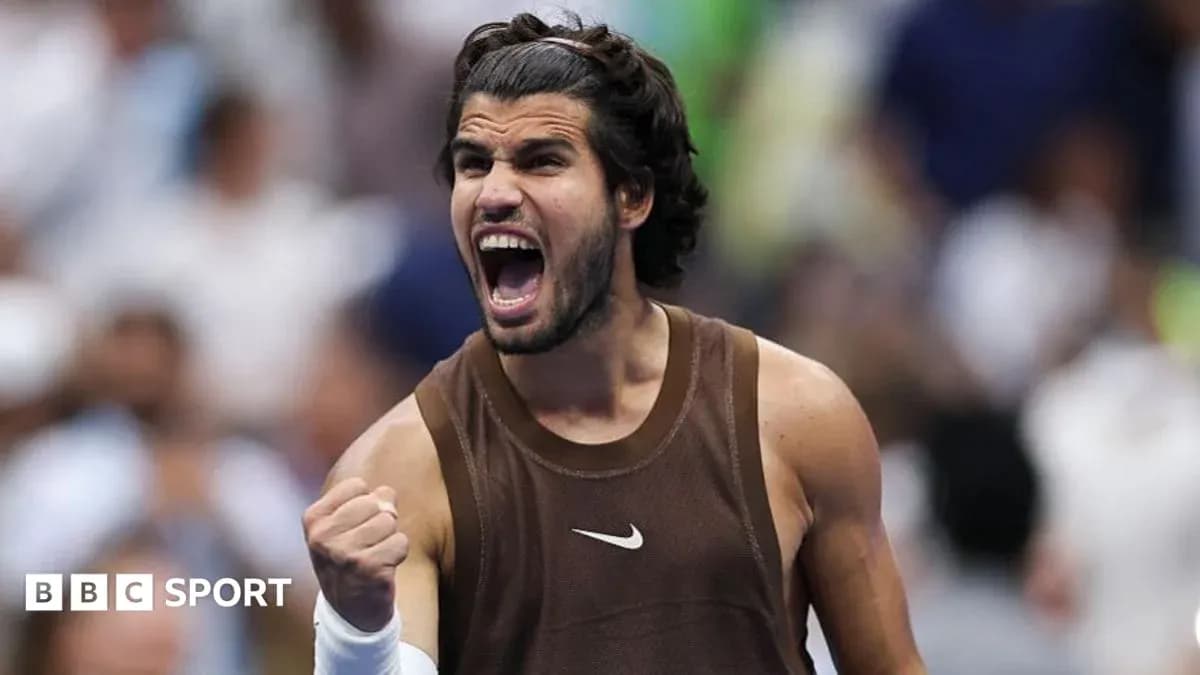
Carlos Alcaraz walked back into Arthur Ashe Stadium on Monday night as if he had been away for a week, not 139 days.
Four months of frustration, rehab and watching others lift the biggest trophies vanished in three brisk sets as the defending US Open champion dismissed Roman Safiullin 6-4 6-4 6-4, and did it with the full, unapologetic theatre of Carlos Alcaraz tennis.
The showman returns
The right wrist, the reason he had been reduced to a spectator while Alexander Zverev took Roland Garros and Jannik Sinner conquered Wimbledon, was wrapped in a compression sleeve. It might as well have been a costume piece.
From the first game, Alcaraz ripped his forehand with the old violence, that whippy, elastic motion producing the bulk of his 28 winners. Every clean strike came with a clenched fist and a roar of “vamos” toward his box. Not the cautious return of a player testing his body. This was a man intent on picking up exactly where he left off.
“I missed the crowd, the energy, the competition – I missed everything,” he said on court, smiling as if he had just been let back into his favourite playground. “I'm just really, really happy that I was able to compete again.”
He played like it. He grinned after points, chatted with his team, and at one changeover casually sang along to Michael Jackson as if this were a backyard hit, not the opening step in a major title defence.
When he ended a bruising rally late in the third set with a feathered drop shot, he froze for a beat, then raised his fist to the sky, cupped his ear and whipped his arms at the stands, demanding more noise. Arthur Ashe obliged.
From the commentary box, former Wimbledon champion Pat Cash noted it looked as though “every little win” was being savoured. That was the point.
“What I really want to do is enjoy every time that I'm going to walk into the court, feeling the energy from the people,” Alcaraz said. “That's what I'm going do this tournament. The results, it's going to come after all.”
Rust, risk and a recalibrated serve
For all the joy, this was still a comeback match, and it showed in one key area. The serve.
The numbers told the story: just two aces against five double faults. He landed 68% of first serves and won 66% of those points, solid enough, but the usual sting was missing. The delivery sat a little shorter, a little safer.
“The serve is the shot I was struggling [with] the most,” he admitted. Part of that, he explained, was by design. Slowing it down, mixing the pace, was a tactical ploy to disrupt Safiullin’s rhythm. But he knows this can’t be the long-term version of his game.
“I'm going try to serve better. The point is going to try to serve normal, but it's a shot that I just always struggle [with]. But it will be back, for sure.”
The rest looked reassuringly familiar. The forehand detonated from both corners. The drop shot – that mischievous little dagger he loves to pull at the height of a rally – kept Safiullin guessing. The movement, the elastic defence into sudden offence, stayed intact enough to suggest the wrist had survived its first real test.
Match fitness, though, is another question.
“There were some doubts in the match, I'm not going to lie,” he said. “I've been thinking about 'am I going to last the best of five, am I going to last playing four sets, five sets?'”
He didn’t need to find out on Monday. Straight sets spared him that particular examination. But he knows it’s coming.
“I need more matches under the belt to get again into the rhythm of the tournament. I'm pretty sure I'm going to get better and better every day.”
A draw quietly opening
On paper, this was a routine start: the world number 2 against the world number 99. The real intrigue lies in what comes next, and who will not be standing in his way.
Next up is Portugal’s Jaime Faria, ranked 72. A step up, but not a name to scare a fit and firing Alcaraz. The broader landscape, though, has shifted in his favour in a matter of days.
Sinner, the man who has loomed over the tour all season and sits at world number one, is missing with a knee problem. Novak Djokovic, the 24-time major champion whose shadow usually stretches over every draw he enters, has already gone, stunned in the first round by Argentina’s Mariano Navone.
Arthur Fils, the French 10th seed and fresh off a Cincinnati Masters title that had many tipping him as a serious New York threat, also crashed out, beaten by Stefanos Tsitsipas.
The effect is stark. As second seed, Alcaraz sits on the opposite side of the draw from top seed and French Open champion Zverev. They cannot meet before the final. Between now and the semi-finals, the only top-10 opponent he can possibly face is American Ben Shelton, a potential quarter-final blockbuster and a test of both his tennis and his stamina.
The path is never simple at a major, not over two weeks and seven matches, not when you are still gauging what your body will allow. But compared with the minefields he has navigated in the past, this one looks less crowded.
Joy first, trophies later
Alcaraz insisted he came to New York with one overriding mission: to enjoy himself. It sounded almost disarming from a player already carrying seven major titles at 23, one who has been forced to watch others seize his usual stage.
“That's why I enjoyed so much today, and it wasn't a surprise for me, because I came here to enjoy,” he said.
Yet enjoyment, for him, has always been tied to ambition. He doesn’t separate the two. The fist pumps, the drop shots, the singing at the changeovers – they are not a distraction from the job. They are part of how he does it.
On Monday night, the defending champion didn’t just survive his return. He owned the court again, noise and nerves and all.
If this is the rusty version of Carlos Alcaraz, how dangerous does he become once the serve sharpens, the doubts fade, and the five-set engine starts to purr?