.svg&w=384&q=75 "logo")
Carlos Alcaraz Returns Strongly at US Open
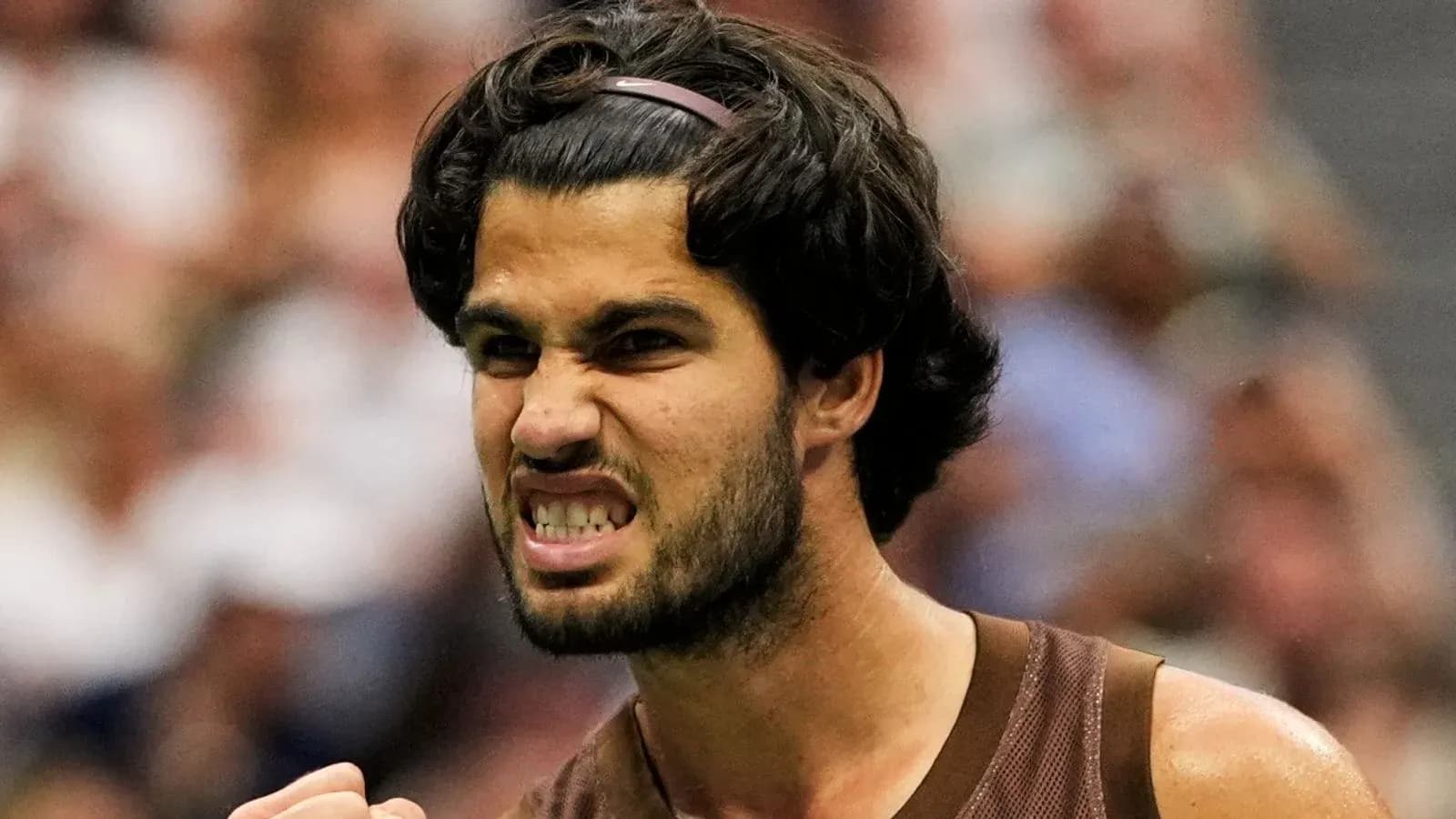
Carlos Alcaraz walks back into the glare of Arthur Ashe Stadium as if he never left.
Four months without a competitive singles match, a wrist injury that tore a hole in his season, doubts about whether he would even make New York. Then three clean, ruthless sets: 6-4 6-4 6-4 against Roman Safiullin. Statement made.
Alcaraz back on the hard court, and back in business
This was not a gentle reintroduction. The last time Alcaraz played singles on tour was April, when that troublesome wrist forced him out of Barcelona and then ruled him out of Roland Garros and Wimbledon. For a player who feeds off rhythm and repetition, it was a brutal interruption.
He arrived at Flushing Meadows under a cloud of uncertainty, his title defence framed by questions about durability more than talent. Best-of-five. Hard courts. A wrist that had been prodded, scanned and protected for months but never truly tested.
He admitted the doubts were real. They didn’t show for long.
Under the lights, with rapper Travis Scott watching from the stands in the outfit he helped design for the Spaniard – a striking brown ensemble that made Alcaraz look like he’d walked straight off a runway and onto a baseline – the focus shifted quickly from fashion to ferocity. Every serve, every forehand, every backhand was inspected for signs of hesitation.
The early games were tight. Safiullin carved out two break points in Alcaraz’s opening three service games, probing the wrist, the movement, the timing. Alcaraz erased them with the kind of bold shot-making that has already defined his young career, then struck in the eighth game, breaking for 5-3 and locking away the first set with a familiar swagger.
The pressure finally told on Safiullin again at the start of the second set, but this time in reverse. Alcaraz dropped serve to fall behind, the first real jolt of the night. The response was immediate and emphatic. He broke straight back, raised the tempo, and once more punched through in the eighth game. Another 6-4. Another reminder that he can turn a set with a single surge.
By the third, the match felt under his control. An early break settled any lingering questions about stamina. He glided into the corners, changed direction with ease, and protected his serve without real alarm. Safiullin, a dangerous ball-striker on his day, was kept firmly at arm’s length as Alcaraz closed out a straight-sets win that looked, by the end, almost routine.
For someone who hadn’t played singles for more than four months, there was nothing tentative about it. The defending champion is here, and he looks ready to stay.
His reward is a second-round meeting with Portugal’s Jaime Faria. The draw in his half also shifted subtly when Cincinnati champion Arthur Fils, one of the form players on hard courts, fell in four sets to Stefanos Tsitsipas, 4-6 7-6 (7-3) 6-1 6-4. One threat gone, several more waiting.
Sabalenka starts her three-peat chase with steel
On the women’s side, Aryna Sabalenka opened her own title defence with a scoreline that looks comfortable on paper and felt anything but at times on court: 6-2 6-4 over Camila Osorio.
The Belarusian is chasing history in New York. No woman has won three consecutive US Open titles since Serena Williams in 2014. Sabalenka has worn the pressure of being world No 1 since October 2024, but her recent form has invited questions she’s not used to hearing.
Three straight last-16 exits – at Wimbledon, the Canadian Open and Cincinnati – have put her ranking under threat. Elena Rybakina, Coco Gauff and Jessica Pegula all stand in range of toppling her from the summit.
Osorio made sure this was no gentle warm-up. After being overpowered in the first set, the Colombian dug in and forced Sabalenka to find her heaviest artillery again in the second. The rallies stretched, the angles sharpened, and Sabalenka had to lean on the raw, brutal power that has brought her four major titles on hard courts.
She found it when it mattered. The straight-sets win will not silence all the doubts around her recent dip, but it restores a sense of order. On this surface, with this weight of shot, she remains a nightmare draw for anyone.
Muchova, Anisimova and the American surge
Karolina Muchova, last year’s Wimbledon runner-up, opened her campaign with the kind of clean, clinical performance that suggests she’s ready for another deep run. Austria’s Sinja Karus barely had time to settle before Muchova swept past 6-3 6-0, tightening her grip as the match went on.
Amanda Anisimova, runner-up here a year ago, also moved through with authority. She dismantled fellow American Ashlyn Krueger 6-1 6-3, a result that set the tone for a strong day for the home contingent.
Emma Navarro, Taylor Townsend and Cate McNally all joined her in the second round, adding local energy to a draw that often feeds off the roars from the outer courts as much as the noise on Ashe.
British grit on show: Dart and Fearnley dig in
For the British players, this was a day that demanded resilience and rewarded nerve.
Harriet Dart looked in real trouble against Peyton Stearns, down a set and a break to an American with the crowd behind her. Dart refused to fold. She clawed her way back into the second set, turned the match on its head with aggressive returning and smarter shot selection, and surged away 3-6 6-3 6-2.
From there, the momentum was all hers. The comeback wasn’t pretty at every turn, but it was full of fight – exactly the sort of performance that draws praise from a coach, and Marion Bartoli, watching on in that role and as a pundit, duly delivered it.
If Dart’s recovery was impressive, Jacob Fearnley’s effort bordered on audacious.
He lost the first set to Martin Landaluce, hit back strongly in the second, then slipped behind again as the Spaniard took the third. When Landaluce stepped up to serve for the match in the fourth, Fearnley’s US Open looked finished.
He tore up that script. Three games in a row turned the fourth set on its head and dragged the contest into a decider. The momentum, now firmly with the Briton, carried him through a tense fifth as he closed out a 4-6 6-2 4-6 7-5 6-3 victory.
There was even room for a heart-stopping twist: a missed routine smash on match point that could have rattled a less composed player. Fearnley steadied himself, reset, and finished the job to reach the second round at Flushing Meadows for the second straight year.
The context makes it even more remarkable. He actually lost in qualifying last week and only slipped into the main draw as a Lucky Loser. Playing, as he put it, on “house money,” he has now turned that second chance into ranking momentum and the possibility of a return to the world’s top 100.
From Alcaraz’s emphatic return to Sabalenka’s steely defence and the British fightbacks on the outside courts, day one in New York carried a clear message: injuries, doubts and near-misses can stall a season, but they rarely decide it. The players do.