.svg&w=384&q=75 "logo")
Carlos Alcaraz Returns to Grand Slam Spotlight with Dominant Win
Carlos Alcaraz didn’t just return. He walked back into the grand slam spotlight as if someone had hit “unpause” on a career that refuses to slow down.
Four and a half months without a singles match, a suspect wrist, no tune‑up events, best-of-five straight away – every warning light was flashing. Then, at 5-4, 30-15 in the opening set, the instinct that separates him from almost everyone else on tour took over.
A wide serve dragged Roman Safiullin off the court. The reply came back low and mean, a dipping backhand that landed right at Alcaraz’s feet. In that split second, the Spaniard slid forward and caressed a half‑volley over the net, the ball dying just out of reach.
One touch. One reminder. This is what the sport has been missing.
He held serve, sealed the set, and never really loosened his grip. Three times 6-4, a straight-sets win – 6-4, 6-4, 6-4 – that did more than just book his place in the second round. It answered the first and most important question: can he compete? Yes. Emphatically.
Forehand fearlessness, wrist at ease
The doubts were obvious. No competitive singles since his layoff, and a wrist that had forced him to sit and watch rather than dictate. Safiullin, with his heavy ball-striking, was hardly a gentle reintroduction. This was a test of impact and resistance as much as tactics.
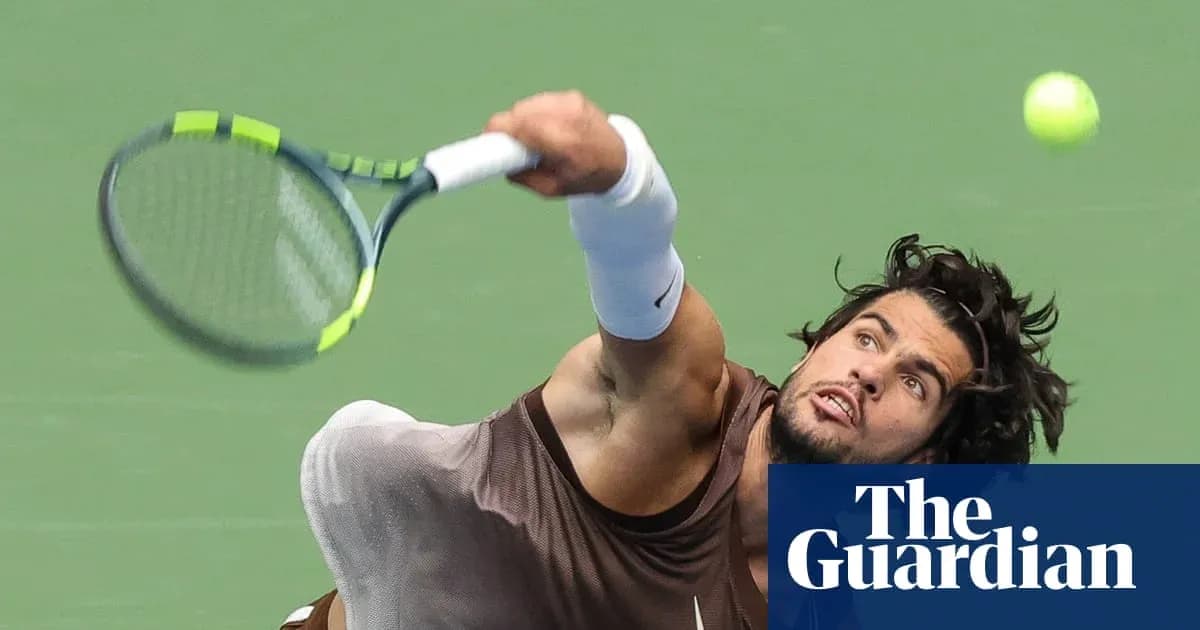
Alcaraz chose not to tiptoe back. He tore into his forehand from the start, leaning on the shot that has become the most feared in the game. He hit it full-blooded, again and again, pinning Safiullin behind the baseline and ripping through rallies as if the last few months had never happened.
By the end, the numbers told the story of his intent: 20 forehand winners against just nine forehand unforced errors. When he did find himself under pressure on serve, he didn’t retreat. He simply hit his way out of trouble, turning defence into sudden attack, the old patterns returning with surprising ease.
Most important of all, the wrist held up.
“It’s pain-free right now,” Alcaraz said afterwards. “I felt great. I don’t know how it looked from outside but, from inside, my feeling was that I was hitting normal. I was playing pretty normal, playing my style, and the arm, the wrist, everything felt great. I’m going to still take care of it, obviously, these days and before the matches and everything, but I’m just really happy it’s pain-free finally.”
The relief was written across his face long before he put it into words. The smile after that half-volley, the looseness in his movement, the willingness to step in on big points – all of it pointed to a player who trusted his body again.
One lingering question: the serve
Not everything was back at full power, though. One area stood out: his serve.
Alcaraz dialled down the radar, averaging just 113mph on his first serve. The tape under the arm sleeve was another clear sign that he and his team are managing the comeback carefully, refusing to gamble on maximum velocity so soon.
The approach makes sense. A grand slam is a marathon, not a single sprint, and any jolt to that wrist could derail more than just this fortnight. But there is a trade-off. Without his usual pop on serve, the free points dry up. Over the course of a long event, that can matter – especially if the matches lengthen and the rallies pile up.
For now, he seems willing to live with that compromise. Control the damage, build rhythm, trust the rest of the game to carry him. On this evidence, it can.
Nerves, family, and a different kind of goal
This wasn’t a routine first round for him. Not emotionally.
In his box sat his parents, his brothers, his team, and even rapper Travis Scott, an unusual but telling snapshot of the star power orbiting Alcaraz these days. The stage was big, the expectations bigger, and inside, he admitted, the tension was real.
“It was a difficult day for me, to be honest, but at the same time, a really beautiful one,” he said. “[I] started the day really nervous. Really, really nervous, thinking: ‘I’m going to make it, I’m going to compete again.’ I had more nerves than usual, but just happy, because for me, my goal here is to compete, to enjoy, and let’s see how my body’s going to react after the matches, after the competition again.
“I don’t know how far I’m going to go in the tournament. I didn’t know if I was going to lose this one, if I’m going to make the second round, final. I don’t know how far I’m going to go. But what I just really want to do is enjoy every time that I’m going to walk into the court feeling the energy from the people, feel the competition, walking up, I’m thinking, all right, it’s match day. That’s what I’m going to do this tournament.”
That shift in tone is striking. This is a player already measured against grand slam titles and No 1 rankings, yet here he is talking not about trophies, but about walking into a stadium and feeling alive again.
For one night, that was enough. The forehand roared, the wrist stayed silent, and the smile never left. How long that balance lasts will shape his tournament – and maybe his season.