.svg&w=384&q=75 "logo")
Cameron Brink Calls Transgender Debate a Non-Issue in WNBA
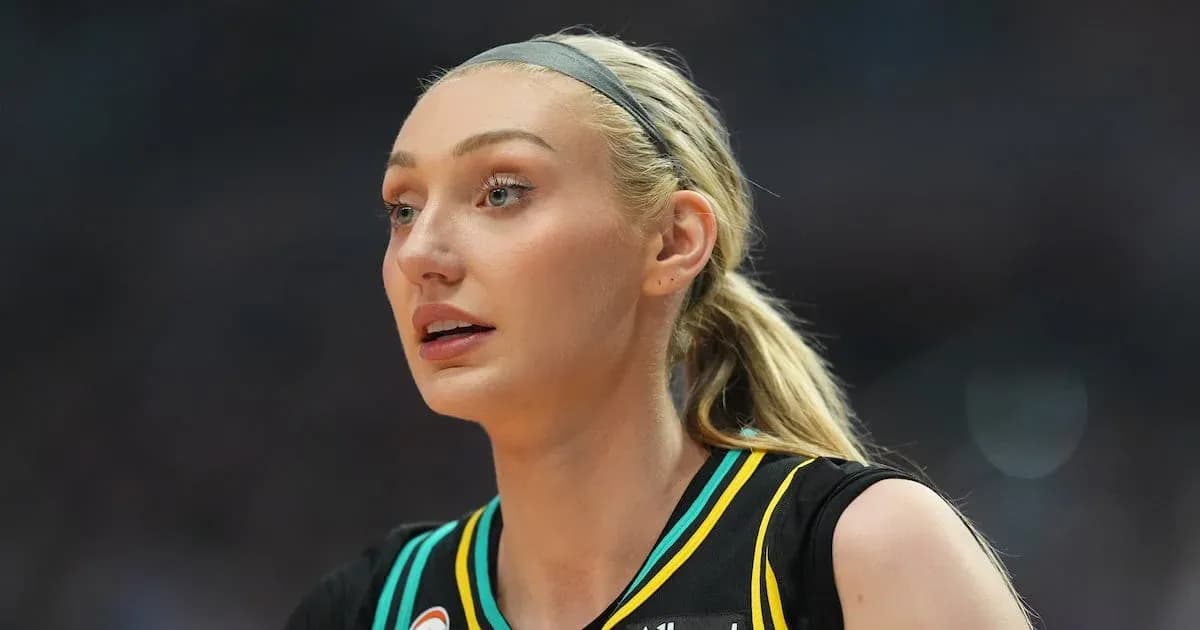
Cameron Brink has had enough.
The Los Angeles Sparks forward isn’t interested in manufactured outrage or social-media theatrics. Asked about the growing noise around transgender participation in the WNBA, Brink cut straight through it.
To her, it’s simple: this is a “non-issue” being twisted into a spectacle.
Speaking to The Mirror’s Jarrod Castillo, the 24-year-old didn’t bother dressing it up. “When it comes to the trans issue...I think it’s a non-issue. I think it’s just people trying to come for the trans community and I just don’t stand for that,” she said, laying down a clear line in a debate that has increasingly been dragged into the women’s game from the outside.
Flashpoint
The flashpoint came in Chicago on Sunday, when former NBA center Enes Kanter Freedom was escorted out of a Chicago Sky game after a confrontation with Natasha Cloud. Freedom, who logged 748 NBA games over 11 seasons, has recently teamed up with another former NBA player, Royce White — now a 2024 GOP Senate candidate in Minnesota — in a series of stunts mocking transgender identities. Both men have publicly “declared” themselves transgender and vowed to enter the WNBA Draft.
That, for Brink, crossed a line.
“I think what - I don’t even know what the f--k his name is - Enes Kanter, he’s a stupid piece of s--t,” Brink said. No euphemisms. No soft landing. “And I think a lot of people think that and I think he’s just trying to stay relevant.”
Her frustration runs deeper than one ex-player chasing headlines. Brink sees a deliberate attempt to weaponize a marginalized group for attention.
“I think people are tuned in for the right reasons and it’s great that we can all talk about things that are important and hard and you can have your opinions on that,” she continued. “But taking something that’s a non-issue right now and just trying to use it for clickbait, for views, for likes and then targeting a vulnerable community is just really low.”
Current Landscape
The reality undercuts the hysteria. There are currently no trans players in the WNBA. In three decades of league history, only one openly trans and non-binary player has ever suited up: Layshia Clarendon, who retired in 2024 after 11 seasons. That’s the actual landscape, far removed from the parade of bad-faith hypotheticals.
The latest wave of discourse traces back to an ESPN feature last month on Indiana Fever guard Sophie Cunningham, who voiced opposition to transgender girls and women competing in girls’ and women’s sports. From there, the topic has been pulled into the culture-war slipstream, with the WNBA used as a prop by people who have never played a minute in it.
Brink, by contrast, is living this league every night.
The Princeton, N.J., native is in her third WNBA season, a central piece of the Sparks’ rebuild after being taken second overall in the 2024 WNBA Draft out of Stanford. Across 28 games this year, she’s averaging 9.4 points on 50 percent shooting, 5.0 rebounds and 1.7 assists in 18.5 minutes per game — efficient, productive, and very much part of the WNBA’s present, not its past.
She could have stayed quiet. Many do. Instead, she chose to plant a flag in a conversation that has often spoken about trans people rather than with them, and frequently without any grounding in the actual WNBA.
No trans players on rosters. One openly trans and non-binary player in 30 seasons. Yet the league finds itself dragged into a fight built for clicks, campaigns, and talking points.
Brink’s message cuts against that current. The league, she insists, has real issues, real battles, real stories. Manufactured ones can stay outside the arena.