.svg&w=384&q=75 "logo")
Caleb Wilson's Impact on the Chicago Bulls Franchise
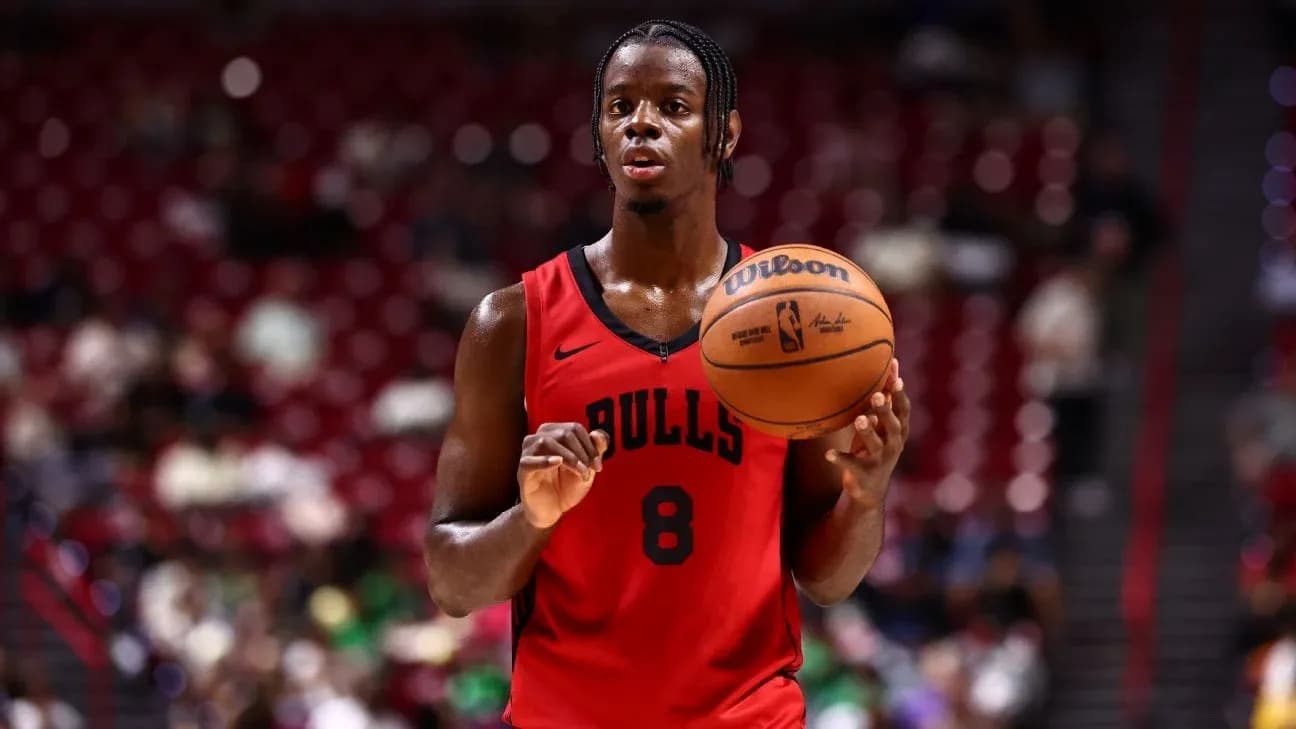
IT’S LATE AUGUST on the West Side of Chicago, and the old building hums again.
Bulls Fest has turned the streets around the United Center into a red-and-black carnival. Kids in fresh No. 4 jerseys tug at their parents’ sleeves. Grown adults crane necks and hold phones high, trying to capture a glimpse of the 20-year-old they’ve already decided is different.
This is Caleb Wilson’s first real day as a Bull, and it feels like a reboot of the franchise’s soul.
The line to meet him coils through the atrium, a living, breathing reminder of how long this city has waited for a reason to care again. Out in the parking lot, there’s a dunk contest on deck, Wilson listed as one of the judges. But before he ever sees a rim, he’s in front of the Michael Jordan statue, screaming into a camera, tongue out, feeding a hype video as hundreds of fans roar behind him.
Jordan cast in bronze. Wilson in high definition. Where the Bulls were, and where they’re begging to go, in one frame.
A franchise grabs at a new face
The anticipation started in June, when Chicago took the North Carolina forward with the No. 4 pick in the NBA draft. It has swelled with every clip, every stat line, every whispered comparison since.
The Bulls aren’t hiding what they want him to be. They see a new face of the franchise, a fresh start for a team that has missed the playoffs in eight of the past nine seasons and spent most of the last decade wandering in the middle.
Then came Las Vegas.
Wilson’s first professional game in summer league didn’t just pop; it detonated. He dropped 35 points, the second-highest rookie debut in summer league history, and splashed seven 3-pointers. Seven. That’s more than he hit in his entire freshman season at North Carolina.
The next outing, he took off over 6-foot-11 Jonas Aidoo and hammered home one of the dunks of the summer, the kind of play that instantly gets replayed with the sound off and the volume still feels loud.
By his fourth and final game, Hall of Famer Kevin Garnett was courtside, studying the kid people kept mentioning in the same breath as him. The physical echoes are hard to miss: both 6-foot-10, wiry, 215 pounds, violent leapers with endless motors.
On his podcast, Draymond Green pushed the conversation even further. Garnett, he said, might be Wilson’s floor. His floor.
“And man, if that's your floor, oh my god. Do you know how great KG was?” Green said. “I actually think with Caleb Wilson, Kevin Garnett could be his floor. That's how special I think Caleb Wilson is.”
Teams usually roll their eyes at summer-league overreactions. Wilson forced them to pay attention.
“He looks,” one Bulls source told ESPN, “like we got a dude.”
New star, new bosses, new plan
Wilson is just one piece of a sweeping reset.
Chicago handed the keys of basketball operations to Bryson Graham, known around the league as a talent hawk, someone who believes in building through the draft and living with the growing pains that come with it. His first major moves: hire Tiago Splitter as head coach, draft Wilson at No. 4 and Dailyn Swain at No. 15, then bring in veterans like Norman Powell and Nic Claxton to steady the room.
The message from the top is clear: development first. Wins will come when they come.
“We just want to see internal growth from our young guys and even from our veteran players,” Graham told ESPN. “We just want to see a team that's going to go out there, represent this city well, play hard and obviously continue to grow and continue to develop.”
Inside the organization, there is no mandate to chase a play-in spot in a loaded Eastern Conference. No artificial deadline on a rebuild that’s already burned through too many shortcuts.
Patience, for once, is the plan.
Wilson doesn’t speak like someone easing into anything.
“I expect to have Rookie of the Year, honestly,” he said. “I'm going to work hard. I'm going to do what it takes. I feel like the team is really good for me and how I envision to play.”
The shot that changed the conversation
The irony of his Vegas explosion from deep is that his jumper was supposed to be the red flag.
At North Carolina, Wilson barely looked at the 3-point line, averaging just 1.1 attempts per game and making fewer total 3s all year than he did in his first night as a pro. Scouts questioned whether his shot would ever stretch out. An injury-shortened college season, including a broken thumb and a fracture in his left wrist that kept him out of the NCAA tournament, only added to the doubt.
Those concerns are a big reason he went behind AJ Dybantsa, Darryn Peterson and Cameron Boozer in the 2026 draft.
Wilson’s explanation for the shooting numbers was simple: the Tar Heels’ system didn’t ask him to fire from deep. Once his college season ended in February, he went to work on the one thing everyone questioned.
“I'm glad I didn't shoot 3s in college,” Wilson said after a summer workout. “Because if I did, I wouldn't be here. I don't know where I'd be. I don't think I'd be a Bull.”
With his thumb immobilized in a cast, he couldn’t move it. He could, however, still hold a basketball. So he stood and repeated the same motion again and again, rebuilding his form while his body healed.
Since then, he estimates he’s been taking between 2,000 and 2,500 3-pointers a day. Not shots. Reps. Day after day.
The numbers in Vegas — 23.5 points, 7.3 rebounds, 1.3 steals and 2.5 blocks across four games, a spot on the all-summer league first team — told one story. Inside the Bulls’ facility, his obsession with the work told an even louder one.
He cried before his first professional game, five months to the day since his college season ended, overwhelmed by how long he’d waited to get back on the floor. When other top picks in his class were shut down after two or three games, Wilson texted Graham and asked to play on the second night of a back-to-back.
He wanted more.
When he learned his 35-point debut ranked among the highest-scoring in summer league history, he brushed it aside. The Bulls lost that game. That was what stuck.
Away from the Vegas spotlight, his routine has become almost monastic. Wilson has basically moved into Chicago since the draft, working out at the practice facility in the morning, then returning at 8 or 9 p.m. with Swain for late-night sessions that often run to midnight.
“Everybody highlights his athleticism, which is generational,” Swain said. “But he can do a lot of things. He's really good facing up at the elbow, jab. He has a really good midrange shot. He's been knocking down 3s, so he's widening his arsenal.”
Splitter’s project, Chicago’s gamble
Graham’s first major hire was Splitter, a coach whose path to this job is built less on name recognition and more on receipts in player development.
As an interim last season, Splitter led the Portland Trail Blazers to a surprise playoff berth as the No. 7 seed in the West. At his introductory news conference in Chicago, though, he and Graham didn’t sell miracles. They talked about growth curves and foundations.
Graham rattled off Splitter’s résumé: helping Deni Avdija turn into an All-Star in Portland, working with Jarrett Allen on the Brooklyn Nets’ development staff in 2019, guiding a young Alperen Sengun in Houston in 2023. The pattern is obvious. Bigs, skill, patience.
“The first thing you do is connect,” Splitter said. “That's the foundation of everything you do, especially at this level. If you don't have that, it's really hard to demand and make them respect you. The foundation is [to] connect with the players in different ways.”
With Wilson, that connection started early this summer and in an unexpected place: music.
Splitter discovered quickly that his rookie’s playlists stretch everywhere. Wilson picked up a guitar in his spare time and has been bouncing between hip-hop, classical, country — whatever catches his ear.
“Very interesting young guy,” Splitter said. “You see how his brain functions and the variety of things he can have a conversation about.”
On the court, Splitter took charge of the Bulls’ first two summer league games, using them as a lab to set a tone. He wanted his young group to feel his expectations from day one. For a coach still shaping his identity, it was a rehearsal for the pressure that comes with inheriting a restless market and a fan base starved for relevance.
“He's really detailed,” Wilson said. “He knows what he wants you to do and he's pretty serious. Most coaches, you have coaches that are joking around and stuff like that. Tiago's pretty serious and he knows what he wants.
“I'd rather have someone who's serious and straightforward with me, so I know what I can do better.”
In Vegas, Splitter used Wilson as a point forward, handing him primary ballhandling duties and letting him orchestrate, something Garnett never did in his Hall of Fame run. That role will ease once the real games start, with Josh Giddey, Powell and third-year forward Matas Buzelis sharing the load after Buzelis started 77 games last season.
For Graham, surrounding Wilson with veterans who’ve seen winning isn’t a luxury; it’s part of the blueprint.
“It builds a healthy environment,” Graham said. “It gives the younger guys confidence, too, because they know that, when it is going bad, they have some guys that have done it, some guys that have won and had success and they can learn. It's just really important for the overall development of our younger players and the health of our team.”
Splitter’s tactical history suggests Chicago’s style is still very much a blank canvas. In France, he pushed Paris Basketball into the EuroLeague playoffs with a high-octane offense. In Portland, defense became the identity. Now, with the Bulls, he finally has the chance to shape a young roster from the ground up.
“You have to adapt your system to the players you have,” Splitter said. “Yes, I have a vision. I have a certain way I want to play, but you also have to explore what they do best. That's what we're going to do here.”
The work before the wait
That’s the assignment: build a system around a 20-year-old who wants the ball, the pressure and the responsibility for dragging a once-great franchise out of the mud.
The Bulls’ players gathered in Miami last week for their now-annual player-run minicamp, a quiet, early checkpoint before training camp opens. Chemistry, reps, conversations — the stuff that never shows up on a box score but often decides whether a young team holds or cracks by January.
The hype around Wilson will only swell from here. Every preseason possession will be clipped. Every made 3 will be turned into a referendum on his summer work. Every mistake will be measured against the Garnett talk.
He doesn’t sound interested in tempering any of it.
“I do expect to win,” Wilson said. “Whatever it takes to win is what I'm going to do.”
Chicago has heard those words before from other would-be saviors. This time, the Bulls are betting the work behind them — the late nights, the 2,000 shots, the serious coach, the patient front office — finally matches the promise.