.svg&w=384&q=75 "logo")
BRM P351 Returns: The Revival of a Lost Le Mans Legend
British Racing Motors has always occupied a peculiar place in motorsport history. It was Britain’s first Formula 1 team, founded in 1949 by Raymond Mays and Peter Berthon, and it climbed to the summit of the sport in 1962 when Graham Hill delivered both the Constructors’ and Drivers’ titles. But BRM never saw itself as just a Grand Prix outfit. The ambition always stretched further, into endurance, into rallying, into anything that could prove British engineering on the world stage.
One car came to embody that restless ambition: the BRM P351.
A Bold Le Mans Dream That Never Quite Happened
Built as a Group C sports prototype, the P351 was supposed to be BRM’s statement piece in endurance racing. Its target was clear: the 1992 World Sportscar Championship and, above all, the 24 Hours of Le Mans.
On paper, it had the credentials. A carbon-composite monocoque chassis. A naturally aspirated 3.5‑litre V12 engine designed in-house. A closed cockpit that looked every inch the part of an early‑’90s Le Mans contender.
On track, it showed flashes of what might have been. At Le Mans, before mechanical gremlins intervened, the P351 stormed down the Mulsanne Straight at 216 mph (348 kph), running with the kind of speed usually reserved for the giants of the era—Peugeot and Toyota. For a brief moment, BRM’s green machine was right there, in the thick of it.
Then the dream broke. Transmission issues forced an early retirement. The car never had the sustained run it needed to carve its name into Le Mans folklore. It appeared again at Silverstone, but the momentum had already slipped away.
From Prototype to Almost Forgotten
What followed was a slow unravelling of the original concept. The P351 didn’t stay in its pure BRM form for long. Later in the 1990s, the car was reworked: out went the V12, in came a Nissan twin‑turbo V6. The roof was removed. Under Pacific Racing’s banner, the once‑singular prototype morphed into something different—a car that would be known as the BRM P301.
It raced, it evolved, and it drifted away from what BRM had first intended. The original vision of a British-built V12 endurance challenger looked, for a time, like it might be lost to history.
Then, quietly, the story turned.
Back Home, Back to Its Roots
Somehow, late in 2024, the old racer found its way back into BRM’s hands. A relic, yes, but a salvageable one. From there, the project became clear: strip away the compromises, peel back the years, and restore the car to its original P351 specification.
That work is now done.
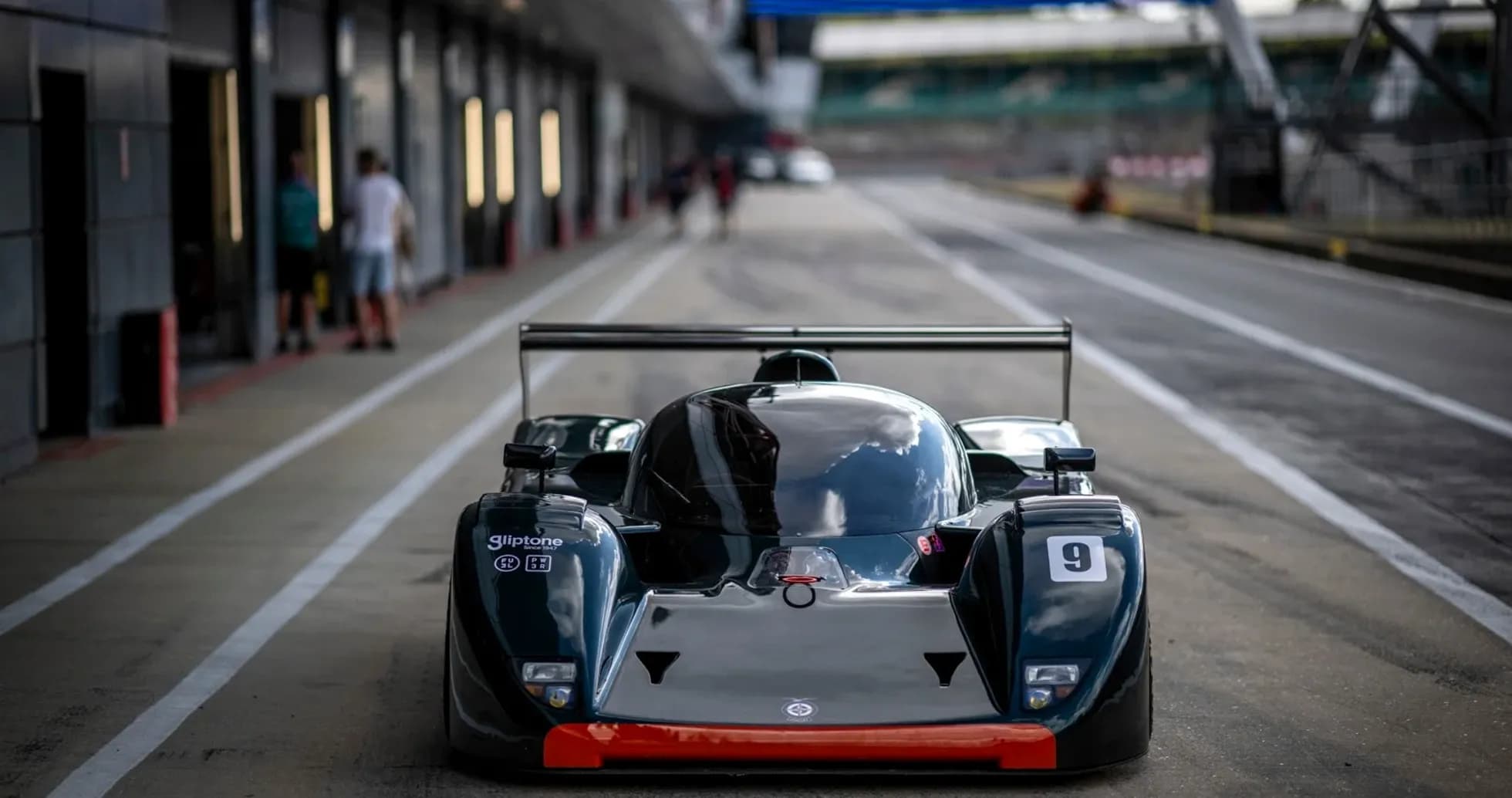
This past weekend, at Silverstone, the revived BRM P351 was unveiled in full period-correct form. Closed cockpit reinstated. Original lines recovered. The car looked once again like the machine that was supposed to attack Le Mans in 1992.
This isn’t a static museum piece. BRM has not brought the P351 back just to park it under spotlights and tell stories about what might have been.
A V12 Reborn for a New Era
Underneath the bodywork sits the heart that always defined the project: an in‑house 3.5‑litre naturally aspirated V12. The engine and transmission have been completely rebuilt, with Dawson Racing handling the intricate work of bringing the powertrain back to life.
There is a twist. The car now runs on sustainable fuel, a nod to the future layered onto a chassis born three decades ago. It is a rare fusion—heritage engineering, modern conscience.
BRM intends to race it. Not just parade laps, not nostalgia runs, but proper competition. The exact series and events have yet to be named, but the intent is clear: the P351 will go back to doing what it was built for—running hard, at speed, in anger.
Recreating a Lost Shape
One of the most striking elements of the restoration is the return of the closed cockpit. The roof that vanished during the car’s conversion to P301 spec has been recreated using surviving original paperwork and period photography. Reverse-engineering a silhouette from old documents and images is painstaking work, but the result is a car that once again looks like the Group C weapon BRM first imagined.
The project drew in support from across the motorsport world. Motul, Goodyear, and SKF Automotive were among those who helped drag the P351 out of the shadows and back into running condition.
So the car that once flashed to 216 mph on the Mulsanne before fading into the background is back, rebuilt, and ready.
The only questions now are where it will race—and who will dare to wrestle that howling BRM V12 to its limits this time.