.svg&w=384&q=75 "logo")
Boulter Blown Away by Muchova in US Open
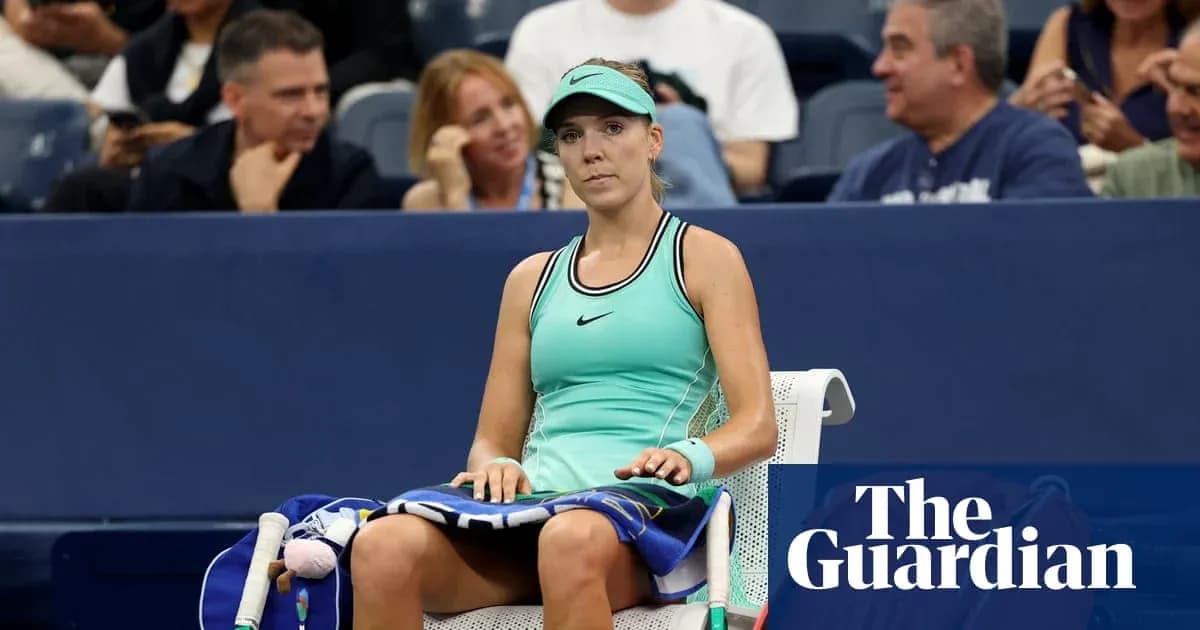
The rain hammered down on Flushing Meadows, driving thousands of fans under cover and forcing the schedule into chaos. On a day when the Billie Jean King National Tennis Centre felt half-submerged, there was no escape for Katie Boulter.
Under the closed roof of Louis Armstrong Stadium, with every stray word and clink of a beer bottle echoing around her, Britain’s No 1 endured a brutal 6-1, 6-0 defeat to the No 7 seed, Karolina Muchova, in the US Open second round. It was over in 59 harsh minutes. It felt longer.
Boulter blown away under the roof
This was supposed to be a lower-key assignment on Court 17, tucked in behind the men’s match between rising Spaniard Rafael Jodar and Yunchaokete Bu. Then the skies opened. With play suspended on the outside courts, Boulter and Muchova were upgraded to Armstrong, one of only two arenas still alive.
The upgrade felt like a trap.
Muchova, a Roland Garros finalist this year and one of the most complete players on tour, settled instantly. She glided into rallies, mixed spins and heights, dragged Boulter forward with knifed slices and then sent her scurrying back with heavy, accurate drives. The Czech’s trademark all-court game was on full display: soft hands, sharp angles, ruthless clarity.
Boulter simply never arrived.
The first set was gone in 27 minutes. The second was even more unforgiving. Boulter’s serve, usually a weapon, gave her little protection. Her forehand leaked errors. She won just one game all afternoon and never earned a break point. Every time she tried to reset, Muchova ripped the momentum away with another clean winner or a clever change of pace.
Afterwards, Boulter did not hide. She did, however, look stunned.
“She was better than me today for sure,” she said. “I think I’m probably struggling to be kind to myself, but I’m going to be right now. I struggled with the conditions. I struggled with the roof, I struggled with the noise. I kind of let these little things distract me a little bit. But ultimately, at the end of the day, it was a bad day at the office.”
Noise, nerves and a harsh lesson
This was Boulter’s first match on a New York stadium court. She had hit once before on Louis Armstrong, nothing more. The US Open is notorious for its restless crowds, and Armstrong is its loudest theatre: people wandering in and out, conversations bubbling during points, the constant hum of a city that refuses to whisper.
Boulter expected it to calm down. It never did.
“I actually expected it to kind of die down a little bit, but it didn’t,” she said. “I think from the first point of the match I was expecting the crowd to go silent, which is normally how it works. But it never changed.
“So I think in my mind I was like, ‘Okay, so you need to adjust here. You need to be ready. You need to work it out as we go along.’ And I think that was my plan.
“I always want to have an atmosphere. I always want to have noise. I love that. I normally relish that feeling. So for me today it’s a very different feeling to feel slightly distracted from that. It was a little abnormal for me.”
The honesty was striking. So was the context.
This has been a transformative year off the court for Boulter, who married ATP player Alex de Minaur in July. On it, though, the story has frayed. She opened the season brightly, winning a fourth WTA title in Ostrava and surging back into the top 60, a run crowned by a superb victory over world No 2 Elena Rybakina at Queen’s.
Then the slide began. Before her opening-round win in Cincinnati last month, she had lost five matches in a row, including a straight-sets defeat in the first round at Wimbledon. Confidence, once flowing, has become fragile. New York was a chance to steady things. Instead, Muchova slammed the door.
Jones digs in and pushes through
While Boulter tried to process a humbling afternoon, another Briton was quietly carving out one of the best wins of her career.
On an outside court repeatedly interrupted by the same rain that had sent Boulter indoors, Francesca Jones beat former top-20 player Magda Linette 6-4, 1-6, 6-3 to reach the US Open second round for the first time. It was not smooth. It was not pretty. It was exactly the kind of match a player with something to prove has to win.
Jones had sparkled on Tuesday, taking the first set 6-4 before the weather shut everything down. She returned on Wednesday, warmed up, then was dragged off again as the storm rolled back in. When they finally resumed, Linette came out blazing, racing through the second set and going 4-0 up in the third with blistering, first-strike tennis.
Jones refused to go away.
“It was incredible how she was playing until about 4-0 and then started to equal out,” Jones said. “But, you know, in that situation, hats off if they can maintain that. I just tried to show my northern grit, stick in there and do what I can.”
The phrase fit the match. Jones tightened her patterns, cut out the cheap errors and dragged Linette into longer rallies. As the Pole’s level dipped, Jones’s belief rose. She reeled off six of the last seven games to close out a victory that felt as much about resilience as shot-making.
It has been a punishing year for the 23-year-old. After breaking into the top 100 last season, she spent long stretches of this one on the sidelines, dealing with a string of injuries and a freak concussion that derailed her momentum. Only from July did she finally put together a sustained training block, and the results came quickly: back-to-back WTA 125 titles on clay, a restored rhythm, a renewed edge.
By the time she arrived in New York, Jones had already battled through three rounds of qualifying. Linette, a former Australian Open semi-finalist, was supposed to be a stern barrier. Instead, she became the marker for one of the most important wins of Jones’s career so far.
Mixed fortunes for the British men – and a shock on Court 17
The British men’s results told a more familiar story.
Jan Choinski went out 6-3, 6-1, 7-6(5) to Botic van de Zandschulp, unable to turn a late third-set push into anything more. Jacob Fearnley, a lucky loser drafted into the main draw, fell 6-3, 6-3, 3-6, 6-3 to the No 27 seed Tomas Etcheverry, showing flashes of promise without quite unsettling the Argentine’s control.
The day’s biggest jolt came on Court 17, where the much-hyped 19-year-old Rafael Jodar was taken apart by Yunchaokete Bu. The Chinese player tore through the match 6-2, 6-1, 6-1, silencing the chatter around one of the tournament’s most talked-about prospects with a ruthless, one-sided demolition.
Back under the Armstrong roof, Boulter’s defeat still lingered. A life-changing summer, a stuttering season, and now a harsh New York lesson in noise, expectation and the thin margins at the top level. The question is no longer whether she belongs on these stages. It is how quickly she can turn a “bad day at the office” into the spark for something sharper when the new season rolls around.