.svg&w=384&q=75 "logo")
Ben Shelton's US Open Final Journey and Zverev's Dominance
Ben Shelton had no right to still be standing.
For nearly three hours inside Arthur Ashe Stadium, the American had been bullied by the heavier serve, the steadier baseline game and the colder nerve of Alexander Zverev. The match felt settled long before the scoreboard said so. Yet at 5-6 in the third set, one game from defeat, Shelton finally swung as if the occasion belonged to him.
He tore into Zverev’s serve, uncorked the forehand that had gone missing, and broke for the first time. Fist pumping, cupping his ear to the crowd, he dragged the US Open men’s final into a fourth set and tried to light a fire under a flat afternoon.
The flame went out almost immediately.
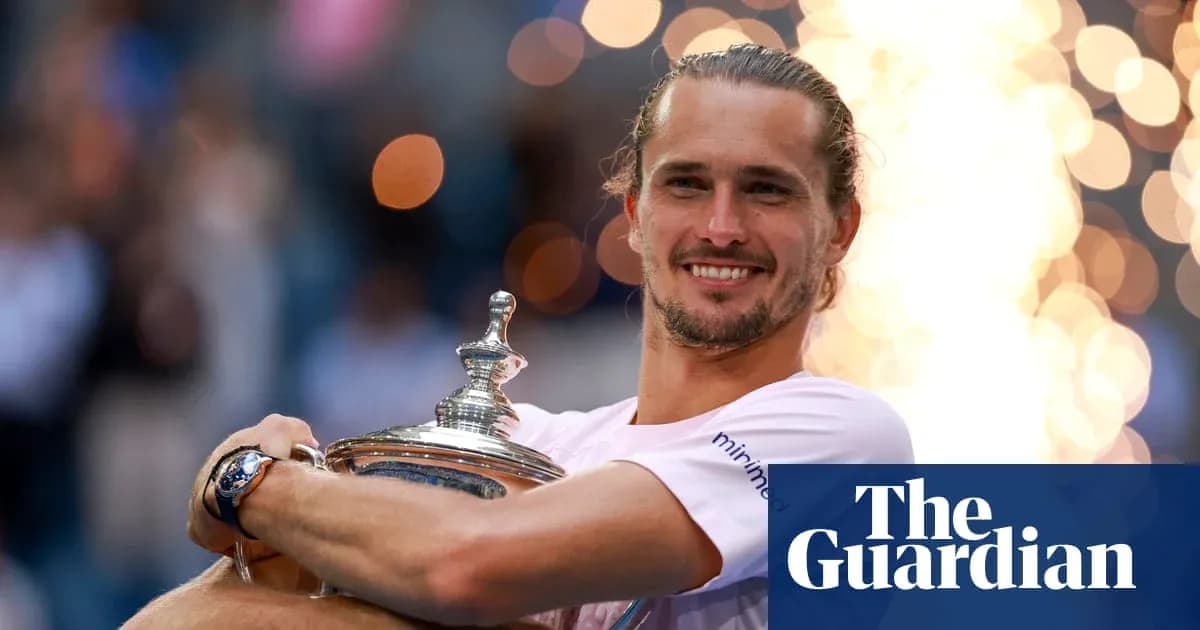
Shelton opened the fourth set with a nervy service game, surrendered his serve at once, and the top seed never loosened his grip again. Zverev closed out a 6-3, 7-6 (2), 5-7, 6-2 win to claim his second grand slam title of the year and complete a season that has quietly become historic.
Zverev’s ruthless hold on the rivalry
For all the noise around Shelton’s rise, one detail in this matchup refuses to budge: the head-to-head. Zverev now leads 6-0. It is not a rivalry. It is a blueprint.
The German knows exactly where to go and how to get there. He served better, he missed less, and he used his elite two-handed backhand to smother the left-hander’s forehand, the very shot Shelton needs to dictate. When Shelton tried to step in, Zverev met him with depth and weight; when Shelton backed off, Zverev rolled forward and took the court away.
On a day that featured two of the biggest serves in the sport, the first job for each man was simple: protect your delivery. Shelton failed that assignment from the start. Visibly tight, he double-faulted on break point in the opening game of the match. When he had a chance to at least force Zverev to serve out the first set, he double-faulted again on set point. Two gifts, two breaks, and a 6-3 deficit that felt heavier than a single set.
From the back of the court, he was outgunned. The forehand that had carried him through the summer sprayed too often, and Zverev’s calm, metronomic hitting kept dragging him into rallies he couldn’t control.
Zverev, by contrast, served with authority from first ball to last. He landed 69% of his first serves and won 85% of those points, a suffocating platform that allowed him to swing freely on return games and to dictate the tempo of almost every big moment.
Tie-break steel, title composure
Shelton did eventually find some rhythm on serve in the second set. He held with more conviction, pushed Zverev back at times, and at least forced the German to think. The crowd sensed a foothold, clung to it, and roared him into a tie-break.
Zverev tore it away.
He grabbed the first mini-break with a precise forehand passing shot after a tentative approach from Shelton, then ripped a vicious forehand down the line to earn a second. With two booming unreturned serves, he raced to 5-0 in the breaker. The set, for all practical purposes, was finished. The margin was small on paper, enormous in reality.
Shelton’s third-set surge, brave and defiant as it was, never quite shook that feeling. He forced Zverev to stay out there longer, to keep serving, to keep thinking. But the match always seemed to be heading in one direction. Once Zverev broke to start the fourth, the contest turned into a procession.
A season of opportunity, and one man who took it
This final doubled as a verdict on a grand slam season that never quite caught fire on the ATP tour. Carlos Alcaraz spent much of the year battling injuries and long layoffs. Jannik Sinner, too, saw his momentum chopped up by physical problems. The two young stars who have defined the sport’s new wave left a vacuum at the top.
Plenty of players were handed chances. Few truly seized them.
Zverev did. He began the year still chasing his first major, his career defined as much by near-misses and physical setbacks as by his titles. Now he stands as just the fourth man in the Open era—after Jimmy Connors, Guillermo Vilas and Jannik Sinner—to win his first two grand slam titles in the same season.
He has done it with relentless consistency, by repeatedly playing himself into the final weekends of majors and hardening with each deep run. The more often he has walked into those pressure matches, the less they seem to weigh on him.
The shadow that won’t disappear
Yet Zverev’s success carries a weight that has nothing to do with tennis.
He has been accused by two former partners, Olya Sharypova and Brenda Patea, of physical abuse. During his run to the French Open final in June 2024, he settled an assault case in Germany relating to allegations that he pushed and strangled Patea, the mother of their daughter. The case ended without a verdict. A court spokesperson stated: “The truth remains open.” Zverev denied the charges and has denied all allegations against him.
The disquiet has followed him around the world. At the Australian Open last year, a fan heckled him before his trophy ceremony speech, shouting: “Australia believes Olya and Brenda.” This season’s three grand slam finals, though, have passed without incident. Inside stadiums, he remains a popular figure, his tennis still drawing cheers even as many viewers watch with unease.
Shelton’s leap, and the gap that remains
Across the net, Shelton’s story this summer has been one of rapid ascent. He arrived on the North American hard courts trying to shake off a painful first-round exit at Wimbledon. He leaves with the best stretch of his career: a second Masters 1000 title at the Canadian Open, a first grand slam final, and a new career-high ranking of No 4.
His run is proof of real, sustained improvement. At 23, he has time, power and ambition on his side.
But the final also exposed the gap that still exists between him and the game’s most complete players. His return of serve remains raw. His ground game, particularly under scoreboard pressure, can unravel against elite pace and precision. On this lonely Sunday inside Arthur Ashe Stadium, those flaws were dragged into the spotlight and pulled apart.
Shelton’s dream of becoming the first Black American man since Arthur Ashe in 1968—and the first American man since Andy Roddick in 2003—to win the US Open will have to wait. Zverev, unflinching and unyielding, slammed that door shut.
The question now is simple: when this stage comes around again, will Shelton’s game be ready to kick it back open?