.svg&w=384&q=75 "logo")
Ben Shelton Reaches First Grand Slam Final at US Open
For 23 years, the names have rolled by like credits after a film America never quite finished. Andy Roddick swung and swung again. Andre Agassi made one last charge. James Blake, Mardy Fish, Sam Querrey, John Isner, Tommy Paul, Taylor Fritz – all good enough to linger into the second week, none able to smash through the sport’s hardened European ceiling.
On Friday night in New York, beneath the lights of Arthur Ashe Stadium, Ben Shelton kicked at that ceiling again. This time, it cracked.
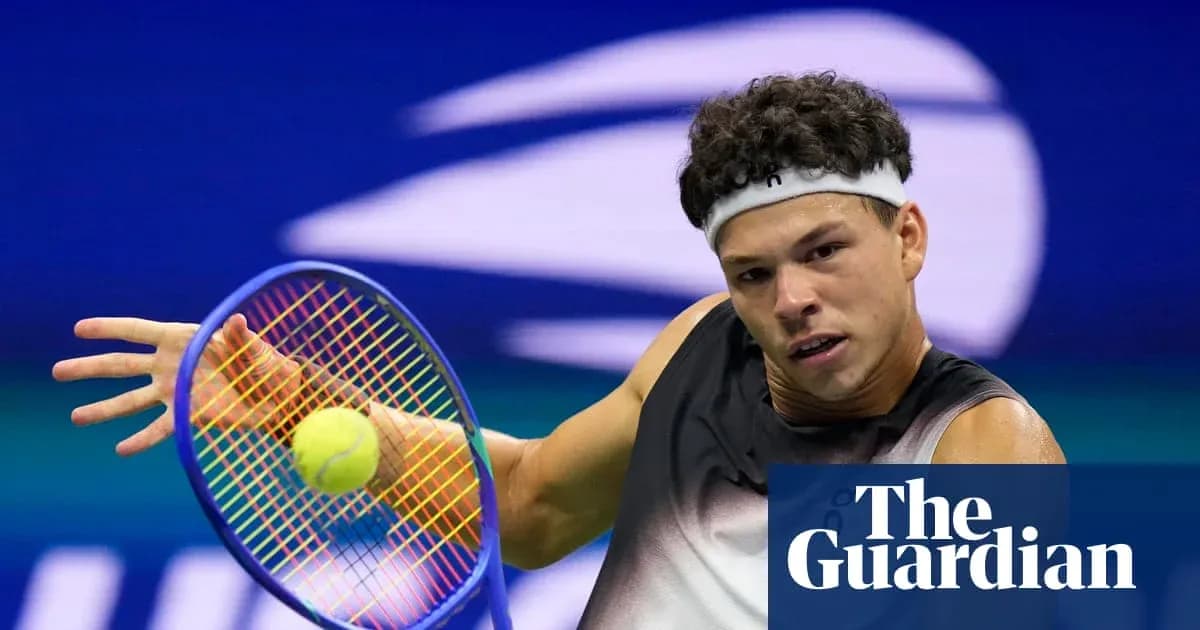
The 23-year-old from Atlanta, all swagger and steel, reached his first grand slam final with a 4-6, 6-3, 6-3, 7-5 win over Frances Tiafoe in a riveting all‑American US Open semi-final that felt less like a tennis match and more like a statement. One more win, and he becomes the first American man to win a major since Roddick lifted this same trophy in 2003.
A night that felt different
From the opening ball, Ashe was locked in. No low hum of conversation, no distracted buzz that so often floats over night sessions in the sport’s biggest arena. Nearly 24,000 people leaned into every point, riding each momentum swing, cheering both men with the kind of noise that rattles the lungs.
Tiafoe struck first. The 11th seed played the cleaner tennis early, waiting for Shelton’s range to settle and pouncing when it didn’t. At 4-4, 30-0 on his own serve, Shelton suddenly unraveled, dropping four of the next five points and double-faulting on break point. Tiafoe needed only a calm, clinical hold at love to close out the opening set in 45 minutes.
For a player in his first major semi-final, that could have been a wobble that lingered. Shelton refused to let it.
He came out in the second set like someone had flipped a switch, breaking at love for 2-0 with a burst of controlled aggression. Tiafoe hit back immediately, but the tone had changed. The younger American began to lean fully into the weapon that has carried him to the sport’s top tier: a first serve that doesn’t just win points, it alters matches.
Serving at 3-all, Shelton unleashed a sequence that underlined the gulf in raw power. One delivery at 125mph, then 144mph, then 139mph, then 140mph – the last two aces, the kind of barrage that leaves opponents staring at the court more than the ball. He broke in the next game and sealed the set with a 149mph first serve that seemed to echo off the Ashe roof.
The match had flipped. The building knew it.
From shot-maker to problem-solver
The third set turned into a grind. Rallies stretched. Patterns deepened. Tiafoe, 28 and seasoned, tried to drag Shelton into longer exchanges, away from the quick-strike chaos that suits him.
At 1-1, Tiafoe wriggled out of break points with stubborn defence. At 2-2, he couldn’t escape. Shelton, once known almost solely for his serve and explosive forehand, stitched together a series of backhand winners to break at love. The shot-maker was now the one dictating from the baseline.
Then came the game that defined the night.
Serving at 3-5, Tiafoe stepped into a 20-point, 15-minute epic, fighting to keep the set alive. He saved three set points with bold hitting and sheer grit. On the fourth, he pushed a forehand into the net. Shelton had the set, and with it, a stranglehold on the match.
“His game is starting to get more polished,” Tiafoe said afterwards. “Instead of just being a shot maker, he’s actually staying tough in the rallies.”
The numbers back it up. Shelton once built his tennis around that serve and little else. Now he’s added layers: a more solid return, greater baseline stability, deeper concentration. He even points to his sleeping habits as part of the transformation. The result is a player who no longer just blasts through opponents but wears them down and thinks his way through matches.
Tiafoe’s window closes
If Tiafoe was going to turn it around, it had to happen at the start of the fourth. He knew it. The crowd felt it.
He carved out 15-40 on Shelton’s serve in the opening game, the door suddenly wide open. Shelton slammed it shut with two serves that told the story of his fortnight: a 140mph ace to erase the first break point, a 144mph bomb that Tiafoe couldn’t put back in play to save the second.
From there, they traded holds, tension building with every game. At 5-5, the match seemed to be drifting toward a tiebreak that might have dragged the night into a fifth set and all the chaos that comes with it.
Shelton never let it get that far.
He held for 6-5, then attacked. Two extended rallies, both won by Shelton, dragged the score to love-30 on Tiafoe’s serve. One more point, and he had three match points in his hand. Tiafoe saved the first. On the second, his arm tightened at the worst possible time. A double fault. The stadium, electric all night, fell briefly silent as reality sank in.
After 3hr 16min, it was over. Shelton had not only outgunned Tiafoe. He had outlasted him.
History, and a new standard
Shelton walked off into a slice of history that reaches far beyond rankings and seedings. He is the first Black American man to reach the US Open singles final since Arthur Ashe in 1972, and the first Black American man in any grand slam singles final since MaliVai Washington at Wimbledon in 1996.
Those are heavy names and heavy milestones, but he insisted he’s kept the occasion at arm’s length.
“Yes, I can think about how cool this moment is and what I’m playing for,” he said. “At the end of the day, I’m here in New York, I’m hanging out with my team, I’m with my homies playing a little bit of tennis and I’ve been able to downplay the moment pretty well.”
It helps that he arrived here battle-hardened. In the quarter-finals he survived a five-set war against defending champion Carlos Alcaraz, a match that ended at 3.33am on Wednesday and snapped the Spaniard’s 18-match winning streak at the majors. It was Shelton’s first win over a top-three opponent after 17 failed attempts. There were no visible signs of that marathon on Friday night.
Tiafoe had emptied his own tank to get here, clawing back from two sets down and two points from defeat to beat Alex Michelsen in a final-set tiebreak in the quarters. Yet once again, the US Open stopped him one step short. For the third time in five years, his run ended in the semi-finals.
“That’s why I just want to win it, man,” he said. “The love is incredible. It’s something that gives me definitely tears in my eyes from a kid starting how I did, and the love I have here is crazy.”
From college courts to the biggest stage
Shelton’s rise has been fast, but not shallow. He won the NCAA singles title for the University of Florida in 2022, turned pro, and within months reached the Australian Open quarter-finals. Later that same year, he was in the US Open semi-finals.
The seasons that followed were about craft, not just noise. He stacked titles in Dallas, Munich, Stuttgart and Montreal, quietly turning raw tools into a complete arsenal. Now he talks about his game with the clarity of a player who knows exactly who he is.
“I feel that I’m a different player. I feel like I have so many more tools. I feel like I know my identity, am comfortable in my own skin, and I know what it takes for me to be playing top-level tennis.”
On Friday night, he backed that up with something else: remarkable composure.
“I was honestly shocked with how calm I was out there today, especially towards the end of the match,” he said. “Calm, confident, focused. I think that that’s what it takes to be in these positions and win at the highest level.”
One last problem to solve
Now comes Alexander Zverev, the top seed, the last obstacle between Shelton and a generational breakthrough for American men’s tennis.
The head-to-head is brutal. Shelton has faced the German five times in a 16‑month span across 2024 and 2025. He has lost all five. They’ve never met at a grand slam. They will on Sunday afternoon.
On paper, Zverev owns the matchup. On form, Shelton doesn’t sound remotely intimidated.
“Problem-solving has been the name of the game here,” he said. “I‘m looking forward to the challenge, being able to problem-solve on Sunday. I know what I’m up against, and I’m also the most confident I’ve ever been in my game.”
For two decades, American men have chased the ghost of 2003. On Sunday, a 23-year-old with a cannon for a serve and a mind increasingly built for the long haul walks into Ashe with the chance to redraw the sport’s balance of power – and to finally finish the story others started.