.svg&w=384&q=75 "logo")
Alexandra Leclerc's Fashion Statement at the Spanish Grand Prix
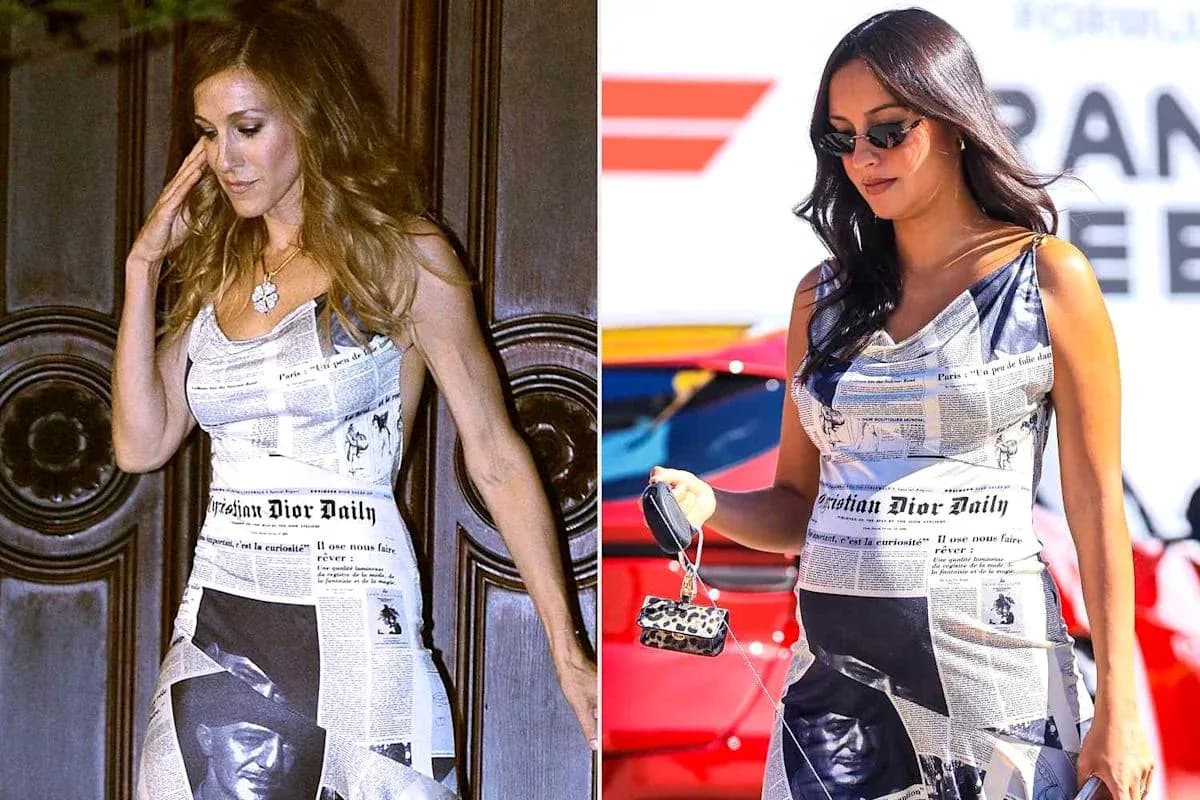
On a weekend built on speed, it was a dress that hit the brakes on the paddock.
At the Spanish Grand Prix in Madrid, Alexandra Leclerc – newly married to Ferrari’s Charles Leclerc and expecting their first child – turned the pit lane into a slice of early-2000s fashion history. She arrived in Christian Dior’s now-iconic newspaper dress, the John Galliano design that stormed the Fall/Winter 2000 runway and later became a pop culture artifact on Sex and the City.
This wasn’t a subtle nod. It was the dress.
The same bold, print-plastered mini that Sarah Jessica Parker’s Carrie Bradshaw made famous in season 3, and again in Sex and the City 2, resurfaced not at a New York gala or fashion week, but on the asphalt edge of a Formula 1 circuit. Alexandra, 26, matched the vintage piece with a coordinated purse, black open-toe heels and her trademark small sunglasses, with her dog Leo trotting alongside like a seasoned paddock regular.
A dress once debated. Now, undeniably desired.
When Galliano first sent the newspaper print down the runway as part of his Hobo collection, it caused a stir. The line drew from what he saw while jogging – displaced people on city streets – and from the “Tramp Ball” trend of the 1920s and 30s, when the wealthy dressed as the homeless for opulent parties. The inspiration, reported at the time by CNN, sparked criticism. Then Sex and the City got hold of it, and the dress crossed over from controversy to cult status.
From there, it refused to fade. In 2025, Jenna Ortega revived the look on the Hurry Up Tomorrow red carpet, proving the design still had bite a quarter of a century on. Alexandra’s turn at the Spanish Grand Prix pushes it into yet another arena: the high-octane, hyper-photographed world of Formula 1.
This is not a one-off cameo. It’s a pattern.
As the F1 season gathers pace, Alexandra has been quietly building a reputation as one of the paddock’s most watchable figures. At free practice on Friday, Sept. 4, at Autodromo Nazionale Monza in northern Italy, she arrived in a black keyhole cutout dress scattered with white polka dots, finished with a bow-tie halter neck. Hair pulled back into a tight, slick bun, the look was sharp, controlled, and made for cameras.
The following day, she switched gears. An all-black, knee-length dress with a plunging halter neckline, paired with black kitten heels and the same narrow sunglasses, delivered a different message: less playful, more sculpted, still unmistakably her.
The grid has always attracted style – from team principals in tailored suits to drivers stepping out in streetwear deals – but Alexandra is treating race weekends like a rolling editorial. And the fashion world has noticed.
Her eye for viral looks first caught the attention of Hailey Bieber. Rhode, Bieber’s beauty brand, named Alexandra its first “muse-ambassador,” a title that underlined her influence beyond the paddock. She later collaborated with the label on her own collection, leaning into a beauty philosophy she summed up simply: makeup that looks and feels like skin.
Now that same sensibility is bleeding into her race-day wardrobe. Clean lines, strong silhouettes, a willingness to pull from the archives. Vintage Dior at a Grand Prix is not an accident; it’s a statement.
With the season still revving up, the question is no longer whether Alexandra Leclerc will stand out trackside. It’s how far she’s prepared to push the idea of a WAG turning the F1 circuit into a runway – and who in the fashion world will try to keep up.