.svg&w=384&q=75 "logo")
Alex de Minaur Faces Tough Loss at US Open: A Turning Point Ahead?
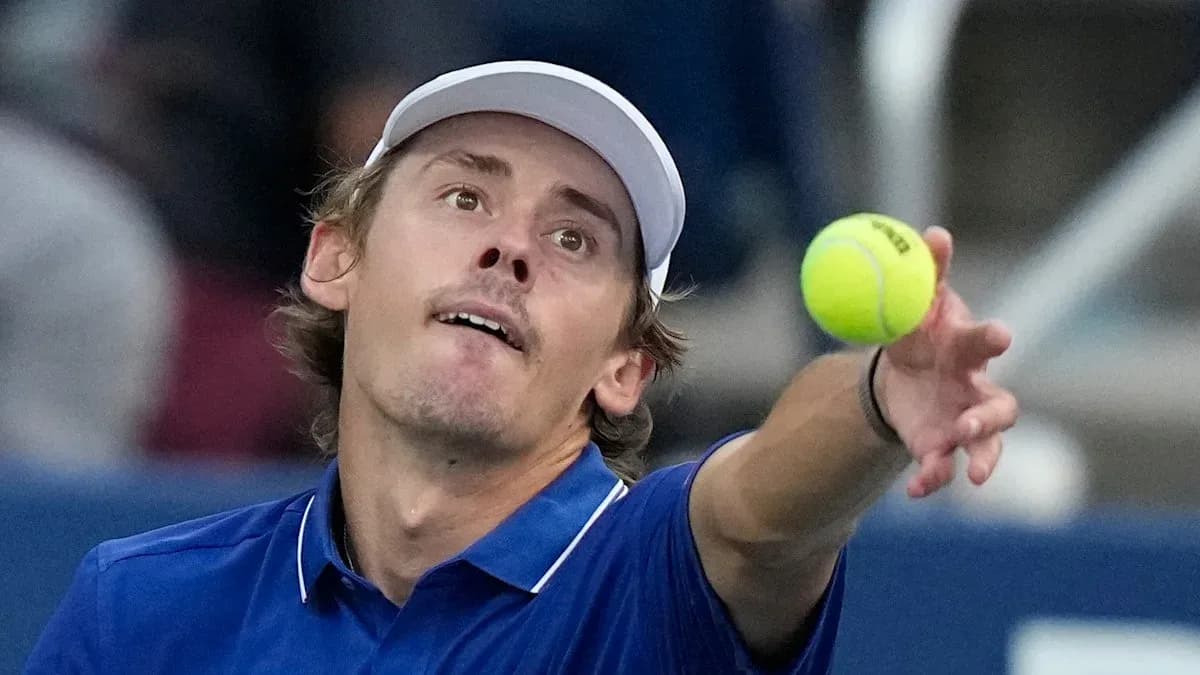
Alex de Minaur walked into New York with history on his side and left with a blunt assessment of where his tennis sits.
Four wins from four against Botic van de Zandschulp meant this second-round clash looked, on paper, like a platform to rebuild confidence. Instead, it became another jagged line in a worrying form graph as the Australian fell 6-4, 7-5, 6-2 in a flat, error-strewn display that never really caught fire.
Rust, rush and a forehand gone missing
The warning signs were there from the first ball.
Backing up barely a day after a delayed first-round win over Italian qualifier Andrea Guerrieri, de Minaur looked rushed, rusty and oddly disconnected from his own game. The usually watertight forehand – a cornerstone of his baseline aggression – abandoned him. Routine balls flew long. Put-away chances died in the net. Others sailed metres past the baseline, drawing gasps more than applause.
He knew it, too.
“My level today wasn’t good enough. It’s pretty straightforward,” he said, offering no alibis, only honesty.
He spoke of a feeling every player dreads: when the ball simply will not sit on the strings the way it should.
“I gave myself every chance by being competitive, having a good mindset, a good attitude, but it was just one of those days where just the feeling of the ball on the strings wasn’t there.
“I was making a lot of errors, which is not really my normal game style. I can't really explain the reasoning of it, but just it felt like the more I tried, the more intensity, the more fired up I was getting, I just kept on making unforced errors.
“When those sort of things happen and the odd chance that you have, he comes out with some good tennis – it's just a recipe for a tough day at the office.”
The pressure finally told in all the wrong ways. Points he usually grinds his way through slipped away in a handful of swings. Van de Zandschulp didn’t need to be spectacular; he only had to be solid and ready when the door opened. It opened often.
Calm words, restless season
If the performance was ragged, the reaction was not.
There was no racket smash, no rant. Just a player clearly frustrated but refusing to spiral.
“Obviously would have loved to do better, as any competitor would, but it’s what happens in this sort of sport. Everyone loses matches,” de Minaur said.
“Everyone is losing matches that maybe they would love to have back.
“… It’s one I would love to have back, but we move forward and it’s not the end of the world.”
It has, however, become a pattern he can no longer ignore.
This US Open exit follows a third-round loss at Roland-Garros and a fourth-round defeat at Wimbledon, both coming after the high of a seventh grand slam quarterfinal at the Australian Open. The Slam season started with promise in Melbourne and has slowly bled momentum since.
The slide has not been confined to the majors. Early departures at recent ATP Tour events have fuelled a louder question around de Minaur’s camp: is it time to move on from long-time coach Adolfo Gutierrez?
A partnership under the microscope
De Minaur and Gutierrez are not a typical tour pairing. They are closer to a tennis lifetime partnership.
They have worked together for the better part of two decades, dating back to de Minaur’s move to Spain at the age of nine. In a sport where coaching changes can feel as frequent as changeovers, their longevity stands out.
From the Nine commentary box, Jelena Dokic acknowledged both sides of that coin. She said she wasn’t surprised calls had started for a split, but pointed to what the relationship had already produced.
“Only Alex knows what he needs … a lot of players will change coaches quickly, especially if they feel like the results are not there,” she said.
“That’s up to him to make those decisions and what he wants to do. Let’s not forget Adolfo has gotten him to such a high point in his career – to the top five in the world.”
The numbers back that up. Gutierrez has overseen de Minaur’s climb into the sport’s elite. Yet even the most successful partnerships hit crossroads, and the Australian’s recent body language has hinted at a deeper struggle than just technical tweaks.
The perfectionist’s burden
The most striking image of his season came not in New York, but at Wimbledon, where de Minaur looked on the verge of tears as he tried to process another performance that fell short of his own expectations.
Dokic believes that internal battle is now as important as any tactical adjustment.
“We know his mindset, we know what a perfectionist he is. He wants to get to the top and maybe not doing that in the last two years has affected him,” she said.
“For him, wins have become almost a relief and not so much satisfaction and joy, and that's hard. Losses have almost been end-of-the-world type things. He's been really, really hard on himself. I think he has to give himself a bit more of a pat on the back and a bit more credit.
“Whatever he decides to do with coaching, the way that he goes about things and the mindset around it is going to have to change. It's very hard to keep this up, to constantly expect from yourself to win. That's been an issue for him.
“When you've got the constant pressure of feeling like you want to win and get to the top, and maybe that's not quite happening the way you want to, you can start to lose motivation, you can get really flat.
“I think that that’s what’s happened – he’s lost a little bit of that mojo to be out there.”
The word “mojo” cuts to the heart of it. De Minaur’s game has always been built on speed, grit and relentless competitiveness. When joy drains away, those qualities can start to feel like chores rather than weapons.
Dokic also floated another practical step: reassessing his schedule and trimming his workload. A lighter calendar might help him reset mentally as much as physically.
One Aussie left standing
While de Minaur packed his bags, another Australian was busy writing a very different story in New York.
Dane Sweeny, earlier in the day, stunned Italian No.13 seed Lorenzo Musetti to become the last Australian standing in either singles draw. On a day that underlined de Minaur’s struggles, it also underlined the depth and opportunity in Australian tennis.
For de Minaur, the picture is more complicated. The ranking remains high, the résumé strong, the work ethic unquestioned. Yet the questions now are bigger than a misfiring forehand or a bad day at the office.
Does he change the voice in his corner? Does he change the way he measures himself? Or does he simply double down on the partnership and personality that carried him this far, trusting that the form will follow?
The answers will shape not just his next few months, but the next phase of a career that has reached the top five and now stands at a quiet but unmistakable crossroads.