.svg&w=384&q=75 "logo")
Alex de Minaur's US Open Exit Highlights Season Struggles
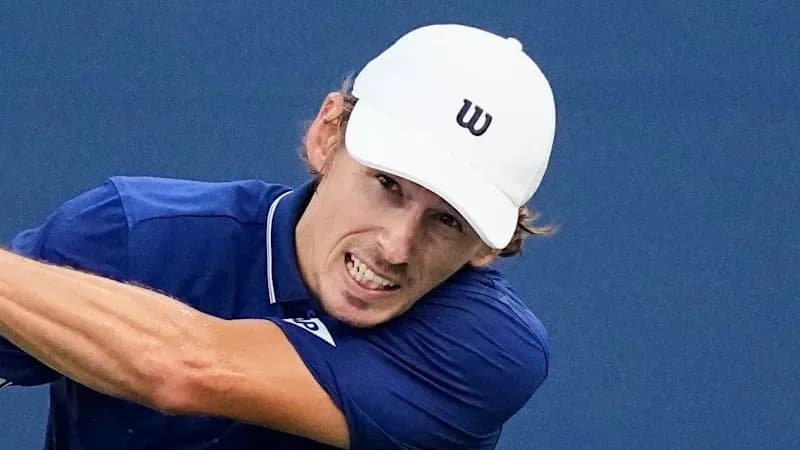
Alex de Minaur’s flat US Open exit has put his top-10 status on the clock and underlined a sobering truth about his season: the early surge of 2026 has well and truly stalled.
The world No.7 was out-hit and out of rhythm in a 6-4, 7-5, 6-2 loss to Botic van de Zandschulp in the second round at Flushing Meadows on Friday (AEST), his earliest departure in New York in five years and the full stop on his least productive grand slam campaign since 2023.
“My level today wasn’t good enough. It’s pretty straightforward,” de Minaur said, offering no excuses.
He tried to fight his way into form, but the ball never obeyed. The Australian, usually so clean and disciplined, sprayed errors, racked up seven double faults to only four aces and dropped serve five times. He faced 11 break points. Too many for a player whose game is built on precision and relentlessness.
He has lost this early at a major only twice in his past 13 appearances. Both the timing and the manner of this defeat will sting.
From contender to concern
De Minaur opened the year like a man ready to plant himself among the elite. He reached a second Australian Open quarter-final in January and briefly looked poised to consolidate his new top-10 status.
Since then, the graph has been pointing the wrong way.
He went out in the third round at Roland-Garros, the fourth round at Wimbledon, and has not gone beyond a quarter-final at any tournament since February. The emotional toll showed after his Wimbledon loss to Flavio Cobolli, when he admitted that failing to deliver on that stage “breaks me inside”. The results since have done little to repair that crack.
Against van de Zandschulp, the same unease resurfaced. A double fault left him a set and a break down at 6-4, 4-3. Then came a slice of luck that could have flipped the script: after a scrambling defensive exchange, a de Minaur backhand clipped the tape and died over the net for a winner, giving him 15-40 and a lifeline.
He grabbed it, broke back, and briefly looked like he might drag the match into the trenches he usually loves. He levelled, then edged ahead. The crowd sensed a shift.
But the pressure game at 5-5 in the second set told the real story. De Minaur fought through four break points, only to surrender on the fifth. Van de Zandschulp, who had never beaten him in four previous meetings, stepped in, took the ball early and refused to blink. A mishit return that landed short set up the Dutchman’s forehand pass for the decisive break, prompting an apology across the net. De Minaur still had a play, and missed it.
Two sets down, history loomed. He had never overturned that deficit in 27 attempts. This was not the day to change that.
He left the court after the second set, tried to reset, tried to raise the tempo. The body language sharpened, the feet moved quicker, but the forehand broke first. He flayed one long to lose serve in the third game, squandered two break points in the next, then saw van de Zandschulp crack him again. By then, the contest was over in everything but name.
On paper, it reads as an upset: a world No.7 falling to a player outside the top bracket. In reality, the Dutchman arrived in better form and with pedigree in New York, having knocked out Carlos Alcaraz at this tournament two years ago. De Minaur, by contrast, has looked increasingly vulnerable.
His ranking now hangs in the balance in the coming weeks. The question is no longer whether he can rise further, but how far he might slide.
Sweeny seizes his moment
On the same day that de Minaur trudged out of Arthur Ashe Stadium crestfallen, another Australian walked off a side court in disbelief.
Dane Sweeny, a 170-centimetre grinder ranked No.123, produced the win of his life, dismantling Lorenzo Musetti 3-6, 6-1, 6-2, 6-2 to reach the third round of a grand slam for the first time.
It is his first victory over a top-20 opponent and it came on one of the sport’s biggest stages. For a player who has spent most of his career well off Broadway, this felt like the lights finally came up.
Little in Sweeny’s journey has been straightforward. Two years ago he stepped away from the sport for several months during a form slump, convinced he was close to a breakthrough but unable to make the results match the work. He came back anyway.
“I put a lot of work in. The tennis journey is such a rollercoaster,” he said, soaking in the moment. “I’m so incredibly grateful to play in front of an awesome crowd and to soak up this moment. To win, and to get a couple of wins, is awesome.”
He framed it as a numbers game as much as a dream.
“Tennis can change on the flip of a coin. You’ve just got to keep persevering, and that’s what I did. I wasn’t getting results for a long while, but there’s a law of probability. I knew it was somehow going to swing in my favour if I just kept going, and I did. Now I’m here, and it’s the best decision I ever made to come back after that two months.”
Musetti, a dual grand slam semi-finalist, unravelled physically after taking the opening set. He laboured through the final three sets, often hunched over between points and clearly under the weather. He left the court for a medical timeout at 3-0 down in the third, flickered briefly, but never truly recovered.
Sweeny, crucially, did not blink. He hunted every ball, pounded his forehand, and twice broke back immediately after losing serve. Each time Musetti hinted at a revival, the Australian slammed the door, starting the fourth set with another break and never letting him back in.
The win guarantees Sweeny a cheque north of $400,000 and a provisional rise to a career-high live ranking of No.109. His reward is another seeded Italian, Luciano Darderi, and another chance to turn a wildcard into something far bigger.
He was never meant to be here in this way. Sweeny was originally slated for qualifying, but a series of withdrawals allowed Alexei Popyrin to squeeze directly into the main draw, shifting Tennis Australia’s reciprocal wildcard into Sweeny’s hands. He has turned that stroke of administrative fortune into his first grand slam win outside Melbourne Park, after Corentin Moutet retired hurt in their opening-round clash.
Now, he has turned it into a statement.
Kyrgios accepts ban as integrity spotlight returns
While one Australian star wrestled with his form and another rode a wave of momentum, Nick Kyrgios’ name reappeared for very different reasons.
The International Tennis Integrity Agency confirmed that Kyrgios accepted a one-month suspension for out-of-competition use of cocaine. The ban, reduced from three months after he agreed to enter a treatment program, stems from social use on a night out before he competed in Mallorca.
His provisional suspension became public last month, prompting Kyrgios to apologise to his family, friends and fans for what he called a “huge mistake”. He admitted the cocaine use to the ITIA.
The suspension officially ended on Thursday, provided he completes the treatment program, but he has forfeited his prizemoney and ranking points from the Mallorca event. Former doubles partner and long-time rival Stefanos Tsitsipas said after his first-round win in New York that the development did not surprise him and that he had been aware of the situation.
Near misses and exits for the rest
For a time, it looked like Sweeny might not be the only Australian to floor a high-profile Italian.
Qualifier Tristan Schoolkate, facing Roland-Garros finalist Flavio Cobolli, came out swinging and took the first set. The upset flickered, then faded. Cobolli, seeded No.5, steadied and prevailed 3-6, 6-3, 6-4, 7-5.
Alexei Popyrin’s campaign ended with a thud. He burst out of the blocks against 25th seed Alejandro Tabilo, taking the opening set 6-2, but the Chilean left-hander dialled in his serve and tiebreak nerve. Popyrin dropped two tight breakers 7-6 (7-4), 7-6 (7-3) and faded 6-2 in the fourth, leaving the court a dispirited figure.
The wider draw added its own shocks. Third seed Felix Auger-Aliassime bowed out in four sets to Karen Khachanov on another turbulent day for the men’s seeds. Coco Gauff, Iga Swiatek, Taylor Fritz and Naomi Osaka all moved through, holding their ground as the chaos swirled around them.
A crossroads for Australian tennis in New York
By the end of a long, strange day at Flushing Meadows, the picture for Australia was stark.
Alex de Minaur, a two-time US Open quarter-finalist and the country’s standard-bearer, was out early and searching for answers in a season that has veered away from the trajectory he set in January. Nick Kyrgios’ future remains clouded by off-court decisions and the demands of a treatment program.
In their place, Dane Sweeny, once on the verge of walking away from the sport, stands as the last Australian singles player left in the draw, carrying the flag into the third round.
For de Minaur, the next few weeks will decide whether this is a temporary dip or the start of something more troubling. For Sweeny, the question is simpler: how far can he push this unexpected run now that the lights are finally on him?