.svg&w=384&q=75 "logo")
2026 FIBA Women’s World Cup: Team USA Faces New Challenges
In Berlin, the standard for women’s basketball doesn’t just get defended. It gets tested.
When the 2026 FIBA Women’s World Cup tips off on Friday, Sept. 4, the sport’s dominant force arrives with a familiar target on its back and a very different kind of pressure. Team USA has won nine of the last 12 World Cups, including the past four, but this edition feels less like a coronation and more like a gauntlet.
Sixteen teams are in the field — back to the expanded format last seen regularly before 2018 — and Kara Lawson, in her first World Cup as head coach, is under no illusion that history guarantees anything.
“The world is improving at a rapid rate,” she said this week, and there was no hint of cliché in her voice. She sees it every day. As Duke’s head coach since 2020, she’s watched teenage prospects from across the globe grow into polished, fearless pros. Now many of them are on the other side of the bracket.
A deeper, sharper World Cup
Lawson has lived this tournament from both angles. In 2008, she wore the USA jersey and delivered 15 perfect points on 5-of-5 shooting in the gold medal game against Australia, adding three rebounds, two assists and a steal. Now she returns as the one holding the clipboard, charged with extending a dynasty in a field that looks stronger and deeper than at any point in her playing days.
“When you look at rosters, there’s a number of just high quality players,” she said. “I think the depth of these rosters is really strong. I think it’s gonna be the most difficult World Cup to win that we’ve had because of that, which is exciting.”
She welcomes the difficulty. She insists it should be hard.
“It’s a World Cup, you know? It’s the best teams, and it’s a tough schedule, and it’s a short — it’s all those things you want to say it is, but at the end of the day, every team’s job is to try and win this. And so we’re hungry, and we’re focused on trying to put our best performances on display and see if we can get the job done.”
The message is clear: the badge alone won’t win it. The gap has closed. The margin for error shrinks with every possession.
A new American core
If the rest of the world has raised its level, the United States has answered with a new wave of star power.
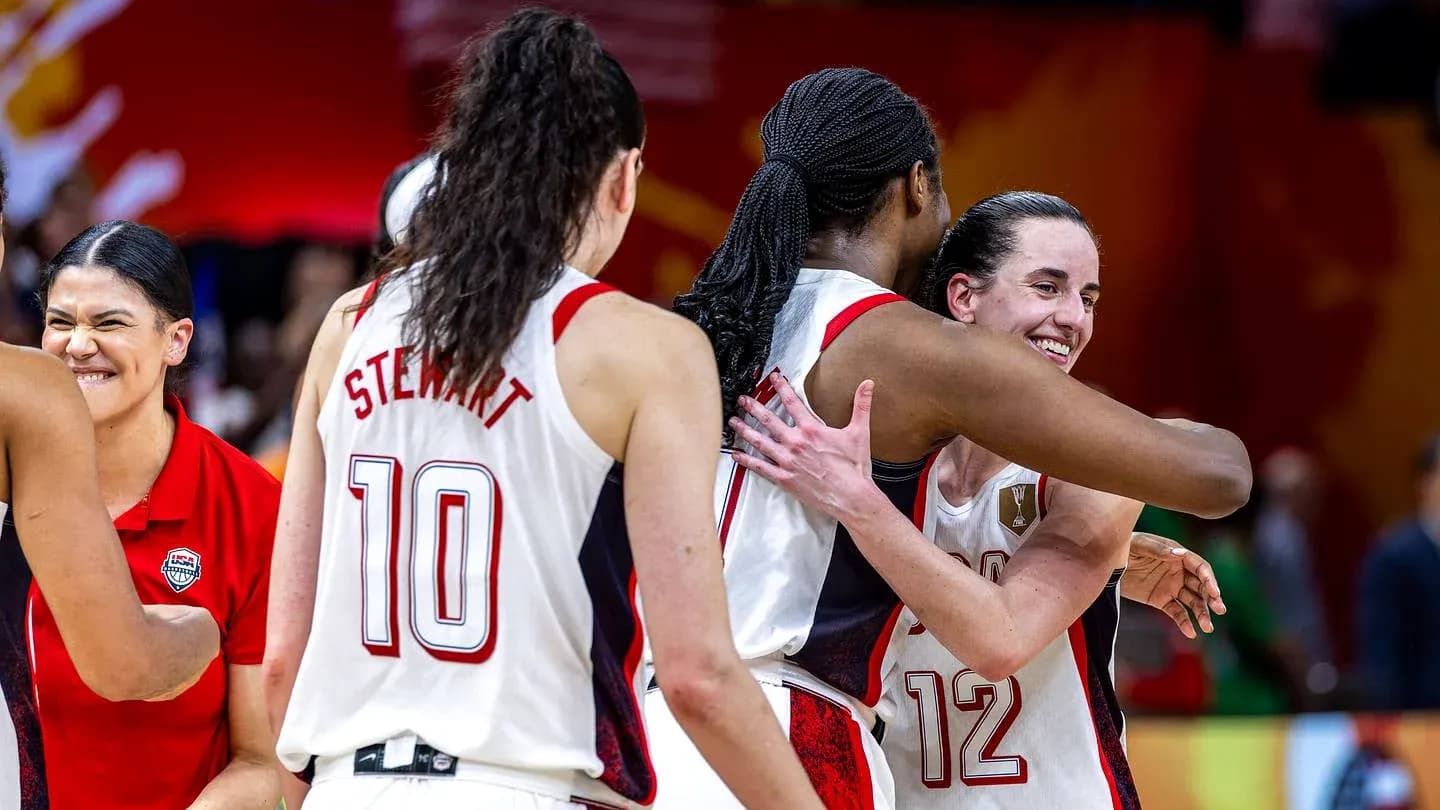
Caitlin Clark, Angel Reese, Paige Bueckers, Kiki Iriafen and Sonia Citron headline a group of World Cup debutants who have already changed the conversation in college basketball and the WNBA. Now they step onto a different stage, under different rules, against defenses that have been scouting them for years.
Clark, in particular, arrives with the spotlight already burning. Her rookie campaign with Indiana has been dissected from every angle. Lawson, who has watched her closely all summer, sees a player ready to transfer that energy to the red, white and blue.
“Caitlin’s focused. She’s had a great campaign with Indiana. I’ve gotten to watch her a lot in person this summer. So she’s locked in and ready to go,” Lawson said.
Then came the part that will make opposing scouts wince.
“She’s somebody that can change games with her ability to create pace, her ability to score, playmaker, and so that’s something that is gonna be a great fit for the personnel that we have on this team. Her ability to get going and get hot, and to stretch the floor, the spacing that she provides, the attention that she generally draws in the WNBA — we’ll see if that’s the same.”
That last line is the intrigue. This is Clark’s first taste of FIBA play at this level. Different whistles. Different physicality. Different schemes.
“Since it’s her first time here, [we’ll see] how people defend her. Is it similar to what we see in the United States, or is it a little bit different?” Lawson said. “So, we’re still in fact-finding mode in some of those areas … but we’re excited about having her on the team, and expecting her to make an impact for us each game.”
Reese brings edge and rebounding. Bueckers offers poise and shot-making. Iriafen and Citron add versatility and length. For once, it’s not just the rest of the world studying USA. The Americans are studying themselves, learning how this new mix fits together on the fly.
No time for what-ifs
One storyline could have overshadowed everything: the absence of A’ja Wilson and Kelsey Plum, two pillars of recent USA success. Instead, Lawson has refused to let it dominate the narrative.
“I didn’t have any conversation with A’ja… I don’t have a timeline,” she said when asked about Wilson’s status before the tournament. “We’ll miss being around them … We wish them both a speedy recovery… but we don’t have time to be worried about who’s not here.”
That line tells you where her focus lies. The Americans won’t replace Wilson’s dominance or Plum’s shot-making with a single player. They’ll try to do it with chemistry, with speed, with layers of talent that can attack in waves.
Lawson has made it clear: the energy goes to the group in Berlin, not the hypothetical roster that might have been.
Building on the floor, not on paper
The first practice in Germany set the tone. No dramatic speeches. No marathon session. Just a measured start.
“We had a good day today … It was great to get out on the court with them,” Lawson said. “It was a light day for us today. Just wanted to get a light sweat and get some things installed. Tomorrow, we’ll do a little bit more.”
The work now is about details — spacing for Clark’s deep range, timing on pick-and-rolls, defensive communication against the kind of multi-skilled bigs and sharpshooting wings that have transformed the global game.
Lawson knows this environment as well as anyone in the gym. She knows what it feels like to chase gold, and what it means to carry USA Basketball’s history.
“The opportunity is an amazing one, and as a player that played for the federation … there’s a lot of pride that comes into representing our country and representing all the legends before us that played the game,” she said in August. “Now to be able to be a head coach and take the helm of the program, there’s not a higher honor in our sport.”
The honor is one thing. The responsibility is another. In Berlin, those two collide.
The world has caught up enough to make this the toughest World Cup the United States has faced. Lawson welcomes that reality. Her players will feel it from the opening tip.
If this group can turn raw talent, fresh faces and old standards into another title, it won’t just extend a dynasty — it will redefine what American dominance looks like in a world that no longer bows before the first ball goes up.