.svg&w=384&q=75 "logo")
Uefa Takes Legal Action Against Fifa President Infantino
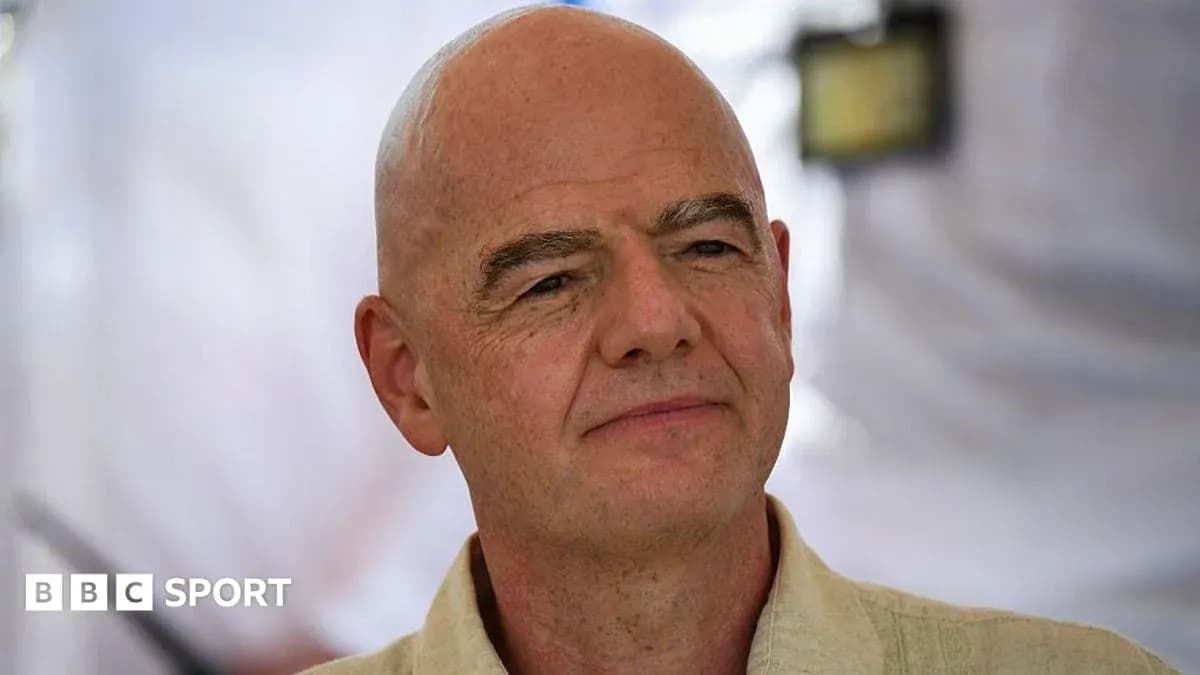
The words leap off the page like a legal red card.
“Criminal mismanagement.”
“A stunning dereliction of duty.”
“A fraudulently off-market price promoted by Infantino for his own benefit.”
This is not a rival federation grumbling in a back room. It is Uefa’s legal team, on the record in a United States court, going after the sitting Fifa president with language rarely seen in the sport’s polite public discourse.
At the heart of the storm sits the Fifa Forward Enterprise plan (FFE), Gianni Infantino’s now-abandoned project to sell stakes in Fifa competitions to private investors. In Uefa’s telling, it was a secretive carve‑up that handed the World Cup an “absurdly low enterprise value” of around £15bn – a figure they say was never exposed to an open auction or tested by an independent valuer, and one that inflicted “direct and concrete injury” on Fifa and its 211 member associations.
The gloves are off. And this is no longer just a political fight. It is edging towards a courtroom battle.
Uefa turns to the courts
Uefa’s filing in the US is not a lawsuit against Infantino in itself, but a move to secure evidence for potential criminal proceedings in Switzerland. The documents talk of Infantino’s “cronies” and “co‑conspirators”, and even include a chapter on “the enduring history of corruption among Fifa officials”.
The European body is asking US judges to force the release of documents and communications linked to the FFE plan. It wants material from Fifa, from Thrive Capital – the venture capital firm lined up as lead investor – and from its founder Josh Kushner. It also targets former Formula 1 chief Greg Maffei, described as “the key commercial adviser” on the proposed deal.
For Thrive and Kushner, Uefa is seeking subpoenas covering both documents and sworn testimony. Kushner, the brother of Jared Kushner, has kept his counsel so far. Legal specialists, though, believe he could try to block any subpoena on the grounds of commercial confidentiality, arguing that exposing the details of the deal would damage his business and future investments. His plate is already full: he has just agreed a record £9.3bn deal to buy the Los Angeles Lakers.
How long this legal dance will last is anyone’s guess. Uefa must first persuade US courts that it has an arguable basis for a criminal case in Switzerland. If it clears that hurdle, it gains access to potentially explosive files. If it fails, its most aggressive weapon may be blunted before it is even swung.
Sports lawyer Nick De Marco KC believes the first step is within reach.
“What Uefa have to show is that they have an arguable case for criminal proceedings to be brought against Infantino,” he says. “If they can show that… then they ought to be given disclosure of a lot of the documents.”
He rates the chances of success at this initial disclosure stage as “high”, but stresses that any eventual prosecution would rest with the Swiss authorities, who would need time to sift through whatever emerges.
What might emerge? “Very interesting documents,” De Marco predicts, and “more light shone onto this plan.”
Infantino’s best week in a civil war
The ferocity of Uefa’s legal language contrasts sharply with Infantino’s public demeanour. While the papers were being filed, the Fifa president was on a whistlestop tour: Dominican Republic, Paris, Vietnam. Smiling in videos, shaking hands, talking unity. It looks and feels like a world tour designed to lock in support ahead of an election year.
Ironically, this legal escalation comes during what may be Infantino’s strongest week since the FFE saga burst into the open.
On Thursday, the Saudi Arabian Football Federation offered him qualified backing, saying that “at this time [it] supports the continued efforts of Gianni Infantino to restore unity”. For a president under siege, support from such a powerful player in the global game matters.
Then came a second boost. Uefa, which had threatened to boycott Fifa competitions, stepped back from the brink after being given assurances that the FFE scheme would not be revived. That retreat was widely interpreted as a tactical win for Infantino. He has defied calls from three confederations and a raft of stakeholders to stand down. He is still in the chair. He is still travelling. He is still campaigning.
Yet the war has only changed fronts. Uefa’s shift from boycott threats to criminal complaints is a dramatic escalation, a clear signal that it intends to drive this dispute into the legal arena if it can.
A battle with history – and the law
Infantino has already apologised for “errors” around the FFE plan, while insisting it was conceived as a way to unlock Fifa’s commercial potential. Fifa itself has stayed largely silent on Uefa’s latest move, stressing that officials are concentrating on the U20 Women’s World Cup, which kicks off in Poland next week.
Behind the scenes, though, Fifa has known this was coming. Almost a month ago, Uefa warned that legal action was on the table and instructed Fifa to preserve all “relevant materials” linked to the plan. Infantino will not have been caught off guard.
Whether Uefa can turn this into a criminal case is another matter entirely. Swiss prosecutors have been here before. In 2002, several Fifa executive committee members filed a criminal complaint against then president Sepp Blatter, in a case that also reflected deep internal division. The Zurich public prosecutor declined to act; Blatter denied any wrongdoing.
More recently, the Swiss Attorney General’s long-running attempt to prosecute Blatter and former Uefa president Michel Platini ended in failure. Both men were fully cleared of corruption charges last year. That history hangs over any new attempt to drag a Fifa president into a criminal court.
Uefa knows it. Publicly, the organisation is talking not only about Infantino and FFE, but about the system that allowed the plan to reach such an advanced stage.
It has pledged to “secure fundamental reform, restore proper limits on presidential authority and ensure that Fifa is once again governed as an institution – not around one individual”, and is demanding “a genuinely independent external review of FFE”.
The message is blunt: this is not just about one deal. It is about power.
Reform, rebellion and the search for a challenger
For all the fury coming from Europe, Infantino’s position is far from isolated. He retains significant support in South America, Africa and parts of Asia. Those alliances have helped him ride out a barrage of statements from former players, politicians and fan groups. Even the leaking of claims – branded “categorically untrue” by Infantino – that an alleged lover received a severance payment during his time at Uefa has not dislodged him.
Many insiders still expect him to seek a fourth term when the Fifa presidential election comes around in the spring. Uefa has already fired a warning shot: if he runs, it will “join forces with its partner confederations to ensure that member associations are offered a credible alternative – one committed to integrity, accountability, development and genuine institutional change”.
That is an ambitious promise. The obvious question is: who?
In Monaco, Uefa vice-president Laura McAllister set out the profile they want.
“We would want to have a candidate, obviously, who would champion that agenda and be committed to a process of reform and change,” she told BBC Sport. “I think there are lots of credible candidates out there, but it has to be a candidate that can unite that standpoint and somebody who has the credentials and the credibility and the buy-in to really champion that agenda.”
Her checklist is clear: transparency, independence, robust scrutiny, proper due diligence. Governance rooted in principles, not personalities. But turning that into a single, unifying name – someone who can command votes beyond Europe and persuade other regions to break with an incumbent – is a far more difficult task.
“We knew this wouldn’t be a simple process and we knew that change wouldn’t happen overnight,” McAllister admitted.
Time is tight. In October, Infantino will sit across the table from some of his fiercest critics at the first Fifa Council meeting since the FFE rebellion. Tensions will be high. A month later, the formal nomination period for presidential candidates opens. By March, the election will be upon them – and, if Infantino’s name is on the ballot, the sport faces a defining choice.
A sport at war with itself
For now, world football lives with open fracture. Uefa’s legal broadside has deepened the sense of crisis around Fifa’s leadership. Infantino’s global tour, and the backing he still enjoys in key regions, underline how entrenched the divide has become.
Much rests on those US courtrooms, on whether judges allow Uefa to prise open the files of Thrive, Kushner, Maffei and Fifa itself. Much rests, too, on whether anyone emerges who can credibly stand against a president who has already survived scandal, rebellion and intense public scrutiny.
The intrigue will roll on into council meetings, nomination deadlines and, eventually, the ballot box.
What no one can yet answer is whether the game will come out of this with a stronger, more accountable Fifa – or with the same president, a deeper scar, and another missed chance to change.