.svg&w=384&q=75 "logo")
Rio's Journey to Gold: A Tribute to His Coach
On the mats, the uniforms tell you everything.
In Gi, the fighters are wrapped in heavy cotton – jacket, pants and a belt that quietly broadcasts their rank. Hands sink into collars and sleeves, fingers knot in fabric, and control comes from grips, drags and chokes built around that thick weave.
No-Gi strips all of that away. Tight synthetic tops, board shorts, nowhere to hide and nothing to hold but the human body itself. Underhooks, wrist ties, body locks – it is the same sport, but it feels like a different language.
Inside those rules, competitors split by sex, belt, age and weight, Rio carved out his moment.
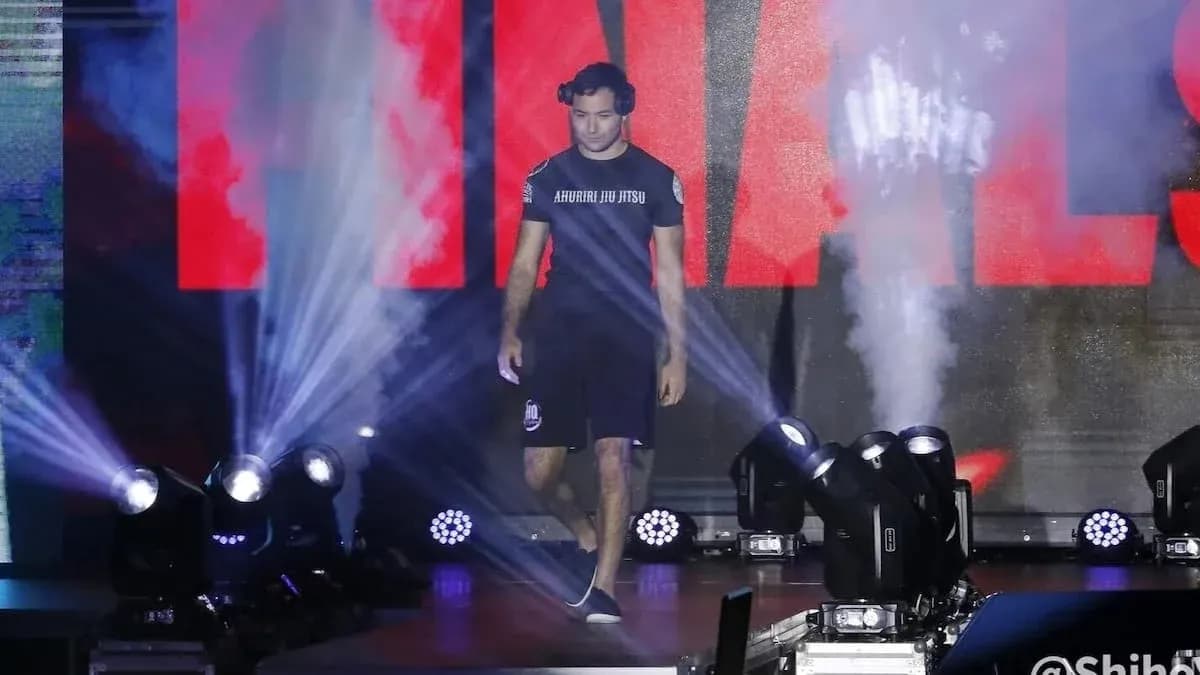
He ran through opponents from Mongolia and Mexico to claim gold. The first fight barely had time to breathe: an Aoki lock, a brutal, precise footlock, ended it inside the opening minute. The second was slower, more suffocating, finished with a triangle choke that closed the show and the division.
From the outside, it looked like dominance. Inside his own head, the road there had been anything but smooth.
He called the tournament “good fun” and said that once he stepped onto the mats it felt like any other day. The build-up told a different story. A heavy winter illness had smashed his preparation, the worst lead-in he’d known. On top of that, he lost his coach barely a month before the event, a shock that weighed on him harder than any cut or bruise.
So when the referee raised his hand, there was more than a medal in it.
“[It] felt good to go out there and just go hard though,” he said, a simple line that barely covers the emotional load behind it.
This was his first international medal at black belt level, a milestone most fighters dream about. He shrugged at the hardware. The metal around his neck mattered less than the way he earned it.
The final ended with a triangle. That detail meant everything.
His late coach, Damian Smith, was a triangle specialist, the man who had drilled those angles and grips into him over countless sessions. When Rio felt the opening, he didn’t just see a submission – he saw years of coaching, mat-side instructions, quiet corrections.
“My coach Damian Smith was a triangle specialist and taught me all I know about triangles, so when I felt the opening for one, I was thinking about him and all the times he’d coached me at tournaments, [the] perfect way to end the tournament.”
In that moment, technique became tribute.
He spread the credit quickly. Rio thanked his team at Gracie Allegiance Ahuriri and Gracie Allegiance Team New Zealand, along with friends and training partners from Brazilian Jiu-Jitsu gyms across Hawke’s Bay. For him, the podium is crowded.
“You get nowhere in martial arts without good teammates and training partners,” he said. In Hawke’s Bay, that support network is tight. The BJJ community there is small enough that, if you stay on the mats long enough, you end up knowing most of the gyms and the people who keep them alive.
Gold won, Rio and his partner and fellow coach, Yukako Mori, stayed on in Japan. No victory lap of beaches and cocktails – more time with friends, more Brazilian Jiu-Jitsu, more Judo. The grind doesn’t stop; it just changes scenery.
When they return to Hawke’s Bay, the plan is simple. Back to training in Ahuriri. Back to the routines that built this run. Back to “having fun with Jiu-Jitsu,” as he puts it.
For Rio, the sport is more than medals and rankings. It is self-defence that actually works, fitness that doesn’t feel like punishment, and a conveyor belt of lifelong friendships.
“Aside from being a good way of learning some self-defence, it’s an awesome way to stay active without feeling like it’s a chore and it’s a great way to make lifelong friends. Anyone is welcome.”
The gold will fade. The triangle finish will live in his memory. But the real question now sits on the mats back home: how many more black belts in Hawke’s Bay will chase their own moment because they saw his?