.svg&w=384&q=75 "logo")
Rachael Gunn's Journey in Untold Raygun: Breaking Badly
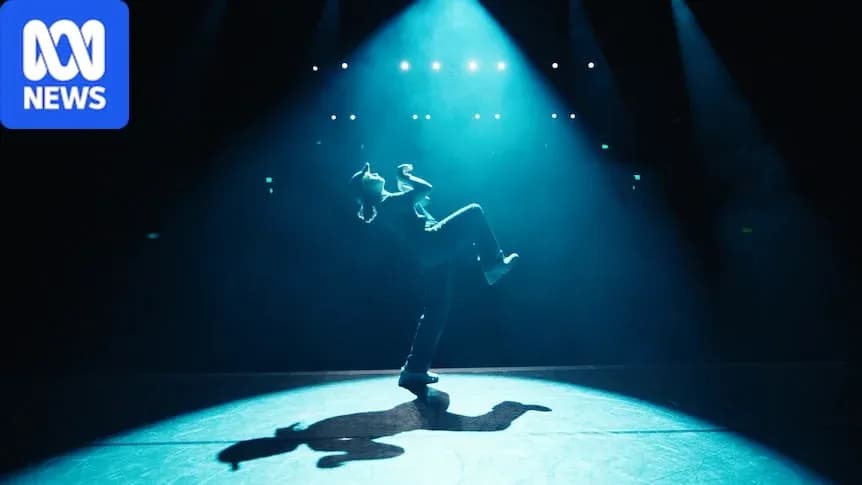
Rachael Gunn thought she knew the worst-case scenario.
In Netflix’s new documentary Untold Raygun: Breaking Badly, the Australian academic-turned-Olympian recalls a session with her therapist on the eve of Paris 2024. Panicked, she was asked to imagine the most catastrophic outcome.
“The whole world could laugh at me,” she replied.
Then Paris happened.
What unfolds in the film is not just the story of a viral moment, but the anatomy of a public pile-on — and the very awkward birth of breaking as an Olympic sport.
A love story at the centre of a storm
The documentary opens softly, almost tenderly. Before the memes, before the outrage, there is Rachael Gunn — Raygun — and her husband Samuel Free, known as Sammy (Sex) in the film.
They meet through dance. They fall in love through dance. He becomes her coach in breaking. Viewers are invited into their wedding, where the first language of the relationship is obvious: movement. The dance floor is their shared home.
For a while, it feels like that’s the story. Two people, one culture, one dream. Then the narrative collides head-on with the reality of the Olympic Games.
From lecture theatre to Olympic arena
Raygun arrives in Paris not as a seasoned professional athlete, but as an academic who found her way into breaking after childhood stints in ballet, tap and jazz. Her parents, Russell and Beverly, recall a “normal suburban girl,” not a future Olympian.
They laugh at the idea they ever pictured her on sport’s grandest stage. Her father even jokes that on his way to Paris he thought he was going to console his daughter, not watch her become a global talking point.
The documentary does not flatter her preparation. In the countdown to the Games, Raygun looks strikingly unready for the scale and pressure of the Olympics. She has very few people around her with genuine experience of that environment. The gap between ambition and support is stark.
The film lets that discomfort breathe. There is no attempt to pretend she arrived as a favourite, or even as a polished contender.
The routine that broke the internet
Then comes the performance.
By now, almost everyone has seen it: the kangaroo, the sprinkler, the idiosyncratic moves that launched a thousand memes. In a matter of hours, Raygun goes from obscure academic to pop culture lightning rod.
Comedy skits flood social media. Conspiracy theories swirl. Opinion pieces multiply. Some defend her creativity; many mock her. Snoop Dogg and Adele weigh in. The routine stops being just a performance and becomes a global in-joke, dissected and replayed on a loop.
On the judging panel, though, there is no ambiguity. Raygun fails to pick up a single vote in her Olympic rounds. The scoreboard is as brutal as the comment sections.
The documentary lingers on that contrast: the carnival of online reaction set against the cold numbers that defined her Olympic debut.
Breaking’s big stage, and a community divided
This wasn’t only Raygun’s first Olympics. It was breaking’s.
For a culture that has long fought for recognition as an art form, its arrival at the Games carried huge symbolic weight. That is where the story turns sharper.
B-Girl Tinylocks, a breaker who chose not to try out for Paris, watches Raygun’s performance with something closer to horror than amusement. She is “appalled” by what she sees, and her reaction is not played for drama. It comes from a fierce protectiveness of breaking itself.
“Who could have imagined it would have gone so wrong?” she asks.
B-Girl Flix, a friend of Raygun’s for 15 years, doesn’t pull her punches either. She describes feeling “offended” and “embarrassed” by the routine. Their long-standing connection only makes that admission heavier.
The film also rewinds to Raygun’s Olympic qualifier against B-Girl Molly. The footage is telling. Both look stiff, neither exudes the swagger or flow associated with elite breaking. It’s a reminder that the Olympic pathway, at least in this case, did not always deliver the kind of battle-hardened performers many in the scene expected.
The anger in the community is not just about one performance. It’s about what, and who, gets to represent breaking on the world’s biggest stage.
Living inside a global joke
If the online world treated Raygun as a punchline, the documentary gives her the microphone.
“Sometimes this all feels like a really wild dream,” she says in a voiceover that opens the film. “It’s like I’ve been charged with some crime.”
The line lands because that is exactly how the reaction looked from the outside: not criticism, but prosecution. Every move, every frame, frozen and ridiculed.
Across the documentary, she revisits the lead-up, the moment itself, and the aftermath with a mix of clarity and disbelief. The film doesn’t try to rehabilitate the routine. It focuses instead on what it means to become instantly recognisable for the wrong reasons, and to carry that weight when the cameras move on.
She reveals she has left her job in academia, stepping away from the stability that once defined her life. What comes next is left deliberately open.
For now, Raygun is suspended in that space between notoriety and opportunity, between a sport still finding its Olympic identity and an athlete still deciding what to do with hers.
Untold Raygun: Breaking Badly is streaming on Netflix.