.svg&w=384&q=75 "logo")
Mike Dean Addresses Controversy Over Refereeing Challenges
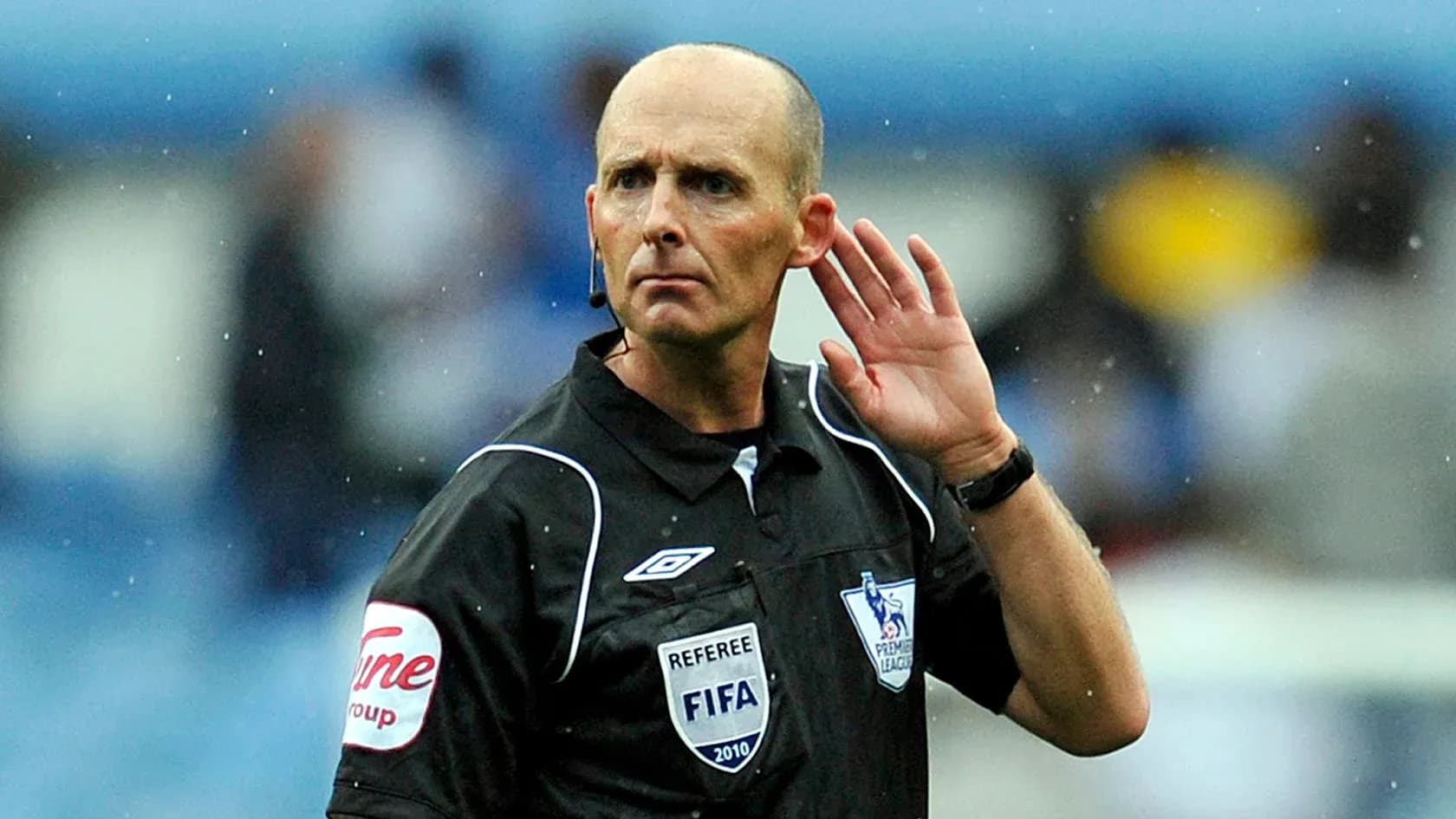
Mike Dean has attempted to steady the storm around his refereeing legacy after a week in which his own words lit the fuse.
The former Premier League referee issued a statement on Instagram defending his professionalism, days after admitting on a podcast that he used to set himself private “challenges” during matches – including seeing how long he could go without blowing his whistle and how long he could stay inside the centre circle.
The reaction was instant and fierce. In an era where trust in officiating already feels fragile, the idea of a referee treating elite fixtures as a personal game struck a nerve.
Dean, now 56, has moved to clarify. He insists the comments on Jamie Vardy's Having a Party podcast were meant as light-hearted anecdotes rather than a confession of dereliction of duty.
“Throughout my 25 years as a professional referee, I have always applied the Laws of the Game to the best of my ability,” he wrote. “My approach as a referee was always to allow the game to flow and whenever possible I preferred to apply a high threshold for contact which the players liked. However, if I saw a foul challenge that needed me to take the appropriate action I would give it from the correct position.”
That line about “flow” is central to his defence. Dean is arguing that what sounded like gimmicks were, in essence, extensions of a philosophy: keep the whistle out of the game where possible, let the contest breathe, intervene only when necessary.
The problem is how those podcast stories landed.
On the show, Dean spoke with unusual candour about how he and his assistants would “have a laugh” during high-pressure Premier League fixtures. He described one routine in detail.
“There used to be games that we used to have, as a laugh, we used to say, ‘Right, we’ll kick off now, right? See how long we can go without blowing a whistle,’” he said. “Done that a few times in the Premier, before VAR obviously. Went 20–25 minutes without blowing a whistle a few times. Let it go, let it go, let it go.”
For fans who spent those very minutes raging at perceived missed fouls, the revelation has gone down badly. What sounded to Dean like a harmless insight into dressing-room banter has, to many, read as confirmation of long-held suspicions about inconsistency and ego in the middle.
He went further on the podcast, outlining another of his on-pitch challenges.
“I used to do another thing in the Premier League. I used to stand in the centre circle and see how long I could stay in the centre circle before I had to leave,” he said. “That was just me joking about. The lads used to be on the line saying ‘you can’t’. I said ‘I’ll try it’. I just used to run around but don’t come out of it. Got about 15 minutes once in one game, without leaving the centre circle.”
Those specifics – 20 to 25 minutes without a whistle, 15 minutes without leaving the centre circle – have fuelled the backlash. They turn a vague idea of “letting the game flow” into something far more tangible, and far more contentious.
Dean’s statement is an attempt to drag the conversation back to his broader body of work. A quarter of a century at the top level. Hundreds of matches. A reputation, at least among some players and managers, for allowing physical contests to develop without constant interruption.
He is adamant that the “mini games” never overrode his core responsibility.
To his critics, the damage is already done. To his supporters, this is a storm whipped up from anecdotes stripped of tone and context. Either way, the debate now stretches beyond one retired referee and into a more uncomfortable question: what else goes on inside the heads of officials when the stakes are highest?