.svg&w=384&q=75 "logo")
Islam Makhachev Defends UFC Winning Streak Against Jon Jones
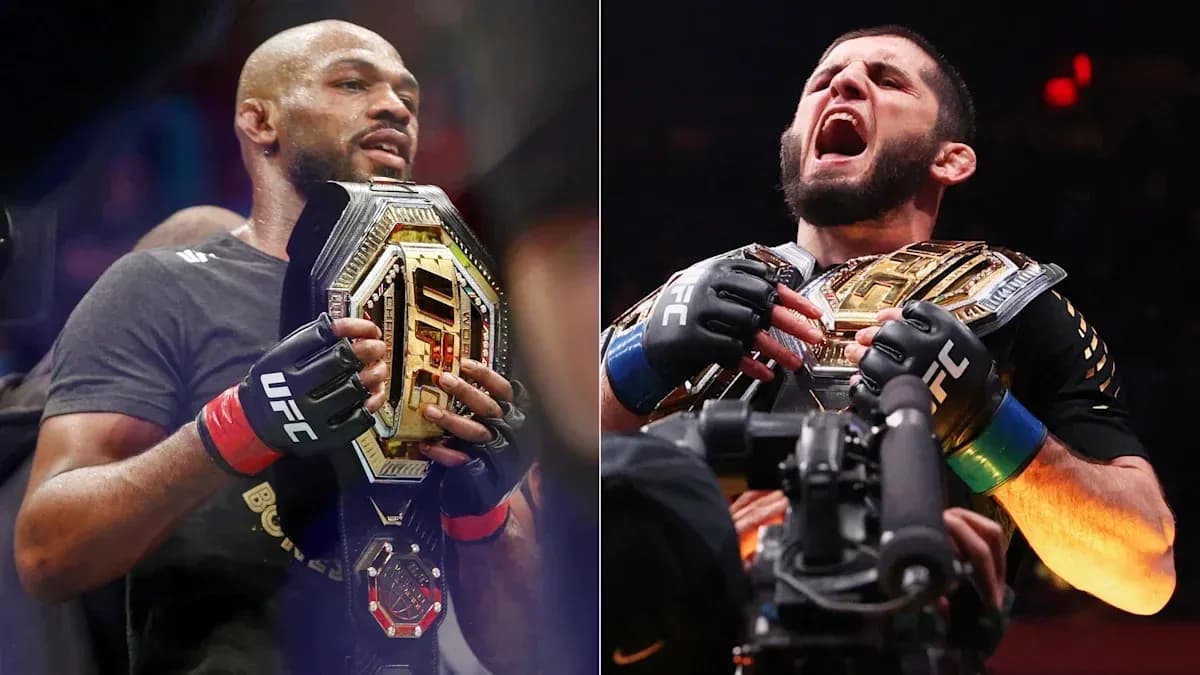
Islam Makhachev isn’t backing down from the numbers. Or from the name.
Fresh off setting a new UFC benchmark with 17 consecutive wins, the reigning welterweight champion has drawn a hard line in the never‑ending debate over who owns the greatest run in company history. For him, Jon Jones is out of that conversation.
Makhachev, now 29-1 in MMA and 18-1 in the UFC, pushed past Anderson Silva’s long-standing record at UFC 330 in August when he turned back Ian Machado Garry to defend his 170-pound title. Silva’s 16-fight streak had stood for more than a decade as the gold standard. Makhachev just rewrote it.
The pushback arrived immediately. Jones loyalists point to a different number: 20 straight UFC bouts without a loss dating back to December 2009. On paper, that stretch looks untouchable. Jones is officially 28-1 with one no contest, and that lone “NC” is the flashpoint in this argument.
His 2017 rematch with Daniel Cormier at UFC 214 ended in a brutal Jones knockout, only for the result to be overturned when he failed a drug test. The win vanished from his record, the bout reclassified as a no contest, and the debate over what counts — and what should count — has raged ever since.
Makhachev made his stance clear in an interview with Ushatayka, delivered in Russian and pointed in tone.
"I'm not denying that Jon Jones is one of the greatest athletes in history," Makhachev said. "But he was caught doping twice, and I think that's why his streak isn't considered valid.
"Because he went into a fight while on PEDs and won. That's where a new count should have started."
For Makhachev, the issue isn’t just statistics. It’s legitimacy. If a fighter steps into the cage enhanced, every result that follows, in his eyes, becomes tainted. The numbers might stay in the record books, but the aura of an unbroken run does not.
That stance will inflame plenty of critics, especially given Makhachev’s own history with anti-doping. He failed a test in 2016, a stain that has followed him as his profile has grown. The accusation of hypocrisy is inevitable.
Yet the UFC’s own anti-doping chief has publicly tried to put that episode to rest. When Jeff Novitzky, the promotion’s senior vice president of anti-doping compliance, presented Makhachev with a jacket in May 2024 for reaching 50 clean tests, he labeled the 2016 result “one of the greatest, colossal mistakes in anti-doping.”
That endorsement has given Makhachev cover to speak more forcefully about the subject. He now leans on a long, documented run of clean tests as proof that his record-breaking streak stands on firmer ground than Jones’ extended unbeaten stretch.
The numbers, then, tell two very different stories. Jones, the former light heavyweight and current heavyweight champion, carries the aura of a man who has never truly been beaten in the cage, his lone official loss a disqualification. Makhachev, the relentless technician from Dagestan, now owns the longest official winning streak in UFC history.
One run is longer. The other, he argues, is cleaner.
Away from the legacy dispute, Makhachev’s attention is already drifting back toward the cage. After dispatching Garry at UFC 330, he signaled his desire to return as early as January, or sooner if his body allows. He’s waiting on MRI results for potential injuries, hopeful they won’t derail his momentum.
If the scans come back as he expects, the man who just broke the UFC’s most sacred record plans to keep stretching it — and to do so while insisting that his streak, unlike Jones’, carries no asterisk at all.